Current Electricity - NEET Physics Questions
← All Chapters

Current Electricity

Question 31: moderate

Three copper wires have lengths and cross-sectional areas as : (l, A), (2l, A/2) and (l/2, 2A). Resistance is minimum in :

1. Wire of cross-sectional area A/2
2. Wire of cross-sectional area A
3. Wire of cross-sectional area 2A
4. Same in all the three cases
View Answer

The resistance

RR

of a wire is given by the formula:


R=ρlAR = \rho \frac{l}{A}


Where:


  • ρ\rho
     

    is the resistivity of the material (which is constant for copper),


  • ll
     

    is the length of the wire,


  • AA
     

    is the cross-sectional area of the wire.

Given:

  • Wire 1: Length =
    ll
     

    , Area = AA 

  • Wire 2: Length =
    2l2l
     

    , Area = A2\frac{A}{2} 

  • Wire 3: Length =
    l2\frac{l}{2}
     

    , Area = 2A2A 

We will calculate the resistance for each wire.

Step 1: Calculate the resistance for each wire

Wire 1: Length = ll


, Area = AA


R1=ρlAR_1 = \rho \frac{l}{A}


Wire 2: Length = 2l2l


, Area = A2\frac{A}{2}


R2=ρ2lA2=ρ2lΓ—2A=ρ4lAR_2 = \rho \frac{2l}{\frac{A}{2}} = \rho \frac{2l \times 2}{A} = \rho \frac{4l}{A}


Wire 3: Length = l2\frac{l}{2}


, Area = 2A2A


R3=ρl22A=ρl4AR_3 = \rho \frac{\frac{l}{2}}{2A} = \rho \frac{l}{4A}


Step 2: Compare the resistances


  • R1=ρlAR_1 = \rho \frac{l}{A}
     

  • R2=ρ4lAR_2 = \rho \frac{4l}{A}
     

  • R3=ρl4AR_3 = \rho \frac{l}{4A}
     

Clearly,

R3R_3

is the smallest resistance because

l4A\frac{l}{4A}

is the smallest fraction compared to

lA\frac{l}{A}

and

4lA\frac{4l}{A}

.

Step 3: Conclusion

The wire with the minimum resistance is Wire 3, which has a cross-sectional area of

2A2A

.

Thus, the answer is Wire 3.

Question 32: moderate

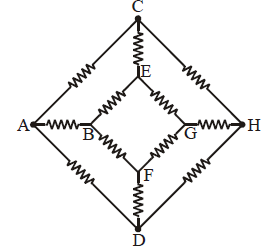
Twelve resistors each of resistance 1 Ξ© are connected in the circuit shown in the figure. Net resistance between points A and H would be :-

1. 5/3 Ξ©
2. 1 Ξ©
3. 3/4 Ξ©
4. 7/6 Ξ©
View Answer
Question 33: moderate

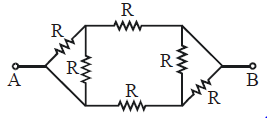
In the given network of resistors, each of resistance R ohm, the equivalent resistance between points A and B is :-

1. 5 R
2. 2R/3
3. 3R/5
4. R/2
View Answer
Question 34: moderate

10,000 alpha particles per minute are passing through a straight tube of radius r. The resulting electric current is approximately :


1. \[0.5\times 10^{-16} amp\]
2. \[2\times 10^{12} amp\]
3. \[0.5\times 10^{12} amp\]
4. \[2\times 10^{-12} amp\]
View Answer

Let’s solve the problem step by step:


1. Key Concepts

  • Alpha particles (
    Ξ±\alpha
     

    ) have a charge of qΞ±=2eq_\alpha = 2e 

    , where e=1.6Γ—10βˆ’19 Ce = 1.6 \times 10^{-19} \, \text{C} 

    is the elementary charge.

  • Electric current
    II
     

    is the rate of flow of charge: I=TotalΒ chargeΒ passingTimeI = \frac{\text{Total charge passing}}{\text{Time}} 


2. Total Charge Passing per Minute

We are given:


  • N=10,000 α N = 10,000 \, \alpha
     

    -particles per minute,

  • Each
    Ξ±\alpha
     

    -particle carries a charge qΞ±=2e=2Γ—1.6Γ—10βˆ’19=3.2Γ—10βˆ’19 Cq_\alpha = 2e = 2 \times 1.6 \times 10^{-19} = 3.2 \times 10^{-19} \, \text{C} 

    .

The total charge passing in 1 minute is:


Q=Nβ‹…qΞ±=10,000β‹…3.2Γ—10βˆ’19=3.2Γ—10βˆ’15 C.Q = N \cdot q_\alpha = 10,000 \cdot 3.2 \times 10^{-19} = 3.2 \times 10^{-15} \, \text{C}.


3. Current

Convert the time from minutes to seconds:


t=60 seconds.t = 60 \, \text{seconds}.


The current is:


I=Qt=3.2Γ—10βˆ’1560=0.533Γ—10βˆ’16 A.I = \frac{Q}{t} = \frac{3.2 \times 10^{-15}}{60} = 0.533 \times 10^{-16} \, \text{A}.


Rounding off, the current is approximately:


0.5Γ—10βˆ’16 A.\boxed{0.5 \times 10^{-16} \, \text{A}}.


Question 35: easy

Two cells of e.m.fs. E1 and E2 and internal resistance r1 and r2 are connected in parallel. Then the e.m.f. and internal resistance of the equivalent source is :

1. \[E_{1}+E_{2} and \frac{r_{1}r_{2}}{r_{1}+r_{2}}\]
2. \[E_{1}-E_{2} and r_{1}+r_{2}\]
3. \[\frac{E_{1}r_{2}+E_{2}r_{1}}{r_{1}+r_{2}} and \frac{r_{1}r_{2}}{r_{1}+r_{2}}\]
4. \[\frac{E_{1}r_{2}+E_{2}r_{1}}{r_{1}+r_{2}} and r_{1} +r_{2}\]
View Answer

To find the equivalent emf (

EeqE_{\text{eq}}

) and internal resistance (

reqr_{\text{eq}}

) of two cells connected in parallel, we use the following principles:


1. Equivalent emf ( EeqE_{\text{eq}}


):

In parallel connection, the total current is the sum of the currents through each cell. Using Kirchhoff's Voltage Law, the equivalent emf is given by:


Eeq=E1r2+E2r1r1+r2.E_{\text{eq}} = \frac{E_1 r_2 + E_2 r_1}{r_1 + r_2}.


2. Equivalent internal resistance ( reqr_{\text{eq}}


):

For resistances in parallel, the equivalent resistance is given by:


1req=1r1+1r2.\frac{1}{r_{\text{eq}}} = \frac{1}{r_1} + \frac{1}{r_2}.


Simplify:


req=r1r2r1+r2.r_{\text{eq}} = \frac{r_1 r_2}{r_1 + r_2}.


Final Answer:

The equivalent emf and internal resistance of the parallel combination are:


Eeq=E1r2+E2r1r1+r2,req=r1r2r1+r2.\boxed{E_{\text{eq}} = \frac{E_1 r_2 + E_2 r_1}{r_1 + r_2}, \quad r_{\text{eq}} = \frac{r_1 r_2}{r_1 + r_2}}.


Question 36: moderate

Two cells, having the same e.m.f. are connected in series through an external resistance R. Cells have internal resistance r1 and r2 (r1 > r2) respectively. When the circuit is closed the potential difference across the first cell is zero. The value of R is :


1. \[r_{1}-r_{2}\]
2. \[\frac{r_{1}+r_{2}}{2}\]
3. \[\frac{r_{1}-r_{2}}{2}\]
4. \[r_{1}+r_{2}\]
View Answer

We are tasked to find the external resistance

RR

when the potential difference across the first cell is zero. Let the emf of each cell be

EE

, the internal resistances of the two cells be

r1r_1

and

r2r_2

, and the external resistance be

RR

.


Key points:

  1. Current in the circuit: The total resistance in the circuit is
    r1+r2+Rr_1 + r_2 + R
     

    . The current II 

    is given by: 

    I=E+Er1+r2+R=2Er1+r2+R.I = \frac{E + E}{r_1 + r_2 + R} = \frac{2E}{r_1 + r_2 + R}. 

  2. Potential difference across the first cell: The potential difference across the first cell is: 

    V1=Eβˆ’Ir1.V_1 = E - I r_1.Since the potential difference across the first cell is zero, we set

    V1=0V_1 = 0:


    0=Eβˆ’Ir1.0 = E - I r_1.Substitute

    I=2Er1+r2+RI = \frac{2E}{r_1 + r_2 + R}:


    0=Eβˆ’2Er1+r2+Rβ‹…r1.0 = E - \frac{2E}{r_1 + r_2 + R} \cdot r_1. 

  3. Simplify the equation: Rearrange: 

    E=2Er1r1+r2+R.E = \frac{2E r_1}{r_1 + r_2 + R}.Divide through by

    EE(since

    E≠0E \neq 0):


    1=2r1r1+r2+R.1 = \frac{2r_1}{r_1 + r_2 + R}.Multiply both sides by

    r1+r2+Rr_1 + r_2 + R:


    r1+r2+R=2r1.r_1 + r_2 + R = 2r_1.Simplify:


    R=2r1βˆ’r1βˆ’r2.R = 2r_1 - r_1 - r_2. 

    R=r1βˆ’r2.R = r_1 - r_2. 


Final Answer:

The value of

RR

is:


R=r1βˆ’r2.\boxed{R = r_1 - r_2}.


Question 37: moderate

If two bulbs of wattage 60 W and 100 W respectively each rated at 110 V are connected in series with the supply of 220 V, which bulb will fuse ?

1. 60 W bulb
2. 100 W bulb
3. Both the bulbs
4. Bulbs will not fuse
View Answer

Step 1: Resistance of the bulbs


R1=110260β‰ˆ202 Ω,R2=1102100=121 Ω.R_1 = \frac{110^2}{60} \approx 202 \, \Omega, \quad R_2 = \frac{110^2}{100} = 121 \, \Omega.


Step 2: Total current in the circuit

In series, the same current flows through both bulbs:


I=VtotalR1+R2=220202+121β‰ˆ0.682 A.I = \frac{V_{\text{total}}}{R_1 + R_2} = \frac{220}{202 + 121} \approx 0.682 \, \text{A}.


Step 3: Voltage across each bulb

  • Voltage across the 60 W bulb:


V1=Iβ‹…R1=0.682β‹…202β‰ˆ137.6 V.V_1 = I \cdot R_1 = 0.682 \cdot 202 \approx 137.6 \, \text{V}.


  • Voltage across the 100 W bulb:


V2=Iβ‹…R2=0.682β‹…121β‰ˆ82.5 V.V_2 = I \cdot R_2 = 0.682 \cdot 121 \approx 82.5 \, \text{V}.


Step 4: Compare with rated voltage

  • The 60 W bulb experiences
    137.6 V137.6 \, \text{V}
     

    , exceeding its 110 V110 \, \text{V} 

    rating, so it fuses.

  • The 100 W bulb experiences
    82.5 V82.5 \, \text{V}
     

    , within its 110 V110 \, \text{V} 

    rating.

Conclusion

The 60 W bulb will fuse.

\boxed{\text{Answer: 60 W bulb.}}


Question 38: moderate

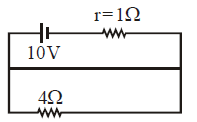
Potential difference across the terminals of the battery shown in figure is :(r = internal resistance of battery)


1. 8 V
2. 10 V
3. 6 V
4. zero
View Answer

Here 4 ohm resistor is short circuited. So current in circuit is 10/1 = 10 Ampere.

Potential V= E -ir= 10 - 10Γ—1 = 0 (zero)

Question 39: moderate

The potential difference across the terminals of a battery is 10 V when there is a current of 3A in the battery from the negative to the positive terminal. When the current is 2 A in the reverse direction, the potential difference becomes 15 V. The internal resistance of the battery is :

1. 2.5
2. 5.0
3. 2.83
4. 1
View Answer

To find the internal resistance (

rr

) of the battery, we use the following equations based on the given information:

1. Case 1: Current flows from negative to positive terminal

The potential difference is:


V1=Eβˆ’I1rV_1 = E - I_1 r


Substitute

V1=10 VV_1 = 10 \, \text{V}

,

I1=3 AI_1 = 3 \, \text{A}

:


10=Eβˆ’3r(1)10 = E - 3r \tag{1}


2. Case 2: Current flows in reverse (from positive to negative terminal)

The potential difference is:


V2=E+I2rV_2 = E + I_2 r


Substitute

V2=15 VV_2 = 15 \, \text{V}

,

I2=2 AI_2 = 2 \, \text{A}

:


15=E+2r(2)15 = E + 2r \tag{2}


3. Solve the two equations

From Equation (1):


E=10+3rE = 10 + 3r


Substitute

E=10+3rE = 10 + 3r

into Equation (2):


15=(10+3r)+2r15 = (10 + 3r) + 2r


Simplify:


15=10+5r15 = 10 + 5r


5r=5β€…β€ŠβŸΉβ€…β€Šr=1 Ω5r = 5 \implies r = 1 \, \Omega


Final Answer:

The internal resistance of the battery is:


1 Ω\boxed{1 \, \Omega}