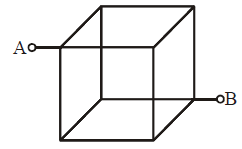
Five identical resistors, each of value 1100Ω, are connected to a 220V battery as shown. The reading of ideal ammeter is :

Current through each resistor is 220/1100 = 1/5 A
Total current through ammeter = 3 * 1/5 A= 3/5 A
Five identical resistors, each of value 1100Ω, are connected to a 220V battery as shown. The reading of ideal ammeter is :

Current through each resistor is 220/1100 = 1/5 A
Total current through ammeter = 3 * 1/5 A= 3/5 A
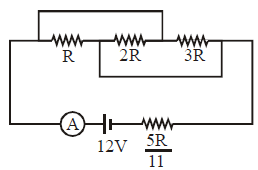
In the circuit shown the reading of ammeter is 2A. The ammeter has negligible resistance. The value of R equals.

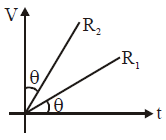
The V-I graph for two conductor of resistance R1 & R2 are as shown in the figure, the resistance of their series combination (R2 + R1) is proportional to :

If the number of free electrons is \(5\times 10^{28} m^{-3}\) then the drift velocity of electron in a conductor of area of cross-section \(10^{-4} m^{2}\) for a current of 1.2 A is:
To find the drift velocity
of the electrons, we use the formula for current in terms of drift velocity:
Where:
is the current (1.2 A),
is the number of free electrons per unit volume (
),
is the cross-sectional area of the conductor (
),
is the charge of an electron (
),
is the drift velocity of the electrons (which we need to calculate).
The drift velocity of the electrons is
.
A wire is stretched so that its length increases by 10%. The resistance of the wire increases by :
When a wire is stretched, its length increases, and its cross-sectional area decreases. The resistance of a wire is given by the formula:
Where:
is the resistance,
is the resistivity of the material (constant),
is the length of the wire,
is the cross-sectional area of the wire.
is given by:
Since the volume remains constant:
Solving for
, the new cross-sectional area:
The new resistance
of the stretched wire is given by:
So, the new resistance
is 1.21 times the original resistance
.
The resistance increases by 21% when the wire is stretched by 10%.
The specific resistance of a wire :
Specific resistance is property of substance it doesn't depend on any other physical factor
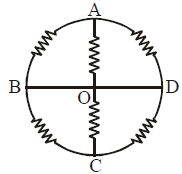
Find effective resistance between A & C if each resistor is of 6Ω.

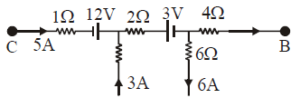
Potential difference between C and B /[\left( V_{C}-V_{B} \right)/] in the circuit is :

The resistance of two conductors in series is 40 Ω and this becomes 7.5 Ω in parallel, the resistances of conductors are:
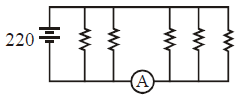
Twelve wires, each of resistance R, are connected to form a cube as shown in the figure. The effective resistance between A and B is :-