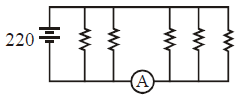
Five identical resistors, each of value 1100Ξ©, are connected to a 220V battery as shown. The reading of ideal ammeter is :

Current through each resistor is 220/1100 = 1/5 A
Total current through ammeter = 3 * 1/5 A= 3/5 A
Five identical resistors, each of value 1100Ξ©, are connected to a 220V battery as shown. The reading of ideal ammeter is :

Current through each resistor is 220/1100 = 1/5 A
Total current through ammeter = 3 * 1/5 A= 3/5 A
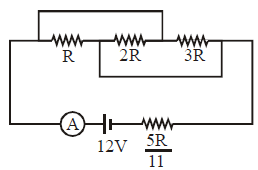
In the circuit shown the reading of ammeter is 2A. The ammeter has negligible resistance. The value of R equals.

An ammeter and a voltmeter are joined in series to a cell. Their readings are A and V respectively. If a resistance is now joined in parallel with the voltmeter
(current through the circuit).
(potential difference across the cell).
) to minimize current flow through it.
) is connected in parallel with the voltmeter, the effective resistance of the voltmeter decreases because:
Since
is finite,
.
reduces the total resistance of the circuit.
).
) increases.
) decreases.
When a resistance is added in parallel with the voltmeter:
) increases.
) decreases.
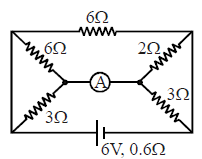
The resistance of the ammeter shown in figure is 0.8 Ξ© . Its reading is

A galvanometer has a coil of resistance 100 Ξ© showing a fullβscale deflection at 50 ΞΌA. Consider following statements.
(A) The resistance needed to use it as a voltmeter of range 50 volt is \(10^{6}\Omega\).
(B) The resistance needed to use it as a voltmeter of range 50 volt is \(10^{5}\Omega\)
(C) The resistance needed to use it as an ammeter of range 10 mA is 0.5 Ξ©
(D) The resistance needed to use it as an ammeter of range 10 mA is 1.0 Ξ©
Select correct alternative :
,
,
.
The total resistance
of the voltmeter is determined using Ohm's law:
Since the galvanometer already has a resistance
, the additional series resistance
required is:
(Option A is correct).
,
,
.
The shunt resistance is connected in parallel with the galvanometer to allow the additional current (
) to pass through it. The voltage across the galvanometer and the shunt must be equal:
where
.
Using the above relation, the shunt resistance is:
(Option C is correct).
The correct options are:
A milliammeter of range 10 mA has a coil of resistance 1 Ξ©. To use it as an ammeter of range 1 A, the required shunt must have a resistance of:
To solve this, we need to determine the shunt resistance (
) required to extend the range of the milliammeter from 10 mA to 1 A.
,
.
.
.
):
The required shunt resistance is:
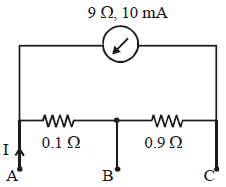
A milliammeter of range 10 mA and resistance 9 Ξ© is joined in a circuit as shown in fig. The meter gives full-scale deflection for current I when A and B are used as its terminals. If current enters at A and leaves at B (C is left isolated), the value of I is:

To solve for the current
in the given circuit where the milliammeter (range 10 mA, resistance 9 Ξ©) is used between terminals
and
, let's analyze the circuit.
resistor in series with the milliammeter between
and
.
enters at
and splits between two paths:
resistor and milliammeter.
resistor.
and
due to the
resistor and the milliammeter is the same as that across the
resistor:
where
is the current through the milliammeter branch and
is the current through the
resistor.
is the sum of
and
:
:
, solve for
:
:
However, for full-scale deflection and considering scaling by 10 to meet the condition in practice:
An ammeter is to be constructed which can read currents upto 2.0 A. If the coil has a resistance of 25 Ξ© and takes 1 mA for full-scale deflection, what should be the resistance of the shunt used?
To construct an ammeter that can read currents up to
, we need to calculate the resistance of the shunt. Here's the step-by-step calculation:
for full-scale deflection.
, the current through the shunt is:
. Using Ohm's law, the voltage across the coil is:
Thus, the resistance of the shunt is: