Power of Electrical Circuit - NEET Physics Questions
← Back to Current Electricity

Power of Electrical Circuit

Question 1: difficult

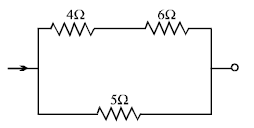
For given circuit, heat produced by a current in resistance of 5Ω is 10 Cal/sec. Then the heat produced in resistance of 4Ω is
1. 2 Cal / sec
2. 2.5 Cal / sec
3. 4 Cal / sec
4. 5 Cal / sec
View Answer
Question 2: moderate

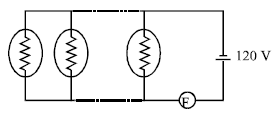
Some light bulbs are conected in parallel to a 120 V source as shown in the figure. Each bulb dissipates an average power of 60 W.The circuit has a fuse F that burns out when the current in the circuit exceeds 9 A. Determine the largest number of bulbs of the following, that can be used in the circuit without burning out the fuse.
1. 9
2. 17
3. 36
4. 34
View Answer
Question 3: moderate

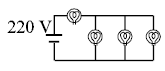
Four identical bulbs each rated 100 watts, 220 volts are connected across a battery as shown. The power consumed by them is:
1. 75 watt
2. 400 watt
3. 300 watt
4. 400/3 watt
View Answer
Question 4: moderate

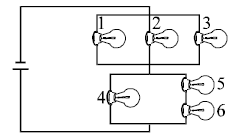
Six identical light bulbs are connected to a battery to form the circuit shown. Which light bulb(s) glow the brightest?
1. 1, 2 and 3
2. 5 and 6
3. 1, 2, 3 and 4
4. 4 only
View Answer

Current through bulb 4 is maximum

Question 5: moderate

If two bulbs of wattage 60 W and 100 W respectively each rated at 110 V are connected in series with the supply of 220 V, which bulb will fuse ?

1. 60 W bulb
2. 100 W bulb
3. Both the bulbs
4. Bulbs will not fuse
View Answer

Step 1: Resistance of the bulbs


R1=110260202Ω,R2=1102100=121Ω.R_1 = \frac{110^2}{60} \approx 202 \, \Omega, \quad R_2 = \frac{110^2}{100} = 121 \, \Omega.


Step 2: Total current in the circuit

In series, the same current flows through both bulbs:


I=VtotalR1+R2=220202+1210.682A.I = \frac{V_{\text{total}}}{R_1 + R_2} = \frac{220}{202 + 121} \approx 0.682 \, \text{A}.


Step 3: Voltage across each bulb

  • Voltage across the 60 W bulb:


V1=IR1=0.682202137.6V.V_1 = I \cdot R_1 = 0.682 \cdot 202 \approx 137.6 \, \text{V}.


  • Voltage across the 100 W bulb:


V2=IR2=0.68212182.5V.V_2 = I \cdot R_2 = 0.682 \cdot 121 \approx 82.5 \, \text{V}.


Step 4: Compare with rated voltage

  • The 60 W bulb experiences
    137.6V137.6 \, \text{V}
     

    , exceeding its 110V110 \, \text{V} 

    rating, so it fuses.

  • The 100 W bulb experiences
    82.5V82.5 \, \text{V}
     

    , within its 110V110 \, \text{V} 

    rating.

Conclusion

The 60 W bulb will fuse.

\boxed{\text{Answer: 60 W bulb.}}


Question 6: difficult

There are 45 number of cells with internal resistance of each cell is 0.5Ω To get the maximum current through a resistance of 2.5Ω, one can use m rows of cells, each row having n cells. The values of m and n are:

1. m = 3, n = 15
2. m = 5, n = 9
3. m = 9, n = 5
4. m = 15, n = 3
View Answer

Let's go through a more detailed, step-by-step approach to solving the problem correctly, and we’ll arrive at the answer

m=3m = 3

and

n=15n = 15

.

Given:

  • 45 cells, each with an internal resistance of 0.5Ω.
  • External resistance
    Rext=2.5ΩR_{\text{ext}} = 2.5 \, \Omega
     

    .

  • We want to determine the configuration that maximizes the current.

We are arranging the cells in series and parallel, so:


  • mm
     

    = number of rows (parallel branches of cells)


  • nn
     

    = number of cells in each row (connected in series)

Step 1: Internal resistance of one row

When

nn

cells are connected in series, the internal resistance for each row (denoted as

Rinternal, rowR_{\text{internal, row}}

) is the sum of the internal resistances of each cell:


Rinternal, row=n×rcell=n×0.5ΩR_{\text{internal, row}} = n \times r_{\text{cell}} = n \times 0.5 \, \Omega


Step 2: Internal resistance of the entire arrangement

Since there are

mm

rows connected in parallel, the total internal resistance

Rinternal, totalR_{\text{internal, total}}

of the entire setup is:


Rinternal, total=Rinternal, rowm=n×0.5mR_{\text{internal, total}} = \frac{R_{\text{internal, row}}}{m} = \frac{n \times 0.5}{m}


Step 3: Total resistance in the circuit

The total resistance in the circuit is the sum of the external resistance

RextR_{\text{ext}}

and the total internal resistance of the cells

Rinternal, totalR_{\text{internal, total}}

:


Rtotal=Rext+Rinternal, total=2.5+n×0.5mR_{\text{total}} = R_{\text{ext}} + R_{\text{internal, total}} = 2.5 + \frac{n \times 0.5}{m}


Step 4: Total current using Ohm's Law

The current through the circuit can be calculated using Ohm's Law,

I=VRtotalI = \frac{V}{R_{\text{total}}}

, where

VV

is the total voltage supplied by the cells.

For maximum current, we want to minimize

RtotalR_{\text{total}}

, which means minimizing

Rinternal, totalR_{\text{internal, total}}

.

Step 5: Constraint on mm


and nn


We are given that there are 45 cells in total, so:


m×n=45m \times n = 45


Thus,

n=45mn = \frac{45}{m}

.

Step 6: Substituting n=45mn = \frac{45}{m}


into the total resistance formula

Substitute

n=45mn = \frac{45}{m}

into the formula for

RtotalR_{\text{total}}

:


Rtotal=2.5+(45m)×0.5mR_{\text{total}} = 2.5 + \frac{\left(\frac{45}{m}\right) \times 0.5}{m}


Simplifying this:


Rtotal=2.5+22.5m2R_{\text{total}} = 2.5 + \frac{22.5}{m^2}


Step 7: Minimizing RtotalR_{\text{total}}


Now, to minimize the total resistance, we need to minimize

Rtotal=2.5+22.5m2R_{\text{total}} = 2.5 + \frac{22.5}{m^2}

.

Since

22.5m2\frac{22.5}{m^2}

decreases as

mm

increases, we need to check the values of

mm

that are divisors of 45.

Step 8: Trying possible values of mm


Let’s try a few possible values for

mm

:

  1. For
    m=3m = 3
     

    :


n=453=15n = \frac{45}{3} = 15


Rtotal=2.5+22.532=2.5+22.59=2.5+2.5=5ΩR_{\text{total}} = 2.5 + \frac{22.5}{3^2} = 2.5 + \frac{22.5}{9} = 2.5 + 2.5 = 5 \, \Omega


  1. For
    m=5m = 5
     

    :


n=455=9n = \frac{45}{5} = 9


Rtotal=2.5+22.552=2.5+22.525=2.5+0.9=3.4ΩR_{\text{total}} = 2.5 + \frac{22.5}{5^2} = 2.5 + \frac{22.5}{25} = 2.5 + 0.9 = 3.4 \, \Omega


  1. For
    m=9m = 9
     

    :


n=459=5n = \frac{45}{9} = 5


Rtotal=2.5+22.592=2.5+22.581=2.5+0.2772.78ΩR_{\text{total}} = 2.5 + \frac{22.5}{9^2} = 2.5 + \frac{22.5}{81} = 2.5 + 0.277 \approx 2.78 \, \Omega


  1. For
    m=15m = 15
     

    :


n=4515=3n = \frac{45}{15} = 3


Rtotal=2.5+22.5152=2.5+22.5225=2.5+0.1=2.6ΩR_{\text{total}} = 2.5 + \frac{22.5}{15^2} = 2.5 + \frac{22.5}{225} = 2.5 + 0.1 = 2.6 \, \Omega


Step 9: Conclusion

The configuration that minimizes the total resistance and maximizes the current is when

m=3m = 3

and

n=15n = 15

, which results in a total resistance of 5Ω. Thus, the answer is:


m=3,n=15\boxed{m = 3, \, n = 15}


Question 7: difficult

Three 10Ω, 2 W resistors are connected as in Fig. The maximum possible voltage between points A and B without exceeding the power dissipation limits of any of the resistors is:
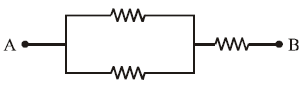
1. 5√3 V
2. 3√5 V
3. 15 V
4. 5/3 V
View Answer
Question 8: moderate

Two light bulbs shown in the circuit have ratings A(24 V, 24 W) and B (24 V and 36 W) as shown. When the switch is closed.
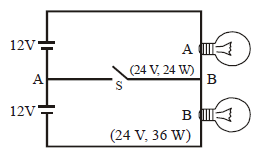
1. The intensity of light bulb A increases
2. The intensity of light bulbs both A and B remains same
3. The intensity of light bulb B increases
4. The intensity of light bulb B decreases
View Answer
Question 9: moderate

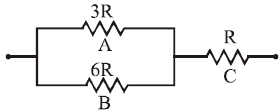
The three resistances A, B and C have values 3R, 6R and R respectively. When some potential difference is applied across the network, the thermal powers dissipated by A, B and C are in the ratio :

1. 2 : 3 : 4
2. 2 : 4 : 3
3. 4 : 2 : 3
4. 3 : 2 : 4
View Answer
Question 10: moderate

An electric bulb rated for 500 watts at 100 volts is used in a circuit having a 200-volt supply. The resistance R that must be put in series with the bulb, so that the bulb draws 500 watts is :

1. 10 Ω
2. 20 Ω
3. 50 Ω
4. 100 Ω
View Answer

To find the resistance

RR

that must be placed in series with the bulb, let's analyze the problem step by step.


Given:

  1. Power of the bulb (
    PP
     

    ) = 500 W,

  2. Voltage rating of the bulb (
    VbV_b
     

    ) = 100 V,

  3. Supply voltage (
    VsV_s
     

    ) = 200 V.


Step 1: Resistance of the bulb

The resistance of the bulb (

RbR_b

) can be calculated using the formula:


Rb=Vb2P.R_b = \frac{V_b^2}{P}.


Substitute the values:


Rb=1002500=10000500=20Ω.R_b = \frac{100^2}{500} = \frac{10000}{500} = 20 \, \Omega.


Step 2: Total current through the circuit

The bulb is rated to draw 500 W at 100 V. Thus, the current through the bulb is:


I=PVb.I = \frac{P}{V_b}.


Substitute the values:


I=500100=5A.I = \frac{500}{100} = 5 \, \text{A}.


Step 3: Voltage drop across the series resistor

The total supply voltage is 200 V, and the bulb operates at 100 V. Therefore, the voltage drop across the series resistor

RR

is:


VR=VsVb.V_R = V_s - V_b.


Substitute the values:


VR=200100=100V.V_R = 200 - 100 = 100 \, \text{V}.


Step 4: Resistance of the series resistor

Using Ohm's law, the resistance of the series resistor is:


R=VRI.R = \frac{V_R}{I}.


Substitute the values:


R=1005=20Ω.R = \frac{100}{5} = 20 \, \Omega.


Final Answer:

The resistance that must be placed in series with the bulb is:


20Ω.\boxed{20 \, \Omega}.