Question 21:
difficult
For given circuit, heat produced by a current in resistance of 5Ω is 10 Cal/sec. Then the heat produced in resistance of 4Ω is
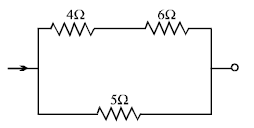
For given circuit, heat produced by a current in resistance of 5Ω is 10 Cal/sec. Then the heat produced in resistance of 4Ω is
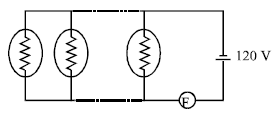
Some light bulbs are conected in parallel to a 120 V source as shown in the figure. Each bulb dissipates an average power of 60 W.The circuit has a fuse F that burns out when the current in the circuit exceeds 9 A. Determine the largest number of bulbs of the following, that can be used in the circuit without burning out the fuse.
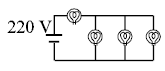
Four identical bulbs each rated 100 watts, 220 volts are connected across a battery as shown. The power consumed by them is:
Six identical light bulbs are connected to a battery to form the circuit shown. Which light bulb(s) glow the brightest?
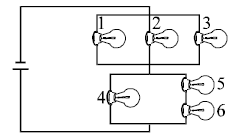
Current through bulb 4 is maximum
A carbon resistor is marked with the rings coloured brown, black green and gold. The resistance (in ohm) is :
To determine the resistance of a carbon resistor with color bands brown, black, green, and gold, use the color code for resistors:
(1st digit)
(2nd digit)
(multiplier)
(tolerance)
The resistance is calculated as:
Substitute values:
This is equal to:
The gold band indicates a tolerance of
, so the resistance can vary between:
The resistance is:
N identical cells, each of emf e and internal resistance r, are joined in series. Out of these, n cells are wrongly connected, i.e., their terminals are connected in reverse of that required for series connection. n < N/2. Let \(\varepsilon_{0}\) be the emf of the resulting battery and \( r_{0}\) be its internal resistance,
When
identical cells, each of emf
and internal resistance
, are connected in series and
cells are connected in reverse, the resulting emf and internal resistance of the battery can be determined as follows:
The net emf of the resulting battery is:
The emf and internal resistance of the resulting battery are:
The ratio of the resistance of conductor at temperature 15°C to its resistance at temperature 37.5°C is 4 : 5. the temperature coefficient of resistance of the conductor is : (reference is taken as 0°C)
To find the temperature coefficient of resistance
of the conductor, we use the formula for the change in resistance with temperature:
Where:
is the resistance at temperature
,
is the resistance at the reference temperature (0°C),
is the temperature coefficient of resistance,
is the temperature change in °C.
.
.
.
Substituting the expressions for
and
:
Canceling
from both the numerator and denominator:
Cross-multiply to solve for
:
Expanding both sides:
Simplify:
The temperature coefficient of resistance
is
.
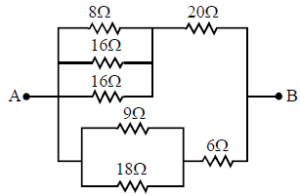
The equivalent resistance of the network shown in the figure between the points A and B is :-
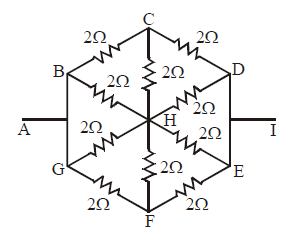
The effective resistance across the points A and I is :-
The resultant resistance value of n resistance each of r ohm when connected in parallel, is x. When these n resistances are connected in series, the resultant value is :
Let's break this down step by step.
When
resistors, each of resistance
, are connected in parallel, the total or equivalent resistance
is given by the formula:
This simplifies to:
So, the equivalent resistance is:
We're told that the resultant resistance when connected in parallel is
, so:
When the same
resistors, each of resistance
, are connected in series, the total or equivalent resistance
is simply the sum of the individual resistances:
So:
From the parallel connection, we know that:
Thus, the resistance when the resistors are connected in series is:
Therefore, the resistance when these
resistors are connected in series is: