Current Electricity - NEET Physics Questions
← All Chapters

Current Electricity

Question 51: difficult

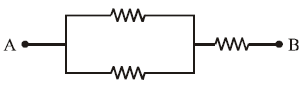
Three 10Ω, 2 W resistors are connected as in Fig. The maximum possible voltage between points A and B without exceeding the power dissipation limits of any of the resistors is:

1. 5√3 V
2. 3√5 V
3. 15 V
4. 5/3 V
View Answer
Question 52: moderate

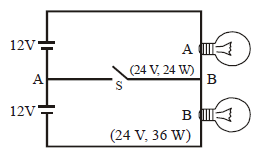
Two light bulbs shown in the circuit have ratings A(24 V, 24 W) and B (24 V and 36 W) as shown. When the switch is closed.

1. The intensity of light bulb A increases
2. The intensity of light bulbs both A and B remains same
3. The intensity of light bulb B increases
4. The intensity of light bulb B decreases
View Answer
Question 53: moderate

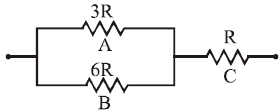
The three resistances A, B and C have values 3R, 6R and R respectively. When some potential difference is applied across the network, the thermal powers dissipated by A, B and C are in the ratio :

1. 2 : 3 : 4
2. 2 : 4 : 3
3. 4 : 2 : 3
4. 3 : 2 : 4
View Answer
Question 54: moderate

An electric bulb rated for 500 watts at 100 volts is used in a circuit having a 200-volt supply. The resistance R that must be put in series with the bulb, so that the bulb draws 500 watts is :

1. 10 Ω
2. 20 Ω
3. 50 Ω
4. 100 Ω
View Answer

To find the resistance

RR

that must be placed in series with the bulb, let's analyze the problem step by step.


Given:

  1. Power of the bulb (
    PP
     

    ) = 500 W,

  2. Voltage rating of the bulb (
    VbV_b
     

    ) = 100 V,

  3. Supply voltage (
    VsV_s
     

    ) = 200 V.


Step 1: Resistance of the bulb

The resistance of the bulb (

RbR_b

) can be calculated using the formula:


Rb=Vb2P.R_b = \frac{V_b^2}{P}.


Substitute the values:


Rb=1002500=10000500=20Ω.R_b = \frac{100^2}{500} = \frac{10000}{500} = 20 \, \Omega.


Step 2: Total current through the circuit

The bulb is rated to draw 500 W at 100 V. Thus, the current through the bulb is:


I=PVb.I = \frac{P}{V_b}.


Substitute the values:


I=500100=5A.I = \frac{500}{100} = 5 \, \text{A}.


Step 3: Voltage drop across the series resistor

The total supply voltage is 200 V, and the bulb operates at 100 V. Therefore, the voltage drop across the series resistor

RR

is:


VR=VsVb.V_R = V_s - V_b.


Substitute the values:


VR=200100=100V.V_R = 200 - 100 = 100 \, \text{V}.


Step 4: Resistance of the series resistor

Using Ohm's law, the resistance of the series resistor is:


R=VRI.R = \frac{V_R}{I}.


Substitute the values:


R=1005=20Ω.R = \frac{100}{5} = 20 \, \Omega.


Final Answer:

The resistance that must be placed in series with the bulb is:
 

20Ω.\boxed{20 \, \Omega}.


Question 55: moderate

An ammeter is to be constructed which can read currents upto 2.0 A. If the coil has a resistance of 25 Ω and takes 1 mA for full-scale deflection, what should be the resistance of the shunt used?

1. \[1.25\times 10^{-2}\Omega\]
2. \[2.5\times 10^{-2}\Omega\]
3. \[0.5\times 10^{-2}\Omega\]
4. \[10^{-2}\Omega\]
View Answer

To construct an ammeter that can read currents up to

2.0A2.0 \, \text{A}

, we need to calculate the resistance of the shunt. Here's the step-by-step calculation:

  1. Full-scale current through the coil:
    The coil takes 1mA=103A1 \, \text{mA} = 10^{-3} \, \text{A} 

    for full-scale deflection.

  2. Remaining current through the shunt:
    When the total current is 2.0A2.0 \, \text{A} 

    , the current through the shunt is:

    Is=ItotalIc=2.0103=1.999A.I_s = I_{\text{total}} - I_c = 2.0 - 10^{-3} = 1.999 \, \text{A}. 

  3. Voltage across the coil:
    The resistance of the coil is 25Ω25 \, \Omega 

    . Using Ohm's law, the voltage across the coil is:

    Vc=IcRc=(103)(25)=0.025V.V_c = I_c R_c = (10^{-3})(25) = 0.025 \, \text{V}. 

  4. Resistance of the shunt:
    The voltage across the shunt must equal the voltage across the coil:  Vs=Vc=0.025V.V_s = V_c = 0.025 \, \text{V}.Using Ohm's law for the shunt:


    Rs=VsIs=0.0251.9991.25×102Ω.R_s = \frac{V_s}{I_s} = \frac{0.025}{1.999} \approx 1.25 \times 10^{-2} \, \Omega. 

Thus, the resistance of the shunt is:


1.25×10²Ω.\boxed{1.25 \times 10^{-2} \, \Omega.}