Combination of Batteries - NEET Physics Questions
← Back to Current Electricity

Combination of Batteries

Question 1: easy

A carbon resistor is marked with the rings coloured brown, black green and gold. The resistance (in ohm) is :

1. \[3.2\times 10^{5}\] Β±5%
2. \[1\times 10^{6}\] Β±10%
3. \[1\times 10^{7}\] Β±5%
4. \[1\times 10^{6}\] Β±5%
View Answer

To determine the resistance of a carbon resistor with color bands brown, black, green, and gold, use the color code for resistors:


1. Color code values:

  • Brown:
    11
     

    (1st digit)

  • Black:
    00
     

    (2nd digit)

  • Green:
    10510^5
     

    (multiplier)

  • Gold:
    Β±5%\pm 5\%
     

    (tolerance)


2. Calculate resistance:

The resistance is calculated as:


R=(1stΒ digit × 10+2ndΒ digit) × multiplier.R = (\text{1st digit}\,\times\,10 + \text{2nd digit}) \,\times\, \text{multiplier}.


Substitute values:


R=(1Γ—10+0)Γ—105=10Γ—105=106 Ω.R = (1 \times 10 + 0) \times 10^5 = 10 \times 10^5 = 10^6 \, \Omega.


This is equal to:


R=1 MΩ (megaohm).R = 1 \, \text{M}\Omega \, (\text{megaohm}).


3. Tolerance:

The gold band indicates a tolerance of

Β±5%\pm 5\%

, so the resistance can vary between:


1 MΩ±5%.1 \, \text{M}\Omega \pm 5\%.


Final Answer:

The resistance is:


1 MΩ ±5%.\boxed{1 \, \text{M}\Omega \, \pm 5\%.}


Question 2: moderate

N identical cells, each of emf e and internal resistance r, are joined in series. Out of these, n cells are wrongly connected, i.e., their terminals are connected in reverse of that required for series connection. n < N/2. LetΒ  \(\varepsilon_{0}\) be the emf of the resulting battery and \( r_{0}\) be its internal resistance,

1. \[\varepsilon_{0}=\left( N-n \right)\varepsilon, r_{0}=\left( N-n \right)r\]
2. \[\varepsilon_{0}=\left( N-2n \right)\varepsilon, r_{0}=\left( N-2n \right)r\]
3. \[\varepsilon_{0}=\left( N-2n \right)\varepsilon, r_{0}=Nr\]
4. \[\varepsilon_{0}=\left( N-n \right)\varepsilon, r_{0}=Nr\]
View Answer

When

NN

identical cells, each of emf

ee

and internal resistance

rr

, are connected in series and

nn

cells are connected in reverse, the resulting emf and internal resistance of the battery can be determined as follows:


1. Resultant emf ( Ξ΅0\varepsilon_0


):

  • For correctly connected cells, the total emf is:
    Ξ΅correct=(Nβˆ’n)e.\varepsilon_{\text{correct}} = (N - n)e.
     
  • For n reversed cells, their emf opposes the total emf. The opposing emf is:
    Ξ΅reverse=ne.\varepsilon_{\text{reverse}} = ne.
     

    The net emf of the resulting battery is: 

    Ξ΅0=Ξ΅correctβˆ’Ξ΅reverse=(Nβˆ’n)eβˆ’ne=(Nβˆ’2n)e.\varepsilon_0 = \varepsilon_{\text{correct}} - \varepsilon_{\text{reverse}} = (N - n)e - ne = (N - 2n)e. 


2. Resultant internal resistance ( r0


):

  • All cells, whether correctly or incorrectly connected, contribute to the total internal resistance because resistances add in series. The total internal resistance is:
    r0=Nr.r_0 = N r.
     

Final Answer:

The emf and internal resistance of the resulting battery are:

Ξ΅0=(Nβˆ’2n)e,r0=Nr.\boxed{\varepsilon_0 = (N - 2n)e, \quad r_0 = Nr.}


Question 3: easy

Two cells of e.m.fs. E1 and E2 and internal resistance r1 and r2 are connected in parallel. Then the e.m.f. and internal resistance of the equivalent source is :

1. \[E_{1}+E_{2} and \frac{r_{1}r_{2}}{r_{1}+r_{2}}\]
2. \[E_{1}-E_{2} and r_{1}+r_{2}\]
3. \[\frac{E_{1}r_{2}+E_{2}r_{1}}{r_{1}+r_{2}} and \frac{r_{1}r_{2}}{r_{1}+r_{2}}\]
4. \[\frac{E_{1}r_{2}+E_{2}r_{1}}{r_{1}+r_{2}} and r_{1} +r_{2}\]
View Answer

To find the equivalent emf (

EeqE_{\text{eq}}

) and internal resistance (

reqr_{\text{eq}}

) of two cells connected in parallel, we use the following principles:


1. Equivalent emf ( EeqE_{\text{eq}}


):

In parallel connection, the total current is the sum of the currents through each cell. Using Kirchhoff's Voltage Law, the equivalent emf is given by:


Eeq=E1r2+E2r1r1+r2.E_{\text{eq}} = \frac{E_1 r_2 + E_2 r_1}{r_1 + r_2}.


2. Equivalent internal resistance ( reqr_{\text{eq}}


):

For resistances in parallel, the equivalent resistance is given by:


1req=1r1+1r2.\frac{1}{r_{\text{eq}}} = \frac{1}{r_1} + \frac{1}{r_2}.


Simplify:


req=r1r2r1+r2.r_{\text{eq}} = \frac{r_1 r_2}{r_1 + r_2}.


Final Answer:

The equivalent emf and internal resistance of the parallel combination are:


Eeq=E1r2+E2r1r1+r2,req=r1r2r1+r2.\boxed{E_{\text{eq}} = \frac{E_1 r_2 + E_2 r_1}{r_1 + r_2}, \quad r_{\text{eq}} = \frac{r_1 r_2}{r_1 + r_2}}.


Question 4: moderate

Two cells, having the same e.m.f. are connected in series through an external resistance R. Cells have internal resistance r1 and r2 (r1 > r2) respectively. When the circuit is closed the potential difference across the first cell is zero. The value of R is :


1. \[r_{1}-r_{2}\]
2. \[\frac{r_{1}+r_{2}}{2}\]
3. \[\frac{r_{1}-r_{2}}{2}\]
4. \[r_{1}+r_{2}\]
View Answer

We are tasked to find the external resistance

RR

when the potential difference across the first cell is zero. Let the emf of each cell be

EE

, the internal resistances of the two cells be

r1r_1

and

r2r_2

, and the external resistance be

RR

.


Key points:

  1. Current in the circuit: The total resistance in the circuit is
    r1+r2+Rr_1 + r_2 + R
     

    . The current II 

    is given by: 

    I=E+Er1+r2+R=2Er1+r2+R.I = \frac{E + E}{r_1 + r_2 + R} = \frac{2E}{r_1 + r_2 + R}. 

  2. Potential difference across the first cell: The potential difference across the first cell is: 

    V1=Eβˆ’Ir1.V_1 = E - I r_1.Since the potential difference across the first cell is zero, we set

    V1=0V_1 = 0:


    0=Eβˆ’Ir1.0 = E - I r_1.Substitute

    I=2Er1+r2+RI = \frac{2E}{r_1 + r_2 + R}:


    0=Eβˆ’2Er1+r2+Rβ‹…r1.0 = E - \frac{2E}{r_1 + r_2 + R} \cdot r_1. 

  3. Simplify the equation: Rearrange: 

    E=2Er1r1+r2+R.E = \frac{2E r_1}{r_1 + r_2 + R}.Divide through by

    EE(since

    E≠0E \neq 0):


    1=2r1r1+r2+R.1 = \frac{2r_1}{r_1 + r_2 + R}.Multiply both sides by

    r1+r2+Rr_1 + r_2 + R:


    r1+r2+R=2r1.r_1 + r_2 + R = 2r_1.Simplify:


    R=2r1βˆ’r1βˆ’r2.R = 2r_1 - r_1 - r_2. 

    R=r1βˆ’r2.R = r_1 - r_2. 


Final Answer:

The value of

RR

is:


R=r1βˆ’r2.\boxed{R = r_1 - r_2}.


Question 5: moderate

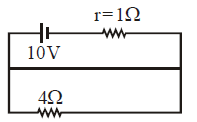
Potential difference across the terminals of the battery shown in figure is :(r = internal resistance of battery)


1. 8 V
2. 10 V
3. 6 V
4. zero
View Answer

Here 4 ohm resistor is short circuited. So current in circuit is 10/1 = 10 Ampere.

Potential V= E -ir= 10 - 10Γ—1 = 0 (zero)

Question 6: moderate

The potential difference across the terminals of a battery is 10 V when there is a current of 3A in the battery from the negative to the positive terminal. When the current is 2 A in the reverse direction, the potential difference becomes 15 V. The internal resistance of the battery is :

1. 2.5
2. 5.0
3. 2.83
4. 1
View Answer

To find the internal resistance (

rr

) of the battery, we use the following equations based on the given information:

1. Case 1: Current flows from negative to positive terminal

The potential difference is:


V1=Eβˆ’I1rV_1 = E - I_1 r


Substitute

V1=10 VV_1 = 10 \, \text{V}

,

I1=3 AI_1 = 3 \, \text{A}

:


10=Eβˆ’3r(1)10 = E - 3r \tag{1}


2. Case 2: Current flows in reverse (from positive to negative terminal)

The potential difference is:


V2=E+I2rV_2 = E + I_2 r


Substitute

V2=15 VV_2 = 15 \, \text{V}

,

I2=2 AI_2 = 2 \, \text{A}

:


15=E+2r(2)15 = E + 2r \tag{2}


3. Solve the two equations

From Equation (1):


E=10+3rE = 10 + 3r


Substitute

E=10+3rE = 10 + 3r

into Equation (2):


15=(10+3r)+2r15 = (10 + 3r) + 2r


Simplify:


15=10+5r15 = 10 + 5r


5r=5β€…β€ŠβŸΉβ€…β€Šr=1 Ω5r = 5 \implies r = 1 \, \Omega


Final Answer:

The internal resistance of the battery is:


1 Ω\boxed{1 \, \Omega}


Question 7: moderate

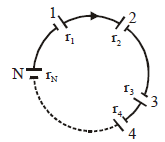
A group of N cells whose emf varies directly with the internal resistance as per the equation \(E_{N}=1.5r_{N} \) are connected as shown in the figure below. The current I in the circuit is :


1. 0.51 amp
2. 5.1 amp
3. 0.15 amp
4. 1.5 amp
View Answer

In the given circuit of

NN

cells, the emf (

ENE_N

) and internal resistance (

rNr_N

) are related as

EN=1.5rNE_N = 1.5r_N

. To find the current (

II

), we follow these steps:

  1. Equivalent emf and resistance:
    • The cells are connected in series, so:
      Eeq=EN=1.5rN,req=rN.E_{\text{eq}} = E_N = 1.5r_N, \quad r_{\text{eq}} = r_N.
       
  2. Total resistance:
    • Let
      RextR_{\text{ext}}
       

      be the external resistance of the circuit. From the figure, the circuit resistance is: Rtotal=rN+Rext.R_{\text{total}} = r_N + R_{\text{ext}}. 

  3. Ohm's Law:
    • The current in the circuit is:
      I=EeqRtotal=1.5rNrN+Rext.I = \frac{E_{\text{eq}}}{R_{\text{total}}} = \frac{1.5r_N}{r_N + R_{\text{ext}}}.
       
  4. Condition for ( I = 1.5 , \text{A}:
    • Substituting
      I=1.5I = 1.5
       

      into the equation: 

      1.5=1.5rNrN+Rext.1.5 = \frac{1.5r_N}{r_N + R_{\text{ext}}}. 

    • Simplifying: 

      rN+Rext=rNβ€…β€ŠβŸΉβ€…β€ŠRext=0.r_N + R_{\text{ext}} = r_N \implies R_{\text{ext}} = 0. 

Thus, the current

I=1.5 AI = 1.5 \, \text{A}

when

Rext=0R_{\text{ext}} = 0

, meaning there is no external resistance.

Question 8: easy

When a resistance of 2 ohm is connected across the terminals of a cell, the current is 0.5 amp. When the resistance is increased to 5 ohm, the current is 0.25 amp. The emf of the cell is:

1. 1.0 volt
2. 2.0 volt
3. 1.5 volt
4. 2.5 volt
View Answer

Using \( E = I(R + r) \), we set up equations: \( E = 0.5(2 + r) \) and \( E = 0.25(5 + r) \). Equating them gives \( r = 1\ \Omega \), which yields \( E = 0.5(2 + 1) = 1.5\text{ V} \).