Current Electricity - NEET Physics Questions
← All Chapters

Current Electricity

Question 31: moderate

A galvanometer has a coil of resistance 100 Ξ© showing a full–scale deflection at 50 ΞΌA. Consider following statements.

(A) The resistance needed to use it as a voltmeter of range 50 volt is \(10^{6}\Omega\).

(B) The resistance needed to use it as a voltmeter of range 50 volt is \(10^{5}\Omega\)

(C) The resistance needed to use it as an ammeter of range 10 mA is 0.5 Ξ©

(D) The resistance needed to use it as an ammeter of range 10 mA is 1.0 Ξ©

Select correct alternative :

1. Only A, D
2. Only A, C
3. Only B, D
4. Only B, C
View Answer


Case 1: Using the galvanometer as a voltmeter

Given Data:

  • Coil resistance of galvanometer:
    Rg=100 ΩR_g = 100 \, \Omega
     

    ,

  • Full-scale deflection current of the galvanometer:
    Ig=50 μA=50Γ—10βˆ’6 AI_g = 50 \, \mu A = 50 \times 10^{-6} \, \text{A}
     

    ,

  • Range of the voltmeter to be designed:
    V=50 VV = 50 \, \text{V}
     

    .

Total Resistance Required ( RvR_v


):

The total resistance

RvR_v

of the voltmeter is determined using Ohm's law:


Rv=VIg=5050Γ—10βˆ’6=106 Ω.R_v = \frac{V}{I_g} = \frac{50}{50 \times 10^{-6}} = 10^6 \, \Omega.


Since the galvanometer already has a resistance

Rg=100 ΩR_g = 100 \, \Omega

, the additional series resistance

RsR_s

required is:


Rs=Rvβˆ’Rg=106βˆ’100β‰ˆ106 Ω.R_s = R_v - R_g = 10^6 - 100 \approx 10^6 \, \Omega.


Conclusion:

  • To use the galvanometer as a voltmeter of range 50 V, the series resistance required is
    106 Ω\mathbf{10^6 \, \Omega}
     

    (Option A is correct).


Case 2: Using the galvanometer as an ammeter

Given Data:

  • Full-scale deflection current of the galvanometer:
    Ig=50 μA=50Γ—10βˆ’6 AI_g = 50 \, \mu A = 50 \times 10^{-6} \, \text{A}
     

    ,

  • Resistance of the galvanometer:
    Rg=100 ΩR_g = 100 \, \Omega
     

    ,

  • Range of the ammeter to be designed:
    I=10 mA=10Γ—10βˆ’3 AI = 10 \, \text{mA} = 10 \times 10^{-3} \, \text{A}
     

    .

Shunt Resistance ( RsR_s


):

The shunt resistance is connected in parallel with the galvanometer to allow the additional current (

Iβˆ’IgI - I_g

) to pass through it. The voltage across the galvanometer and the shunt must be equal:


Vg=Vs⇒IgRg=IsRs,V_g = V_s \quad \Rightarrow \quad I_g R_g = I_s R_s,


where

Is=Iβˆ’Ig=10Γ—10βˆ’3βˆ’50Γ—10βˆ’6=9.95Γ—10βˆ’3 AI_s = I - I_g = 10 \times 10^{-3} - 50 \times 10^{-6} = 9.95 \times 10^{-3} \, \text{A}

.

Using the above relation, the shunt resistance is:


Rs=IgRgIs=(50Γ—10βˆ’6)β‹…1009.95Γ—10βˆ’3=0.5 Ω.R_s = \frac{I_g R_g}{I_s} = \frac{(50 \times 10^{-6}) \cdot 100}{9.95 \times 10^{-3}} = 0.5 \, \Omega.


Conclusion:

  • To use the galvanometer as an ammeter of range 10 mA, the shunt resistance required is
    0.5 Ω\mathbf{0.5 \, \Omega}
     

    (Option C is correct).


Final Answer:

The correct options are:
 

AΒ andΒ C\boxed{\text{A and C}}


Question 32: moderate

The number of free electrons per 100 mm of ordinary copper wire is /[ 2 \times 10^{21} /] . Average drift speed of electrons is 0.25 mm/s. The current flowing is :

1. 5 A
2. 80 A
3. 8 A
4. 0.8 A
View Answer

The current I is calculated by:

$$I = \frac{N \cdot e \cdot v_d}{L} = \frac{(2 \times 10^{21}) \times (1.6 \times 10^{-19}) \times (0.25 \times 10^{-3})}{0.1} = 0.8\text{ A}$$

Thus, the correct answer is 0.8 A (Option 4)

Question 33: moderate

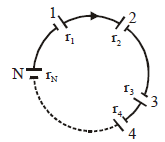
A group of N cells whose emf varies directly with the internal resistance as per the equation \(E_{N}=1.5r_{N} \) are connected as shown in the figure below. The current I in the circuit is :


1. 0.51 amp
2. 5.1 amp
3. 0.15 amp
4. 1.5 amp
View Answer

In the given circuit of

NN

cells, the emf (

ENE_N

) and internal resistance (

rNr_N

) are related as

EN=1.5rNE_N = 1.5r_N

. To find the current (

II

), we follow these steps:

  1. Equivalent emf and resistance:
    • The cells are connected in series, so:
      Eeq=EN=1.5rN,req=rN.E_{\text{eq}} = E_N = 1.5r_N, \quad r_{\text{eq}} = r_N.
       
  2. Total resistance:
    • Let
      RextR_{\text{ext}}
       

      be the external resistance of the circuit. From the figure, the circuit resistance is: Rtotal=rN+Rext.R_{\text{total}} = r_N + R_{\text{ext}}. 

  3. Ohm's Law:
    • The current in the circuit is:
      I=EeqRtotal=1.5rNrN+Rext.I = \frac{E_{\text{eq}}}{R_{\text{total}}} = \frac{1.5r_N}{r_N + R_{\text{ext}}}.
       
  4. Condition for ( I = 1.5 , \text{A}:
    • Substituting
      I=1.5I = 1.5
       

      into the equation: 

      1.5=1.5rNrN+Rext.1.5 = \frac{1.5r_N}{r_N + R_{\text{ext}}}. 

    • Simplifying: 

      rN+Rext=rNβ€…β€ŠβŸΉβ€…β€ŠRext=0.r_N + R_{\text{ext}} = r_N \implies R_{\text{ext}} = 0. 

Thus, the current

I=1.5 AI = 1.5 \, \text{A}

when

Rext=0R_{\text{ext}} = 0

, meaning there is no external resistance.

Question 34: moderate

A milliammeter of range 10 mA has a coil of resistance 1 Ξ©. To use it as an ammeter of range 1 A, the required shunt must have a resistance of:

1. 1/101 Ξ©
2. 1/100 Ξ©
3. 1/99 Ξ©
4. 1/9 Ξ©
View Answer

To solve this, we need to determine the shunt resistance (

RSR_S

) required to extend the range of the milliammeter from 10 mA to 1 A.

Key Points:

  1. Milliammeter Current and Resistance:
    • Maximum current through the milliammeter coil:
      Im=10 mA=0.01 AI_m = 10 \, \text{mA} = 0.01 \, \text{A}
       

      ,

    • Resistance of the milliammeter coil:
      Rm=1 ΩR_m = 1 \, \Omega
       

      .

  2. Total Current for the Ammeter:
    • The total current to be measured by the modified ammeter:
      I=1 AI = 1 \, \text{A}
       

      .

  3. Shunt Current:
    • The shunt carries the remaining current,
      IS=Iβˆ’Im=1 Aβˆ’0.01 A=0.99 AI_S = I - I_m = 1 \, \text{A} - 0.01 \, \text{A} = 0.99 \, \text{A}
       

      .

  4. Voltage Across Shunt and Milliammeter:
    • The shunt is connected in parallel with the milliammeter, so the voltage across them is the same:
      Vm=VS.V_m = V_S.
       
  5. Ohm's Law:
    • Voltage across the milliammeter:
      Vm=Imβ‹…Rm=0.01β‹…1=0.01 V.V_m = I_m \cdot R_m = 0.01 \cdot 1 = 0.01 \, \text{V}.
       
    • Voltage across the shunt:
      VS=ISβ‹…RS=0.01 V.V_S = I_S \cdot R_S = 0.01 \, \text{V}.
       
  6. Solve for Shunt Resistance (
    RSR_S
     

    ):

    • From the voltage equation:
      RS=VSIS=0.010.99=199 Ω.R_S = \frac{V_S}{I_S} = \frac{0.01}{0.99} = \frac{1}{99} \, \Omega.
       

Final Answer:

The required shunt resistance is:


199 Ω.\boxed{\frac{1}{99} \, \Omega}.


Question 35: moderate

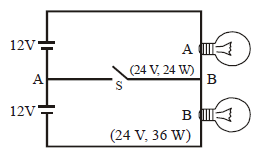
Two light bulbs shown in the circuit have ratings A(24 V, 24 W) and B (24 V and 36 W) as shown. When the switch is closed.

1. The intensity of light bulb A increases
2. The intensity of light bulbs both A and B remains same
3. The intensity of light bulb B increases
4. The intensity of light bulb B decreases
View Answer
Question 36: moderate

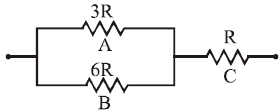
The three resistances A, B and C have values 3R, 6R and R respectively. When some potential difference is applied across the network, the thermal powers dissipated by A, B and C are in the ratio :

1. 2 : 3 : 4
2. 2 : 4 : 3
3. 4 : 2 : 3
4. 3 : 2 : 4
View Answer
Question 37: moderate

An electric bulb rated for 500 watts at 100 volts is used in a circuit having a 200-volt supply. The resistance R that must be put in series with the bulb, so that the bulb draws 500 watts is :

1. 10 Ξ©
2. 20 Ξ©
3. 50 Ξ©
4. 100 Ξ©
View Answer

To find the resistance

RR

that must be placed in series with the bulb, let's analyze the problem step by step.


Given:

  1. Power of the bulb (
    PP
     

    ) = 500 W,

  2. Voltage rating of the bulb (
    VbV_b
     

    ) = 100 V,

  3. Supply voltage (
    VsV_s
     

    ) = 200 V.


Step 1: Resistance of the bulb

The resistance of the bulb (

RbR_b

) can be calculated using the formula:


Rb=Vb2P.R_b = \frac{V_b^2}{P}.


Substitute the values:


Rb=1002500=10000500=20 Ω.R_b = \frac{100^2}{500} = \frac{10000}{500} = 20 \, \Omega.


Step 2: Total current through the circuit

The bulb is rated to draw 500 W at 100 V. Thus, the current through the bulb is:


I=PVb.I = \frac{P}{V_b}.


Substitute the values:


I=500100=5 A.I = \frac{500}{100} = 5 \, \text{A}.


Step 3: Voltage drop across the series resistor

The total supply voltage is 200 V, and the bulb operates at 100 V. Therefore, the voltage drop across the series resistor

RR

is:


VR=Vsβˆ’Vb.V_R = V_s - V_b.


Substitute the values:


VR=200βˆ’100=100 V.V_R = 200 - 100 = 100 \, \text{V}.


Step 4: Resistance of the series resistor

Using Ohm's law, the resistance of the series resistor is:


R=VRI.R = \frac{V_R}{I}.


Substitute the values:


R=1005=20 Ω.R = \frac{100}{5} = 20 \, \Omega.


Final Answer:

The resistance that must be placed in series with the bulb is:


20 Ω.\boxed{20 \, \Omega}.


Question 38: moderate

An ammeter is to be constructed which can read currents upto 2.0 A. If the coil has a resistance of 25 Ξ© and takes 1 mA for full-scale deflection, what should be the resistance of the shunt used?

1. \[1.25\times 10^{-2}\Omega\]
2. \[2.5\times 10^{-2}\Omega\]
3. \[0.5\times 10^{-2}\Omega\]
4. \[10^{-2}\Omega\]
View Answer

To construct an ammeter that can read currents up to

2.0 A2.0 \, \text{A}

, we need to calculate the resistance of the shunt. Here's the step-by-step calculation:

  1. Full-scale current through the coil:
    The coil takes 1 mA=10βˆ’3 A1 \, \text{mA} = 10^{-3} \, \text{A} 

    for full-scale deflection.

  2. Remaining current through the shunt:
    When the total current is 2.0 A2.0 \, \text{A} 

    , the current through the shunt is:

    Is=Itotalβˆ’Ic=2.0βˆ’10βˆ’3=1.999 A.I_s = I_{\text{total}} - I_c = 2.0 - 10^{-3} = 1.999 \, \text{A}. 

  3. Voltage across the coil:
    The resistance of the coil is 25 Ω25 \, \Omega 

    . Using Ohm's law, the voltage across the coil is:

    Vc=IcRc=(10βˆ’3)(25)=0.025 V.V_c = I_c R_c = (10^{-3})(25) = 0.025 \, \text{V}. 

  4. Resistance of the shunt:
    The voltage across the shunt must equal the voltage across the coil:Β  Vs=Vc=0.025 V.V_s = V_c = 0.025 \, \text{V}.Using Ohm's law for the shunt:


    Rs=VsIs=0.0251.999β‰ˆ1.25Γ—10βˆ’2 Ω.R_s = \frac{V_s}{I_s} = \frac{0.025}{1.999} \approx 1.25 \times 10^{-2} \, \Omega. 

Thus, the resistance of the shunt is:


1.25Γ—10βˆ’2 Ω.\boxed{1.25 \times 10^{-2} \, \Omega.}