Variation of Resistance with Temperature - NEET Physics Questions
← Back to Current Electricity

Variation of Resistance with Temperature

Question 1: moderate

The ratio of the resistance of conductor at temperature 15°C to its resistance at temperature 37.5°C is 4 : 5. the temperature coefficient of resistance of the conductor is : (reference is taken as 0°C)

1. \[1/25 ^{o}C^{-1}\]
2. \[1/50 ^{o}C^{-1}\]
3. \[1/80 ^{o}C^{-1}\]
4. \[1/75 ^{o}C^{-1}\]
View Answer

To find the temperature coefficient of resistance

α\alpha

of the conductor, we use the formula for the change in resistance with temperature:


RT=R0(1+αT)R_T = R_0 \left( 1 + \alpha T \right)


Where:


  • RTR_T
     

    is the resistance at temperature TT 

    ,


  • R0R_0
     

    is the resistance at the reference temperature (0°C),


  • α\alpha
     

    is the temperature coefficient of resistance,


  • TT
     

    is the temperature change in °C.

Step 1: Given

  • The ratio of resistances at 15°C and 37.5°C is given as
    R15R37.5=45\frac{R_{15}}{R_{37.5}} = \frac{4}{5}
     

    .

  • The resistance at temperature 15°C,
    R15=R0(1+α×15)R_{15} = R_0 (1 + \alpha \times 15)
     

    .

  • The resistance at temperature 37.5°C,
    R37.5=R0(1+α×37.5)R_{37.5} = R_0 (1 + \alpha \times 37.5)
     

    .

Step 2: Set up the equation based on the given ratio


R15R37.5=45\frac{R_{15}}{R_{37.5}} = \frac{4}{5}


Substituting the expressions for

R15R_{15}

and

R37.5R_{37.5}

:


R0(1+α×15)R0(1+α×37.5)=45\frac{R_0 (1 + \alpha \times 15)}{R_0 (1 + \alpha \times 37.5)} = \frac{4}{5}


Canceling

R0R_0

from both the numerator and denominator:


1+15α1+37.5α=45\frac{1 + 15\alpha}{1 + 37.5\alpha} = \frac{4}{5}


Step 3: Solve for α\alpha


Cross-multiply to solve for

α\alpha

:


5(1+15α)=4(1+37.5α)5(1 + 15\alpha) = 4(1 + 37.5\alpha)


Expanding both sides:


5+75α=4+150α5 + 75\alpha = 4 + 150\alpha


Simplify:


54=150α75α5 - 4 = 150\alpha - 75\alpha


1=75α1 = 75\alpha


α=175\alpha = \frac{1}{75}


Final Answer:

The temperature coefficient of resistance

α\alpha

is

175per °C\boxed{\frac{1}{75}} \, \text{per °C}

.

Question 2: difficult

Two wires of resistances R1 and R2 have temperature coefficient of resistances α1 and α2 respectively. These are joined in series. The effective temperature coefficient of resistance is :

1. \[\frac{\alpha_{1}+\alpha_{2}}{2}\]
2. \[\sqrt{\alpha_{1}\alpha_{2}}\]
3. \[\frac{\alpha_{1}R_{1}+\alpha_{2}R_{2}}{R_{1}+R_{2}}\]
4. \[\frac{\sqrt{R_{1}R_{2}\alpha_{1}\alpha_{2}}}{\sqrt{R_{1}^{2}R_{2}^{2}}}\]
View Answer

When two resistors with resistances

R1R_1

and

R2R_2

and temperature coefficients of resistance

α1\alpha_1

and

α2\alpha_2

are connected in series, the effective temperature coefficient of resistance

αeff\alpha_{\text{eff}}

is given by the formula:


αeff=α1R1+α2R2R1+R2\alpha_{\text{eff}} = \frac{\alpha_1 R_1 + \alpha_2 R_2}{R_1 + R_2}


This formula takes into account the individual resistances and temperature coefficients of the two wires, considering that their total resistance is the sum of the individual resistances.

Question 3: easy

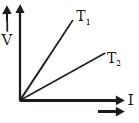
The voltage V and current I graph for a conductor at two different temperatures T1 and T2 are shown in the figure. The relation between T1 and T2 is :-

1. T1 > T2
2. T1 ≈ T2
3. T1 = T2
4. T1 < T2
View Answer

Slope of V-I graph represents Resistance. So R1>R2