Basics of Current - NEET Physics Questions
Question 1: moderate

10,000 alpha particles per minute are passing through a straight tube of radius r. The resulting electric current is approximately :


1. \[0.5\times 10^{-16} amp\]
2. \[2\times 10^{12} amp\]
3. \[0.5\times 10^{12} amp\]
4. \[2\times 10^{-12} amp\]
View Answer

Let’s solve the problem step by step:


1. Key Concepts

  • Alpha particles (
    Ξ±\alpha
     

    ) have a charge of qΞ±=2eq_\alpha = 2e 

    , where e=1.6Γ—10βˆ’19 Ce = 1.6 \times 10^{-19} \, \text{C} 

    is the elementary charge.

  • Electric current
    II
     

    is the rate of flow of charge: I=TotalΒ chargeΒ passingTimeI = \frac{\text{Total charge passing}}{\text{Time}} 


2. Total Charge Passing per Minute

We are given:


  • N=10,000 α N = 10,000 \, \alpha
     

    -particles per minute,

  • Each
    Ξ±\alpha
     

    -particle carries a charge qΞ±=2e=2Γ—1.6Γ—10βˆ’19=3.2Γ—10βˆ’19 Cq_\alpha = 2e = 2 \times 1.6 \times 10^{-19} = 3.2 \times 10^{-19} \, \text{C} 

    .

The total charge passing in 1 minute is:


Q=Nβ‹…qΞ±=10,000β‹…3.2Γ—10βˆ’19=3.2Γ—10βˆ’15 C.Q = N \cdot q_\alpha = 10,000 \cdot 3.2 \times 10^{-19} = 3.2 \times 10^{-15} \, \text{C}.


3. Current

Convert the time from minutes to seconds:


t=60 seconds.t = 60 \, \text{seconds}.


The current is:


I=Qt=3.2Γ—10βˆ’1560=0.533Γ—10βˆ’16 A.I = \frac{Q}{t} = \frac{3.2 \times 10^{-15}}{60} = 0.533 \times 10^{-16} \, \text{A}.


Rounding off, the current is approximately:
 

0.5Γ—10βˆ’16 A.\boxed{0.5 \times 10^{-16} \, \text{A}}.


Question 2: easy

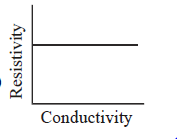
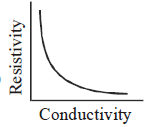
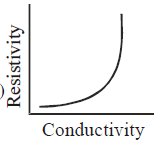
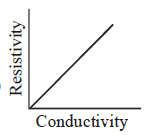
Which graph best represents the relationship between conductivity and resistivity for a solid ?

1.
2.
3.
4.
View Answer

Product of Resistivity and Conductivity is 1.

\[ \rho\times \sigma= 1\]

So graph will be rectangular hyperbola.

Question 3: easy

On the basis of electrical conductivity, which one of the following material has the smallest resistivity?

1. Glass
2. Silicon
3. Germanium
4. Silver
View Answer

Silver is a metal which has very high electrical conductivity and hence possesses the smallest resistivity compared to semiconductors (Silicon, Germanium) and insulators (Glass).

Question 4: easy

A certain wire \(A\) has resistance \(81 \Omega\). The resistance of another wire \(B\) of same material and equal length but of diameter thrice the diameter of \(A\) will be

1. \(729 \Omega\)
2. \(243 \Omega\)
3. \(81 \Omega\)
4. \(9 \Omega\)
View Answer

Resistance is inversely proportional to the square of the diameter: \(R = \frac{1}{d^2}\). Since the diameter is tripled, the resistance becomes \(\frac{R}{9} = \frac{81}{9} = 9 \Omega\).

Question 5: easy

A copper wire of radius 1 mm contains \(10^{22}\) free electrons per cubic metre. The drift velocity for free electrons when 10 A current flows through the wire will be (Given, charge on electron = \(1.6 \times 10^{-19}\text{ C}\))

1. \(\frac{6.25}{\pi}\text{ m s}^{-1}\)
2. \(\frac{6.25 \times 10^5}{\pi}\text{ m s}^{-1}\)
3. \(\frac{6.25 \times 10^4}{\pi}\text{ m s}^{-1}\)
4. \(\frac{6.25}{\pi} \times 10^3\text{ m s}^{-1}\)
View Answer

Using the relation \(I = n e A v_d β‡’ v_d = \frac{I}{n e \pi r^2}\). Substituting the given values: \(v_d = \frac{10}{10^{22} \times 1.6 \times 10^{-19} \times \pi \times (10^{-3})^2} = \frac{6.25}{\pi} \times 10^3\text{ m s}^{-1}\).

Question 6: easy

If a copper wire is stretched to make it 0.1% longer, the percentage increase in resistance will be:

1. 0.2%
2. 2%
3. 1%
4. 0.1%
View Answer

Resistance of a stretched wire of constant volume is proportional to the square of its length: \( R \propto l^2 \). Thus, \( \frac{\Delta R}{R}\text{ (%)} = 2 \frac{\Delta l}{l}\text{ (%)} = 2 \times 0.1\% = 0.2\% \).

Question 7: easy

Arrange the following materials in increasing order of their resistivity:
Nichrome, Copper, Germanium, Silicon

1. Copper < Nichrome < Germanium < Silicon
2. Germanium < Copper < Nichrome < Silicon
3. Nichrome < Copper < Germanium < Silicon
4. Silicon < Nichrome < Germanium < Copper
View Answer

Copper is a conductor (lowest resistivity), Nichrome is an alloy (intermediate), Germanium and Silicon are semiconductors with Silicon having a larger bandgap and thus higher resistivity.

Question 8: easy

The reciprocal of resistance is

1. Resistivity
2. Conductivity
3. Conductance
4. Inductance
View Answer

By definition, the reciprocal of electrical resistance is electrical conductance, \(G = \frac{1}{R}\).

Question 9: easy

Column-I gives certain physical terms associated with flow of current through a metallic conductor. Column-II gives some mathematical relations involving electrical quantities. Match Column-I and Column-II with appropriate relations.


Column-I
(A) Drift Velocity
(B) Electrical Resistivity
(C) Relaxation Period
(D) Current Density


Column-II
(P) \(\frac{m}{n e^2 rho}\)
(Q) \(n e v_d\)
(R) \(\frac{e E}{m} \tau\)
(S) \(\frac{E}{J}\)


Choose the correct match from the given options:

1. (A) - (R), (B) - (Q), (C) - (S), (D) - (P)
2. (A) - (R), (B) - (S), (C) - (P), (D) - (Q)
3. (A) - (R), (B) - (S), (C) - (Q), (D) - (P)
4. (A) - (R), (B) - (P), (C) - (S), (D) - (Q)
View Answer

Using standard formulas of current electricity: drift velocity \(v_d = \frac{eE}{m}\tau\) gives (A)-(R); resistivity \(\rho = \frac{E}{J}\) gives (B)-(S); relaxation time \(\tau = \frac{m}{ne^2\rho}\) gives (C)-(P); current density \(J = ne v_d\) gives (D)-(Q).

Question 10: easy

The drift velocity of free electrons in a conductor is \(v\) when a current \(i\) is flowing in it. If both the area of cross-section and current are doubled, then drift velocity will be

1. 2v
2. \[\frac{v}{2}\]
3. v
4. 4v
View Answer

Formula: \(v_d = \frac{i}{n A e}\). If both \(i\) and \(A\) are doubled, the drift velocity \(v_d\) remains unchanged as the ratio \(\frac{i}{A}\) is constant.