Current Electricity - NEET Physics Questions
← All Chapters

Current Electricity

Question 1: moderate

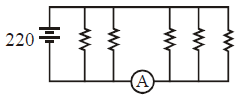
Five identical resistors, each of value 1100Ω, are connected to a 220V battery as shown. The reading of ideal ammeter is :

1. \[\frac{1}{3} A\]
2. \[\frac{1}{5} A\]
3. \[\frac{3}{5} A\]
4. \[\frac{4}{5} A\]
View Answer

Current through each resistor is 220/1100 = 1/5 A

Total current through ammeter = 3 * 1/5 A= 3/5 A

Question 2: moderate

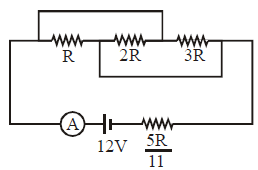
In the circuit shown the reading of ammeter is 2A. The ammeter has negligible resistance. The value of R equals.

1.
2.
3.
4.
View Answer
Question 3: moderate

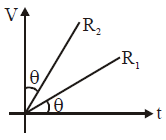
The V-I graph for two conductor of resistance R1 & R2 are as shown in the figure, the resistance of their series combination (R2 + R1) is proportional to :

1. /[\frac{1}{sin^{2}\theta cos^{2}\theta}/]
2. /[\frac{1}{sin\theta cos\theta}/]
3. /[\frac{cos\theta}{sin^{2}\theta}/]
4. /[\frac{tan2\theta}{sin^{2}\theta}/]
View Answer
Question 4: moderate

If the number of free electrons is \(5\times 10^{28} m^{-3}\) then the drift velocity of electron in a conductor of area of cross-section \(10^{-4} m^{2}\) for a current of 1.2 A is:


1. \[1.5\times 10^{-2} m/s\]
2. \[1.5\times 10^{-3} m/s\]
3. \[1.5\times 10^{-4} m/s\]
4. \[1.5\times 10^{-6} m/s\]
View Answer

To find the drift velocity

vdv_d

of the electrons, we use the formula for current in terms of drift velocity:


I=nAevdI = n A e v_d


Where:


  • II
     

    is the current (1.2 A),


  • nn
     

    is the number of free electrons per unit volume ( 5×1028m35 \times 10^{28} \, \text{m}^{-3} 

    ),


  • AA
     

    is the cross-sectional area of the conductor ( 104m210^{-4} \, \text{m}^2 

    ),


  • ee
     

    is the charge of an electron ( 1.6×10¹⁹C1.6 \times 10^{-19} \, \text{C} 

    ),


  • vdv_d
     

    is the drift velocity of the electrons (which we need to calculate).

Step 1: Rearranging the formula to solve for vdv_d


vd=InAev_d = \frac{I}{n A e}


Step 2: Substituting the given values


vd=1.2(5×1028)×(104)×(1.6×1019)v_d = \frac{1.2}{(5 \times 10^{28}) \times (10^{-4}) \times (1.6 \times 10^{-19})}


Step 3: Performing the calculation


vd=1.2(5×1028)×(104)×(1.6×1019)v_d = \frac{1.2}{(5 \times 10^{28}) \times (10^{-4}) \times (1.6 \times 10^{-19})}


vd=1.28×10⁶v_d = \frac{1.2}{8 \times 10^{6}}


vd=1.5×10⁷m/sv_d = 1.5 \times 10^{-7} \, \text{m/s}


Final Answer:

The drift velocity of the electrons is

1.5×10⁷m/s\boxed{1.5 \times 10^{-7} \, \text{m/s}}

.

Question 5: moderate

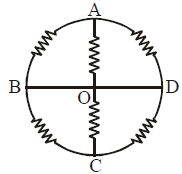
Find effective resistance between A & C if each resistor is of 6Ω.

1. 4 Ω
2. 2 Ω
3. 2.4 Ω
4. 3 Ω
View Answer
Question 6: moderate

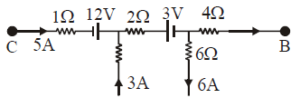
Potential difference between C and B /[\left( V_{C}-V_{B} \right)/] in the circuit is :

1. 15 V
2. 38 V
3. 20 V
4. 9 V
View Answer
Question 7: moderate

An ammeter and a voltmeter are joined in series to a cell. Their readings are A and V respectively. If a resistance is now joined in parallel with the voltmeter

1. both A and V will increase
2. both A and V will decrease
3. A will decrease, V will increase
4. A will increase, V will decrease
View Answer


Initial Setup:

  1. An ammeter and a voltmeter are connected in series to a cell.
  2. The ammeter reading is
    AA
     

    (current through the circuit).

  3. The voltmeter reading is
    VV
     

    (potential difference across the cell).


What Happens When a Resistance is Added in Parallel with the Voltmeter?

  • The voltmeter has a high internal resistance (
    RvR_v
     

    ) to minimize current flow through it.

  • When an additional resistance (
    RR
     

    ) is connected in parallel with the voltmeter, the effective resistance of the voltmeter decreases because: Reff=RvRRv+R.R_{\text{eff}} = \frac{R_v \cdot R}{R_v + R}. 

    Since RR 

    is finite, Reff<RvR_{\text{eff}} < R_v 

    .


Effect on the Circuit:

  1. Decrease in total resistance:
    • The voltmeter (and its parallel combination) is in series with the ammeter.
    • The decrease in
      ReffR_{\text{eff}}
       

      reduces the total resistance of the circuit.

    • Lower resistance means higher total current through the circuit (Ohm's law:
      I=VRtotalI = \frac{V}{R_{\text{total}}}
       

      ).

    • Thus, the ammeter reading (
      AA
       

      ) increases.

  2. Voltage across the voltmeter decreases:
    • With the reduced effective resistance of the voltmeter, a smaller fraction of the total voltage is dropped across it.
    • Hence, the voltmeter reading (
      VV
       

      ) decreases.


Conclusion:

When a resistance is added in parallel with the voltmeter:

  • The ammeter reading (
    AA
     

    ) increases.

  • The voltmeter reading (
    VV
     

    ) decreases.

Question 8: moderate

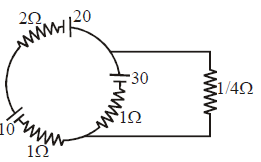
In the following circuit diagram, the current flowing through resistor of 1/4Ω is :

1. 1 A
2. 60 A
3. 30 A
4. None of these
View Answer
Question 9: moderate

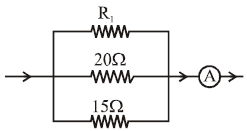
In the given circuit the current flowing through the resistance 20 ohms is 0.3 ampere while the ammeter reads 0.8 ampere. What is the value of R1?

1. 30 ohms
2. 40 ohms
3. 60 ohms
4. 50 ohms
View Answer
Question 10: moderate

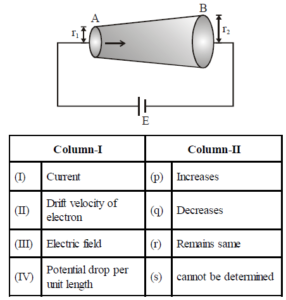
A battery of emf E is connected across a conductor as shown. As one observes from A to B.

Now, match the given columns and select the correct option from the codes given below :
Codes :

1. I-p, II-q, III-r, IV-s
2. I-r, II-q, III-q, IV-q
3. I-q, II-p, III-s, IV-r
4. I-s, II-q, III-q, IV-p
View Answer