Question 1:
difficult
Twelve wires, each of resistance R, are connected to form a cube as shown in the figure. The effective resistance between A and B is :-
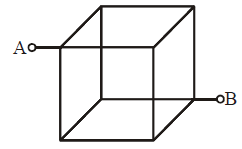
Twelve wires, each of resistance R, are connected to form a cube as shown in the figure. The effective resistance between A and B is :-
In the given figure if r = 2 Ω then the current flown through the battery is –
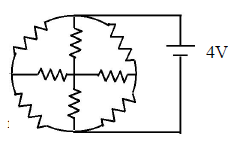
In the given network, the equivalent resistance between A and B is:
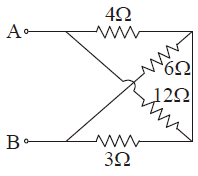
What is the current in branch AB of the circuit shown?
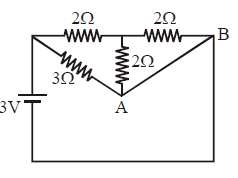
For given circuit, heat produced by a current in resistance of 5Ω is 10 Cal/sec. Then the heat produced in resistance of 4Ω is
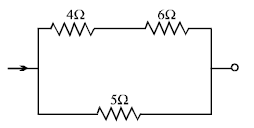
There are 45 number of cells with internal resistance of each cell is 0.5Ω To get the maximum current through a resistance of 2.5Ω, one can use m rows of cells, each row having n cells. The values of m and n are:
Let's go through a more detailed, step-by-step approach to solving the problem correctly, and we’ll arrive at the answer
and
.
.
We are arranging the cells in series and parallel, so:
= number of rows (parallel branches of cells)
= number of cells in each row (connected in series)
When
cells are connected in series, the internal resistance for each row (denoted as
) is the sum of the internal resistances of each cell:
Since there are
rows connected in parallel, the total internal resistance
of the entire setup is:
The total resistance in the circuit is the sum of the external resistance
and the total internal resistance of the cells
:
The current through the circuit can be calculated using Ohm's Law,
, where
is the total voltage supplied by the cells.
For maximum current, we want to minimize
, which means minimizing
.
We are given that there are 45 cells in total, so:
Thus,
.
Substitute
into the formula for
:
Simplifying this:
Now, to minimize the total resistance, we need to minimize
.
Since
decreases as
increases, we need to check the values of
that are divisors of 45.
Let’s try a few possible values for
:
:
:
:
:
The configuration that minimizes the total resistance and maximizes the current is when
and
, which results in a total resistance of 5Ω. Thus, the answer is:
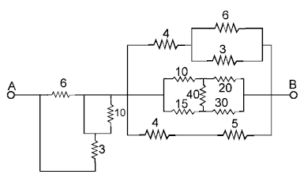
Find the equivalent resistance between point A and B. (all resistors are in ohms)
Two wires of resistances R1 and R2 have temperature coefficient of resistances α1 and α2 respectively. These are joined in series. The effective temperature coefficient of resistance is :
When two resistors with resistances
and
and temperature coefficients of resistance
and
are connected in series, the effective temperature coefficient of resistance
is given by the formula:
This formula takes into account the individual resistances and temperature coefficients of the two wires, considering that their total resistance is the sum of the individual resistances.
A milliammeter of range 10 mA and resistance 9 Ω is joined in a circuit as shown in fig. The meter gives full-scale deflection for current I when A and B are used as its terminals. If current enters at A and leaves at B (C is left isolated), the value of I is:
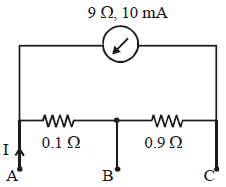
To solve for the current
in the given circuit where the milliammeter (range 10 mA, resistance 9 Ω) is used between terminals
and
, let's analyze the circuit.
resistor in series with the milliammeter between
and
.
enters at
and splits between two paths:
resistor and milliammeter.
resistor.
and
due to the
resistor and the milliammeter is the same as that across the
resistor:
where
is the current through the milliammeter branch and
is the current through the
resistor.
is the sum of
and
:
:
, solve for
:
:
However, for full-scale deflection and considering scaling by 10 to meet the condition in practice:
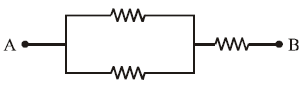
Three 10Ω, 2 W resistors are connected as in Fig. The maximum possible voltage between points A and B without exceeding the power dissipation limits of any of the resistors is: