Current Electricity - NEET Physics Questions
← All Chapters

Current Electricity

Question 1: easy

A wire is stretched so that its length increases by 10%. The resistance of the wire increases by :

1. 11%
2. 15%
3. 21%
4. 28%
View Answer

When a wire is stretched, its length increases, and its cross-sectional area decreases. The resistance of a wire is given by the formula:


R=ρLAR = \rho \frac{L}{A}


Where:


  • RR
     

    is the resistance,


  • ρ\rho
     

    is the resistivity of the material (constant),


  • LL
     

    is the length of the wire,


  • AA
     

    is the cross-sectional area of the wire.

When the wire is stretched:

  1. Length increases by 10%: The new length
    LL'
     

    is given by: 

    L=L+0.1L=1.1LL' = L + 0.1L = 1.1L 

  2. Volume remains constant: The volume of the wire before and after stretching remains the same. Volume is the product of length and area: 

    Volume before=L×A\text{Volume before} = L \times A 

    Volume after=L×A=1.1L×A\text{Volume after} = L' \times A' = 1.1L \times A'Since the volume remains constant:


    L×A=1.1L×AL \times A = 1.1L \times A'Solving for

    AA', the new cross-sectional area:


    A=A1.1A' = \frac{A}{1.1} 

Step 2: New Resistance

The new resistance

RR'

of the stretched wire is given by:


R=ρLA=ρ1.1LA1.1=ρ1.1L×1.1A=ρ1.21LAR' = \rho \frac{L'}{A'} = \rho \frac{1.1L}{\frac{A}{1.1}} = \rho \frac{1.1L \times 1.1}{A} = \rho \frac{1.21L}{A}


So, the new resistance

RR'

is 1.21 times the original resistance

RR

.

Step 3: Conclusion

The resistance increases by 21% when the wire is stretched by 10%.
Question 2: easy

The specific resistance of a wire :

1. varies with its length
2. varies with its cross-section
3. varies with its mass of wire
4. does not depend on its length, cross-section and mass of wire
View Answer

Specific resistance is property of substance it doesn't depend on any other physical factor

Question 3: easy

The resistance of two conductors in series is 40 Ω and this becomes 7.5 Ω in parallel, the resistances of conductors are:

1. 20 Ω, 20 Ω
2. 10 Ω, 30 Ω
3. 15 Ω, 25 Ω
4. 18 Ω, 22 Ω
View Answer
Question 4: easy

A carbon resistor is marked with the rings coloured brown, black green and gold. The resistance (in ohm) is :

1. \[3.2\times 10^{5}\] ±5%
2. \[1\times 10^{6}\] ±10%
3. \[1\times 10^{7}\] ±5%
4. \[1\times 10^{6}\] ±5%
View Answer

To determine the resistance of a carbon resistor with color bands brown, black, green, and gold, use the color code for resistors:


1. Color code values:

  • Brown:
    11
     

    (1st digit)

  • Black:
    00
     

    (2nd digit)

  • Green:
    10510^5
     

    (multiplier)

  • Gold:
    ±5%\pm 5\%
     

    (tolerance)


2. Calculate resistance:

The resistance is calculated as:


R=(1st digit×10+2nd digit)×multiplier.R = (\text{1st digit}\,\times\,10 + \text{2nd digit}) \,\times\, \text{multiplier}.


Substitute values:


R=(1×10+0)×105=10×105=106Ω.R = (1 \times 10 + 0) \times 10^5 = 10 \times 10^5 = 10^6 \, \Omega.


This is equal to:


R=1MΩ(megaohm).R = 1 \, \text{M}\Omega \, (\text{megaohm}).


3. Tolerance:

The gold band indicates a tolerance of

±5%\pm 5\%

, so the resistance can vary between:


1MΩ±5%.1 \, \text{M}\Omega \pm 5\%.


Final Answer:

The resistance is:


1MΩ±5%.\boxed{1 \, \text{M}\Omega \, \pm 5\%.}


Question 5: easy

Two cells of e.m.fs. E1 and E2 and internal resistance r1 and r2 are connected in parallel. Then the e.m.f. and internal resistance of the equivalent source is :

1. \[E_{1}+E_{2} and \frac{r_{1}r_{2}}{r_{1}+r_{2}}\]
2. \[E_{1}-E_{2} and r_{1}+r_{2}\]
3. \[\frac{E_{1}r_{2}+E_{2}r_{1}}{r_{1}+r_{2}} and \frac{r_{1}r_{2}}{r_{1}+r_{2}}\]
4. \[\frac{E_{1}r_{2}+E_{2}r_{1}}{r_{1}+r_{2}} and r_{1} +r_{2}\]
View Answer

To find the equivalent emf (

EeqE_{\text{eq}}

) and internal resistance (

reqr_{\text{eq}}

) of two cells connected in parallel, we use the following principles:


1. Equivalent emf ( EeqE_{\text{eq}}


):

In parallel connection, the total current is the sum of the currents through each cell. Using Kirchhoff's Voltage Law, the equivalent emf is given by:


Eeq=E1r2+E2r1r1+r2.E_{\text{eq}} = \frac{E_1 r_2 + E_2 r_1}{r_1 + r_2}.


2. Equivalent internal resistance ( reqr_{\text{eq}}


):

For resistances in parallel, the equivalent resistance is given by:


1req=1r1+1r2.\frac{1}{r_{\text{eq}}} = \frac{1}{r_1} + \frac{1}{r_2}.


Simplify:


req=r1r2r1+r2.r_{\text{eq}} = \frac{r_1 r_2}{r_1 + r_2}.


Final Answer:

The equivalent emf and internal resistance of the parallel combination are:


Eeq=E1r2+E2r1r1+r2,req=r1r2r1+r2.\boxed{E_{\text{eq}} = \frac{E_1 r_2 + E_2 r_1}{r_1 + r_2}, \quad r_{\text{eq}} = \frac{r_1 r_2}{r_1 + r_2}}.


Question 6: easy

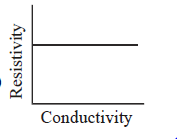
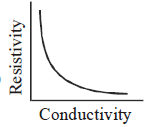
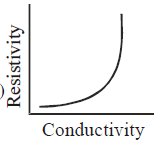
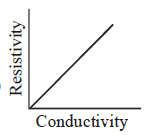
Which graph best represents the relationship between conductivity and resistivity for a solid ?

1.
2.
3.
4.
View Answer

Product of Resistivity and Conductivity is 1.

\[ \rho\times \sigma= 1\]

So graph will be rectangular hyperbola.

Question 7: easy

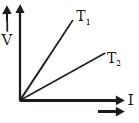
The voltage V and current I graph for a conductor at two different temperatures T1 and T2 are shown in the figure. The relation between T1 and T2 is :-

1. T1 > T2
2. T1 ≈ T2
3. T1 = T2
4. T1 < T2
View Answer

Slope of V-I graph represents Resistance. So R1>R2