Current Electricity - NEET Physics Questions
← All Chapters

Current Electricity

Question 11: moderate

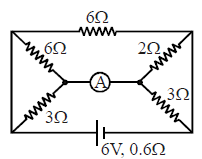
The resistance of the ammeter shown in figure is 0.8 Ω . Its reading is
1. zero
2. 0.6 A
3. 1.2 A
4. none of these
View Answer
Question 12: moderate

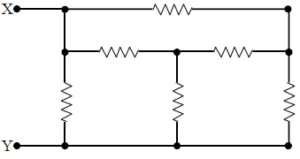
Six resistors each of 10 W are connected as shown. The equivalent resistance between points X and Y is :
1. 20 Ω
2. 5 Ω
3. 25/3 Ω
4. 10 Ω
View Answer
Question 13: moderate

A and B are two points on a uniform ring of resistance R. The ∠ACB = θ, where C is the centre of the ring. The equivalent resistance between A and B is

1. \[R\frac{2\pi-\theta}{4\pi}\]
2. \[R\left( 1-\frac{\theta}{2\pi} \right)\]
3. \[R\frac{\theta}{2\pi}\]
4. \[\frac{R}{4\pi^{2}}\left( 2\pi-\theta \right)\theta\]
View Answer
Question 14: moderate

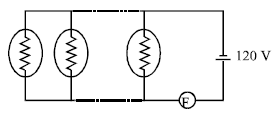
Some light bulbs are conected in parallel to a 120 V source as shown in the figure. Each bulb dissipates an average power of 60 W.The circuit has a fuse F that burns out when the current in the circuit exceeds 9 A. Determine the largest number of bulbs of the following, that can be used in the circuit without burning out the fuse.
1. 9
2. 17
3. 36
4. 34
View Answer
Question 15: moderate

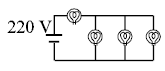
Four identical bulbs each rated 100 watts, 220 volts are connected across a battery as shown. The power consumed by them is:
1. 75 watt
2. 400 watt
3. 300 watt
4. 400/3 watt
View Answer
Question 16: moderate

Six identical light bulbs are connected to a battery to form the circuit shown. Which light bulb(s) glow the brightest?
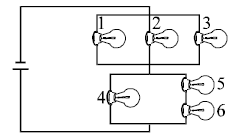
1. 1, 2 and 3
2. 5 and 6
3. 1, 2, 3 and 4
4. 4 only
View Answer

Current through bulb 4 is maximum

Question 17: moderate

N identical cells, each of emf e and internal resistance r, are joined in series. Out of these, n cells are wrongly connected, i.e., their terminals are connected in reverse of that required for series connection. n < N/2. Let  \(\varepsilon_{0}\) be the emf of the resulting battery and \( r_{0}\) be its internal resistance,

1. \[\varepsilon_{0}=\left( N-n \right)\varepsilon, r_{0}=\left( N-n \right)r\]
2. \[\varepsilon_{0}=\left( N-2n \right)\varepsilon, r_{0}=\left( N-2n \right)r\]
3. \[\varepsilon_{0}=\left( N-2n \right)\varepsilon, r_{0}=Nr\]
4. \[\varepsilon_{0}=\left( N-n \right)\varepsilon, r_{0}=Nr\]
View Answer

When

NN

identical cells, each of emf

ee

and internal resistance

rr

, are connected in series and

nn

cells are connected in reverse, the resulting emf and internal resistance of the battery can be determined as follows:


1. Resultant emf ( ε0\varepsilon_0


):

  • For correctly connected cells, the total emf is:
    εcorrect=(Nn)e.\varepsilon_{\text{correct}} = (N - n)e.
     
  • For n reversed cells, their emf opposes the total emf. The opposing emf is:
    εreverse=ne.\varepsilon_{\text{reverse}} = ne.
     

    The net emf of the resulting battery is: 

    ε0=εcorrectεreverse=(Nn)ene=(N2n)e.\varepsilon_0 = \varepsilon_{\text{correct}} - \varepsilon_{\text{reverse}} = (N - n)e - ne = (N - 2n)e. 


2. Resultant internal resistance ( r0


):

  • All cells, whether correctly or incorrectly connected, contribute to the total internal resistance because resistances add in series. The total internal resistance is:
    r0=Nr.r_0 = N r.
     

Final Answer:

The emf and internal resistance of the resulting battery are:

ε0=(N2n)e,r0=Nr.\boxed{\varepsilon_0 = (N - 2n)e, \quad r_0 = Nr.}


Question 18: moderate

The ratio of the resistance of conductor at temperature 15°C to its resistance at temperature 37.5°C is 4 : 5. the temperature coefficient of resistance of the conductor is : (reference is taken as 0°C)

1. \[1/25 ^{o}C^{-1}\]
2. \[1/50 ^{o}C^{-1}\]
3. \[1/80 ^{o}C^{-1}\]
4. \[1/75 ^{o}C^{-1}\]
View Answer

To find the temperature coefficient of resistance

α\alpha

of the conductor, we use the formula for the change in resistance with temperature:


RT=R0(1+αT)R_T = R_0 \left( 1 + \alpha T \right)


Where:


  • RTR_T
     

    is the resistance at temperature TT 

    ,


  • R0R_0
     

    is the resistance at the reference temperature (0°C),


  • α\alpha
     

    is the temperature coefficient of resistance,


  • TT
     

    is the temperature change in °C.

Step 1: Given

  • The ratio of resistances at 15°C and 37.5°C is given as
    R15R37.5=45\frac{R_{15}}{R_{37.5}} = \frac{4}{5}
     

    .

  • The resistance at temperature 15°C,
    R15=R0(1+α×15)R_{15} = R_0 (1 + \alpha \times 15)
     

    .

  • The resistance at temperature 37.5°C,
    R37.5=R0(1+α×37.5)R_{37.5} = R_0 (1 + \alpha \times 37.5)
     

    .

Step 2: Set up the equation based on the given ratio


R15R37.5=45\frac{R_{15}}{R_{37.5}} = \frac{4}{5}


Substituting the expressions for

R15R_{15}

and

R37.5R_{37.5}

:


R0(1+α×15)R0(1+α×37.5)=45\frac{R_0 (1 + \alpha \times 15)}{R_0 (1 + \alpha \times 37.5)} = \frac{4}{5}


Canceling

R0R_0

from both the numerator and denominator:


1+15α1+37.5α=45\frac{1 + 15\alpha}{1 + 37.5\alpha} = \frac{4}{5}


Step 3: Solve for α\alpha


Cross-multiply to solve for

α\alpha

:


5(1+15α)=4(1+37.5α)5(1 + 15\alpha) = 4(1 + 37.5\alpha)


Expanding both sides:


5+75α=4+150α5 + 75\alpha = 4 + 150\alpha


Simplify:


54=150α75α5 - 4 = 150\alpha - 75\alpha


1=75α1 = 75\alpha


α=175\alpha = \frac{1}{75}


Final Answer:

The temperature coefficient of resistance

α\alpha

is

175per °C\boxed{\frac{1}{75}} \, \text{per °C}

.

Question 19: moderate

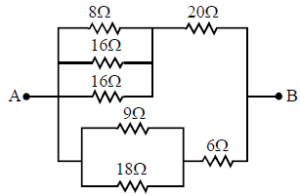
The equivalent resistance of the network shown in the figure between the points A and B is :-
 

1. 6 Ω
2. 8 Ω
3. 16 Ω
4. 24 Ω
View Answer
Question 20: moderate

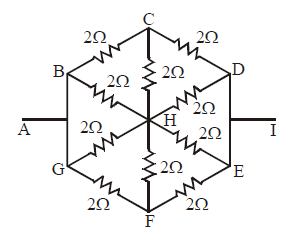
The effective resistance across the points A and I is :-
1. 2 Ω
2. 1 Ω
3. 0.5 Ω
4. 5 Ω
View Answer