Thermal Physics - NEET Physics Questions
← All Chapters

Thermal Physics

Question 21: easy

The temperature of a gas contained in a closed vessel increases by 2°C, when the pressure is increased by 2%. The initial temperature of the gas is :

1. 200 K
2. 100 K
3. 200 °C
4. 100 °C
View Answer

Given:

- The increase in temperature \(\Delta T = 2^\circ \text{C} = 2 \text{ K}\)
- The increase in pressure \(\frac{\Delta P}{P} = 2\% = 0.02\)

Using the relation for a gas at constant volume, \(\frac{\Delta P}{P} = \frac{\Delta T}{T}\):

\[
0.02 = \frac{2}{T}
\]

Solving for \(T\):

\[
T = \frac{2}{0.02} = 100 \text{ K}
\]

Answer: \(T = 100 \, \text{K}\)
Question 22: easy

An ideal gas has a volume of 3V at 2 atmosphere pressure. Keeping the temperature constant, its pressure is doubled. The volume of the gas will be :

1. 6V
2. 3V
3. 1.5V
4. 1V
View Answer

Since the temperature is constant, we can use Boyle's Law, which states that \( P_1 V_1 = P_2 V_2 \).

Given:
- Initial pressure, \( P_1 = 2 \) atm
- Initial volume, \( V_1 = 3V \)
- Final pressure, \( P_2 = 2 \times P_1 = 4 \) atm

Using Boyle's Law:

\[
P_1 V_1 = P_2 V_2
\]
\[
2 \times 3V = 4 \times V_2
\]
\[
6V = 4V_2
\]
\[
V_2 = \frac{6V}{4} = 1.5V
\]

So, the final volume \( V_2 \) is \( 1.5V \).

Question 23: easy

At a given volume and temperature, the pressure of a gas :

1. varies inversely as its mass
2. varies inversely as the square of its mass
3. varies directly as its mass
4. is independent of its mass
View Answer

At constant volume and temperature, the ideal gas law is:

\[
PV = nRT
\]

Since \( n = \frac{\text{mass}}{\text{molar mass}} \), we can rewrite the equation as:

\[
P \propto \frac{\text{mass}}{M}
\]

Thus, for a given volume and temperature, the pressure \( P \) varies directly with the mass of the gas.

Question 24: easy

A vessel has 6 g of hydrogen at pressure P and temperature 500 K. Their is a small hole in it so that hydogen leaks out. How much hydrogen leaks out if the final pressure is P/2 and temperature falls to 300 K ?

1. 2 g
2. 3 g
3. 4 g
4. 1 g
View Answer

To solve this, we can use the ideal gas law in terms of the number of moles \( n \):

\[
PV = nRT
\]

Let:
- Initial moles of hydrogen be \( n_1 \),
- Final moles of hydrogen be \( n_2 \).

Given data:
- Initial pressure \( P \),
- Final pressure \( P/2 \),
- Initial temperature \( T_1 = 500 \, \text{K} \),
- Final temperature \( T_2 = 300 \, \text{K} \),
- Mass of hydrogen initially = 6 g.

Since \( n = \frac{PV}{RT} \), we can write the initial and final moles as:

\[
n_1 = \frac{PV}{RT_1} \quad \text{and} \quad n_2 = \frac{(P/2)V}{R \cdot 300}
\]

Taking the ratio \( \frac{n_2}{n_1} \):

\[
\frac{n_2}{n_1} = \frac{(P/2) \cdot V / (R \cdot 300)}{P \cdot V / (R \cdot 500)} = \frac{1}{2} \times \frac{500}{300} = \frac{5}{12}
\]

Since initial moles \( n_1 = \frac{6}{2} = 3 \) moles (using molar mass of H₂ = 2 g/mol), then final moles \( n_2 = \frac{5}{12} \times 3 = 2.5 \) moles.

Thus, moles leaked out = \( 3 - 2.5 = 0.5 \) moles, corresponding to \( 0.5 \times 2 = 1 \) gram of hydrogen.

So, 1 g of hydrogen leaks out.

Question 25: easy

Which of the following gases possesses maximum rms velocity, all being at the same temperature :

1. Oxygen
2. Air
3. Carbon dioxide
4. Hydrogen
View Answer

The root mean square (r.m.s.) velocity \( v_{\text{rms}} \) of gas molecules is given by:

\[
v_{\text{rms}} = \sqrt{\frac{3 k_B T}{m}}
\]

where \( m \) is the molar mass of the gas. Since all gases are at the same temperature, \( v_{\text{rms}} \) is inversely proportional to the square root of their molar mass:

\[
v_{\text{rms}} \propto \frac{1}{\sqrt{m}}
\]

Among air, oxygen (\( \text{O}_2 \)), carbon dioxide (\( \text{CO}_2 \)), and hydrogen (\( \text{H}_2 \)), hydrogen has the lowest molar mass. Therefore, it has the highest r.m.s. velocity.

Answer: Hydrogen has the maximum r.m.s. velocity.

Question 26: easy

At what temperature the molecules of nitrogen will have the same rms velocity as the molecules of oxygen at 127° C :

1. 77°C
2. 350°C
3. 273°C
4. 457°C
View Answer

The root mean square (r.m.s.) velocity \( v_{\text{rms}} \) of gas molecules is given by:

\[
v_{\text{rms}} = \sqrt{\frac{3 k_B T}{m}}
\]

For nitrogen (\( \text{N}_2 \)) and oxygen (\( \text{O}_2 \)) gases to have the same \( v_{\text{rms}} \):

\[
\sqrt{\frac{3 k_B T_{\text{N}_2}}{M_{\text{N}_2}}} = \sqrt{\frac{3 k_B T_{\text{O}_2}}{M_{\text{O}_2}}}
\]

Squaring both sides and simplifying:

\[
\frac{T_{\text{N}_2}}{T_{\text{O}_2}} = \frac{M_{\text{N}_2}}{M_{\text{O}_2}}
\]

Given:
- \( T_{\text{O}_2} = 127^\circ \text{C} = 127 + 273 = 400 \, \text{K} \),
- Molar masses \( M_{\text{N}_2} = 28 \) and \( M_{\text{O}_2} = 32 \).

Substitute values:

\[
T_{\text{N}_2} = \frac{28}{32} \times 400 = 350 \, \text{K}
\]

Convert \( 350 \, \text{K} \) to Celsius:

\[
350 - 273 = 77^\circ \text{C}
\]

Answer: The temperature is \( 77^\circ \text{C} \).

Question 27: easy

You are given samples of 1 cm3 of H2, 1cm³ of O2 and 1 cm³ of Cl2, which are at NTP. The sample which has maximum number of molecules is :

1. H2
2. O2
3. Cl2
4. all have same values
View Answer

At Normal Temperature and Pressure (NTP), 1 mole of any ideal gas occupies 22.4 liters and contains Avogadro's number (\(6.022 \times 10^{23}\)) of molecules.

Since each gas sample has the same volume (1 cm³) and is at NTP, they all contain the same number of molecules. This is because, at the same conditions of temperature and pressure, equal volumes of gases have equal numbers of molecules (Avogadro's Law).

Answer: All samples have the same number of molecules.

Question 28: easy

The relation between rms velocity. Vrms and the most probable velocity, Vmp of a gas is :

1. \[ v_{rms}=v_{mp}\]
2. \[ v_{rms}=\sqrt{\frac{3}{2}} v_{mp}\]
3. \[ v_{rms}=\sqrt{\frac{2}{3}}v_{mp} \]
4. \[ v_{rms}=\frac{2}{3}v_{mp}\]
View Answer

The relation between the root mean square (r.m.s.) velocity \( v_{\text{rms}} \) and the most probable velocity \( v_{\text{mp}} \) of a gas is derived from their respective formulas:

1. **Most probable velocity** \( v_{\text{mp}} \):
\[
v_{\text{mp}} = \sqrt{\frac{2 k_B T}{m}}
\]

2. **Root mean square velocity** \( v_{\text{rms}} \):
\[
v_{\text{rms}} = \sqrt{\frac{3 k_B T}{m}}
\]

Dividing \( v_{\text{rms}} \) by \( v_{\text{mp}} \):

\[
\frac{v_{\text{rms}}}{v_{\text{mp}}} = \sqrt{\frac{3}{2}}
\]

Thus:

\[
v_{\text{rms}} = \sqrt{\frac{3}{2}} \, v_{\text{mp}}
\]

Question 29: easy

The temperature of an ideal gas is increased from 120K to 480 K. If at 120 K, the root mean square speed of gas molecules is v, then at 480K it will be :

1. 4v
2. 2v
3. v/2
4. v/4
View Answer

The root mean square (r.m.s.) speed \( v_{\text{rms}} \) of gas molecules is given by:

\[
v_{\text{rms}} = \sqrt{\frac{3 k_B T}{m}}
\]

Since \( v_{\text{rms}} \propto \sqrt{T} \), if the temperature changes, the r.m.s. speed changes proportionally to the square root of the temperature.

Let the initial r.m.s. speed at \( T = 120 \, \text{K} \) be \( v \). Then, at \( T = 480 \, \text{K} \), the r.m.s. speed \( v' \) is:

\[
v' = v \cdot \sqrt{\frac{480}{120}} = v \cdot \sqrt{4} = 2v
\]

So, the r.m.s. speed at \( 480 \, \text{K} \) will be \( 2v \).

Question 30: easy

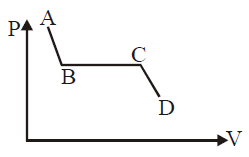
The portion AB of the indicator diagram representing the state of matter denotes :

1. The liquid state of matter
2. Gaseous state of matter
3. Change from liquid to gaseous state
4. Change from gaseous state to liquid state
View Answer

If the portion AB is slant, it indicates that both pressure (P) and volume (V) are changing. In thermodynamic terms, this suggests that AB could represent a compression or expansion, process where both pressure decreases and volume decreases.

Given that you mentioned that the correct answer is "the liquid state of matter," it is likely that AB represents the compression of a liquid.

In many thermodynamic diagrams, when a liquid is compressed or expands slightly, both its pressure and volume can change, though not as dramatically as in gases. This phase corresponds to the liquid region of a substance's phase diagram, where both pressure and volume are decreasing, which is why AB represents the liquid state.

To summarize:
- AB is slant: Both pressure and volume are decreasing.
- Liquid state: Liquids are not perfectly incompressible; hence, both pressure and volume can change, but the changes in volume are relatively small compared to gases.

This slant line indicates the behaviour of a liquid as it is compressed, leading to the conclusion that AB represents the liquid state of matter.