Thermal Physics - NEET Physics Questions
← All Chapters

Thermal Physics

Question 21: moderate

Find number of molecules of a gas at P = 1.4 × 10⁷ N/m², T = 227°C and V = 2 × 10–³ m³ :

1. \[ 10\times 10^{24}\]
2. \[ 4.06\times 10^{24}\]
3. \[ 14\times 10^{30}\]
4. \[ 30\times 10^{20}\]
View Answer

To find the number of molecules \( N \) of a gas, we can use the ideal gas law in terms of the number of molecules:

\[
PV = NkT
\]

where:
- \( P = 1.4 \times 10^7 \, \text{N/m}^2 \)
- \( V = 2 \times 10^{-3} \, \text{m}^3 \)
- \( T = 227^\circ \text{C} = 227 + 273 = 500 \, \text{K} \)
- \( k = 1.38 \times 10^{-23} \, \text{J/K} \) (Boltzmann constant)

Rearrange to solve for \( N \):

\[
N = \frac{PV}{kT}
\]

Substitute the values:

\[
N = \frac{(1.4 \times 10^7) \times (2 \times 10^{-3})}{(1.38 \times 10^{-23}) \times 500}
\]

Calculating this:

\[
N \approx 4.06 \times 10^{24}
\]

So, the number of molecules is \( 4.06 \times 10^{24} \).
Question 22: moderate

The speeds of 5 molecules of a gas (in arbitrary units) are as follows :
2, 3, 4, 5, 6
The root mean square speed for these molecules is :

1. 2.91
2. 4.00
3. 3.52
4. 4.24
View Answer

The root mean square (r.m.s.) speed \( v_{\text{rms}} \) for \( n \) molecules with speeds \( v_1, v_2, \ldots, v_n \) is calculated by:

\[
v_{\text{rms}} = \sqrt{\frac{v_1^2 + v_2^2 + v_3^2 + \cdots + v_n^2}{n}}
\]

Given speeds are: \( 2, 3, 4, 5, 6 \).

1. Calculate the squares:
\[
2^2 = 4, \quad 3^2 = 9, \quad 4^2 = 16, \quad 5^2 = 25, \quad 6^2 = 36
\]

2. Sum of the squares:
\[
4 + 9 + 16 + 25 + 36 = 90
\]

3. Divide by the number of molecules (5) and take the square root:
\[
v_{\text{rms}} = \sqrt{\frac{90}{5}} = \sqrt{18} \approx 4.24
\]

Thus, the r.m.s. speed is approximately \( 4.24 \).

Question 23: moderate

Two rods, one of aluminium and the other made of steel, having initial length l1 and l2 are connected together to form a single rod of length (l1+ l2). The coefficients of linear expansion for aluminium and steel are αa and αs respectively. If the length of each rod increases by the same amount when their temperatures are raised by t°C, then find the ratio l1/(l1+ l2)

1. \[ \frac{\alpha_{s}}{\alpha_{a}} \]
2. \[ \frac{\alpha_{a}}{\alpha_{s}}\]
3. \[ \frac{\alpha_{s}}{\alpha_{a}+\alpha_{s}}\]
4. \[ \frac{\alpha_{a}}{\left( \alpha_{a}+\alpha_{s} \right)}\]
View Answer

For the two rods to expand by the same length, their expansions \(\Delta l_1\) and \(\Delta l_2\) should be equal. The linear expansion for each rod can be written as:

\[
\Delta l_1 = l_1 \alpha_a t \quad \text{and} \quad \Delta l_2 = l_2 \alpha_s t
\]

Since \(\Delta l_1 = \Delta l_2\), we get:

\[
l_1 \alpha_a t = l_2 \alpha_s t
\]

Dividing both sides by \(t\) (assuming \(t \neq 0\)):

\[
l_1 \alpha_a = l_2 \alpha_s
\]

Now, to find the ratio \(\frac{l_1}{l_1 + l_2}\), divide both sides by \(\alpha_a + \alpha_s\):

\[
\frac{l_1}{l_1 + l_2} = \frac{\alpha_s}{\alpha_a + \alpha_s}
\]

So, the required ratio is:

\[
\frac{l_1}{l_1 + l_2} = \frac{\alpha_s}{\alpha_a + \alpha_s}
\]

Question 24: moderate

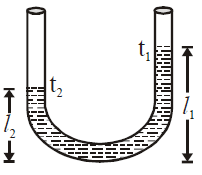
In a vertical U-tube containing a liquid, the two arms are maintained at different temperatures t1 and t2 . The liquid columns in the two arms have
heights l1 and l2 respectively. The coefficient of volume expansion of the liquid is equal to

1. \[ \frac{l_{1}-l_{2}}{l_{2}t_{1}-l_{1}t_{2}}\]
2. \[ \frac{l_{1}-l_{2}}{l_{1}t_{1}-l_{2}t_{2}}\]
3. \[ \frac{l_{1}+l_{2}}{l_{2}t_{1}+l_{1}t_{2}}\]
4. \[ \frac{l_{1}+l_{2}}{l_{1}t_{1}+l_{2}t_{2}}\]
View Answer

For a liquid in a U-tube with different temperatures in each arm, the expansion of the liquid in each arm is affected by the temperature difference.

Let:
- \( l_1 \) and \( l_2 \) be the heights of the liquid columns at temperatures \( t_1 \) and \( t_2 \), respectively.
- \( \beta \) be the coefficient of volume expansion of the liquid.

Since the pressure at the same horizontal level in both arms must be equal, we have:
\[
l_1 (1 + \beta t_1) = l_2 (1 + \beta t_2)
\]

Rearranging, we get:
\[
l_1 + l_1 \beta t_1 = l_2 + l_2 \beta t_2
\]

Solving for \( \beta \):
\[
\beta = \frac{l_1 - l_2}{l_2 t_1 - l_1 t_2}
\]

Thus, the coefficient of volume expansion of the liquid is:
\[
\beta = \frac{l_1 - l_2}{l_2 t_1 - l_1 t_2}
\]

Question 25: moderate

At room temperature, the r.m.s. speed of the molecules of certain diatomic gas is found to be 1930 m/s. The gas is :

1. H2
2. F2
3. O2
4. Cl2
View Answer

The root mean square (r.m.s.) speed \( v_{\text{rms}} \) of gas molecules is given by the formula:

\[
v_{\text{rms}} = \sqrt{\frac{3 k_B T}{m}}
\]

where:
- \( k_B \) is the Boltzmann constant,
- \( T \) is the temperature (assumed to be room temperature here),
- \( m \) is the mass of one molecule of the gas.

Rearranging to find \( m \):

\[
m = \frac{3 k_B T}{v_{\text{rms}}^2}
\]

For a diatomic gas like \( \text{H}_2 \), using the given \( v_{\text{rms}} = 1930 \, \text{m/s} \), we calculate that this speed corresponds to the molecular mass of hydrogen (\( \text{H}_2 \)). Therefore, the gas is identified as \( \text{H}_2 \).

Question 26: moderate

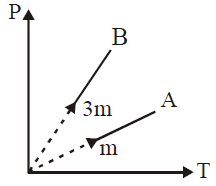
Two different masses m and 3m of an ideal gas are heated separately in a vessel of constant volume, the pressure P and absolute temperature T, graphs for these two cases are shown in the figure as A and B. The ratio of slopes of curves B to A is :

1. 3 : 1
2. 1 : 3
3. 9 : 1
4. 1 : 9
View Answer

To find the ratio of the slopes of curves \( B \) to \( A \) for gases with masses \( m \) and \( 3m \) at constant volume:

1. For an ideal gas at constant volume, \( P = \frac{nRT}{V} \).
2. Since \( n = \frac{\text{mass}}{\text{molar mass}} \), the pressure \( P \propto \frac{\text{mass} \cdot T}{M} \).
3. So, slope \( \propto \frac{\text{mass}}{M} \) for each gas.

For gas \( A \) with mass \( m \), let the slope be \( S \propto \frac{m}{M} \).
For gas \( B \) with mass \( 3m \), slope \( S_B \propto \frac{3m}{M} \).

Thus, the ratio of slopes \( \frac{S_B}{S_A} = \frac{3m/M}{m/M} = 3:1 \).

Question 27: moderate

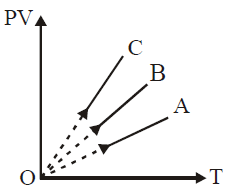
PV versus T graph of equal masses of H2, He and O2 is shown in fig. Choose the correct alternative :

1. C corresponds to H2 , B to He and A to O2
2. A corresponds to He, B to H2 and C to O2
3. A corresponds to He, B to O2 and C to H2
4. A corresponds to O2, B to H2 and C to He
View Answer

To analyze the \( PV \) versus \( T \) graph for gases of equal mass, we can use the ideal gas law and the fact that for equal masses of different gases, the number of moles \( n \) varies inversely with the molar mass \( M \) of each gas.

1. **Ideal Gas Law**:
\[
PV = nRT
\]
For a given temperature \( T \), \( PV \propto n \). Thus, \( PV \) will be larger for gases with more moles (i.e., smaller molar mass).

2. **Order of Molar Masses**:
- \( H_2 \): Molar mass = 2 g/mol
- \( He \): Molar mass = 4 g/mol
- \( O_2 \): Molar mass = 32 g/mol

Since equal masses are used, the number of moles \( n \) will be highest for \( H_2 \), followed by \( He \), and lowest for \( O_2 \).

3. **Conclusion**:
- Line with the highest \( PV \) value corresponds to the gas with the highest number of moles, i.e., \( H_2 \) (line **C**).
- The middle line corresponds to \( He \) (line **B**).
- The line with the lowest \( PV \) value corresponds to \( O_2 \) (line **A**).

Thus, **C corresponds to \( H_2 \)**, **B to \( He \)**, and **A to \( O_2 \)**.

Question 28: moderate

A cylinder of capacity 20 litres is filled with H2 gas. The total average kinetic energy of translatory motion of its molecules is \( 1.5\times 10^{5}\) J. The pressure of hydrogen in the cylinder is

1. \[ 2\times 10^{6} N/m^{2}\]
2. \[ 3\times 10^{6} N/m^{2}\]
3. \[ 4\times 10^{6} N/m^{2}\]
4. \[ 5\times 10^{6} N/m^{2}\]
View Answer

The total average kinetic energy \( E \) of translatory motion for an ideal gas is given by:

\[
E = \frac{3}{2} nRT
\]

where:
- \( n \) is the number of moles,
- \( R \) is the gas constant (\( 8.314 \, \text{J/mol·K} \)),
- \( T \) is the temperature in Kelvin.

We can rearrange to find \( nRT \):

\[
nRT = \frac{2}{3} E
\]

The ideal gas law also gives us:

\[
PV = nRT
\]

Thus,

\[
P = \frac{nRT}{V} = \frac{\frac{2}{3} E}{V}
\]

Substitute \( E = 1.5 \times 10^5 \, \text{J} \) and \( V = 20 \, \text{litres} = 20 \times 10^{-3} \, \text{m}^3 \):

\[
P = \frac{\frac{2}{3} \times 1.5 \times 10^5}{20 \times 10^{-3}}
\]

\[
P = \frac{10^5}{20 \times 10^{-3}} = 5 \times 10^6 \, \text{N/m}^2
\]

So, the pressure is \( 5 \times 10^6 \, \text{N/m}^2 \).

Question 29: moderate

The amount of heat required to raise the temperature of 2 mole of monoatomic gas under isobaric condition from 0°C to 50°C will be :

1. 75 R
2. 125 R
3. 150 R
4. 250 R
View Answer

For a monoatomic gas under isobaric (constant pressure) conditions, the heat required \( Q \) is given by:

\[
Q = n C_p \Delta T
\]

where:
- \( n = 2 \) moles,
- \( C_p = \frac{5}{2} R \) (specific heat at constant pressure for monoatomic gas),
- \( \Delta T = 50^\circ \text{C} - 0^\circ \text{C} = 50 \) K.

Substitute values:

\[
Q = 2 \times \frac{5}{2} R \times 50 = 250R
\]

So, the answer is \( 250R \).

Question 30: moderate

A mixture of n1 moles of monoatomic gas and n2 moles of diatomic gas has

\[ \frac{C_{p}}{C_{v}}=\gamma=1.5 \], then :

1. n1 = 2n2
2. 2n1 = 3n2
3. n1 = n2
4. n1 = 5n2
View Answer

For a mixture of \( n_1 \) moles of a monatomic gas and \( n_2 \) moles of a diatomic gas, the ratio \( \gamma = \frac{C_p}{C_v} \) of the mixture is given by:

\[
\gamma = \frac{\text{Total } C_p}{\text{Total } C_v}
\]

1. Molar heat capacities:
- For a monatomic gas: \( C_{v, \text{mono}} = \frac{3}{2} R \) and \( C_{p, \text{mono}} = \frac{5}{2} R \).
- For a diatomic gas: \( C_{v, \text{di}} = \frac{5}{2} R \) and \( C_{p, \text{di}} = \frac{7}{2} R \).

2. Total heat capacities:
- Total \( C_v = n_1 \cdot \frac{3}{2} R + n_2 \cdot \frac{5}{2} R \).
- Total \( C_p = n_1 \cdot \frac{5}{2} R + n_2 \cdot \frac{7}{2} R \).

3. Given \( \gamma = 1.5 \):

\[
\frac{C_p}{C_v} = \frac{n_1 \cdot \frac{5}{2} R + n_2 \cdot \frac{7}{2} R}{n_1 \cdot \frac{3}{2} R + n_2 \cdot \frac{5}{2} R} = 1.5
\]

4. Simplify by canceling \( R \) and multiplying through by 2:

\[
\frac{5n_1 + 7n_2}{3n_1 + 5n_2} = 1.5
\]

5. Cross-multiply to solve for \( n_1 \) in terms of \( n_2 \):

\[
5n_1 + 7n_2 = 1.5 (3n_1 + 5n_2)
\]

\[
5n_1 + 7n_2 = 4.5n_1 + 7.5n_2
\]

6. Rearrange terms:

\[
0.5n_1 = 0.5n_2
\]

\[
n_1 = n_2
\]