Thermal Physics - NEET Physics Questions
← All Chapters

Thermal Physics

Question 1: easy

In a process the density of a gas remains constant. If the temperature is doubled, then the change in the pressure will be :

1. 100% increase
2. 200% increase
3. 50% decrease
4. 25% decrease
View Answer

Given that density \(\rho\) is constant, we use the ideal gas law:

\[
\frac{P}{T} = \text{constant (since } \rho \text{ is constant)}
\]

If the temperature \(T\) is doubled, then:

\[
\frac{P_2}{T_2} = \frac{P_1}{T_1} \Rightarrow \frac{P_2}{2T_1} = \frac{P_1}{T_1}
\]

Thus, \(P_2 = 2P_1\), meaning the pressure also doubles, resulting in a 100% increase.

Question 2: easy

Internal energy of n1 moles of hydrogen of temperature T is equal to the internal energy of n2 moles of helium at temperature 2T. The ratio n1/n2 is :

1. 3/5
2. 2/3
3. 6/5
4. 3/7
View Answer

The internal energy \( U \) of an ideal gas is given by:

\[
U = n \cdot C_V \cdot T
\]

For a diatomic gas like hydrogen (\( \text{H}_2 \)), \( C_V = \frac{5}{2} R \), and for a monoatomic gas like helium (\( \text{He} \)), \( C_V = \frac{3}{2} R \).

Given that the internal energy of \( n_1 \) moles of hydrogen at temperature \( T \) is equal to the internal energy of \( n_2 \) moles of helium at temperature \( 2T \), we have:

\[
n_1 \cdot \frac{5}{2} R \cdot T = n_2 \cdot \frac{3}{2} R \cdot (2T)
\]

Simplifying:

\[
\frac{5}{2} n_1 = 3 n_2
\]

Rearrange to find the ratio \( \frac{n_1}{n_2} \):

\[
\frac{n_1}{n_2} = \frac{3}{5} \cdot \frac{2}{1} = \frac{6}{5}
\]

Answer: The ratio \( \frac{n_1}{n_2} \) is \( \frac{6}{5} \).

Question 3: easy

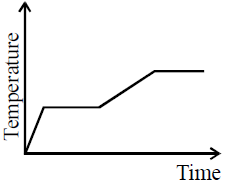
Heat is supplied to a certain homogeneous sample of matter at a uniform rate. Its temperature is plotted against time as shown, which of the following conclusion can be drawn ?

1. It's specific heat capacity is greater in the solid state than in liquid state
2. It's specific heat capacity is greater in the liquid state than in the solid state.
3. It specific heat capacity in liquid state is equal to that of in solid state.
4. data insufficient.
View Answer

Given the graph and your observation, we can analyze whether the specific heat capacity is greater in the liquid state than in the solid state.

In a temperature vs. time graph, under uniform heat supply, the slope of the graph during the temperature rise is inversely proportional to the specific heat capacity (\(C\)). Mathematically, for a given heat input rate:

\[
\text{Rate of temperature increase} \propto \frac{1}{C}
\]

- Solid phase: In the first sloped section (just before the first horizontal plateau), the slope is steeper, indicating a faster temperature increase. This implies that the specific heat capacity of the substance in the solid state is lower.

- Liquid phase: After the first plateau (phase change), the slope in the second sloped section (where the substance is in the liquid state) is less steep, indicating a slower temperature increase. This suggests that more heat is required to raise the temperature in this phase, which means the specific heat capacity is higher in the liquid state.

.

Question 4: easy

The temperature on Celsius scale is 25ºC. What is the corresponding temperature on the Fahrenheit scale ?

1. 40ºF
2. 77ºF
3. 50ºF
4. 45ºF
View Answer

To convert from Celsius to Fahrenheit, we use the formula:

\[
F = \frac{9}{5}C + 32
\]

Given \( C = 25^\circ \):

\[
F = \frac{9}{5} \times 25 + 32
\]
\[
F = 45 + 32 = 77
\]

So, the corresponding temperature is 77ºF.

Question 5: easy

Two temperature scales A and B are related by: \[ \frac{A-42}{100}=\frac{B-7}{220}\]

At which temperature two scales have the same reading ?

1. – 42º
2. – 72º
3. +12º
4. –40º
View Answer

Given the relation between temperature scales \( A \) and \( B \):

\[
\frac{A - 42}{100} = \frac{B - 7}{220}
\]

To find the temperature at which both scales show the same reading, set \( A = B = x \):

\[
\frac{x - 42}{100} = \frac{x - 7}{220}
\]

Cross-multiplying:

\[
220(x - 42) = 100(x - 7)
\]

Expanding and solving for \( x \):

\[
220x - 9240 = 100x - 700
\]
\[
120x = 8540
\]
\[
x = \frac{8540}{120} = 12
\]

Thus, the temperature at which both scales read the same is 12.

Question 6: easy

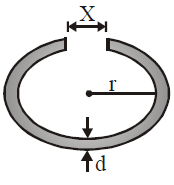
A cylindrical metal rod of length L0 is shaped into a ring with a small gap as shown. On heating the system.

1. x decreases, r and d increase
2. x and r increase, d decreases
3. x, r and d all increase
4. Data insufficient to arrive at a conclusion
View Answer

On heating an object its photographic expansion takes place. so, distance between any two point increases.

Question 7: easy

The absolute zero temperature in Fahrenheit scale is :

1. –273ºF
2. –32ºF
3. –460ºF
4. –132ºF
View Answer

To find absolute zero in Fahrenheit, we use the relationship between Celsius and Fahrenheit:

\[
F = \frac{9}{5}C + 32
\]

Absolute zero in Celsius is \(-273.15^\circ C\). Substitute this into the formula:

\[
F = \frac{9}{5}(-273.15) + 32
\]
\[
F = -491.67 + 32 = -459.67
\]

Rounding to the nearest whole number, we get \(-460^\circ F\).

Question 8: easy

A bar of iron is 10 cm at 20ºC. At 19ºC it will be (α of iron = 11 × 10–6/ºC)

1. \[ 11\times 10^{-6} cm longer\]
2. \[ 11\times 10^{-6} cm shorter \]
3. \[ 11\times 10^{-5} cm shorter\]
4. \[ 11\times 10^{-5} cm longer\]
View Answer

The change in length \( \Delta L \) due to temperature change is given by:

\[
\Delta L = L_0 \alpha \Delta T
\]

where:
- \( L_0 = 10 \, \text{cm} \)
- \( \alpha = 11 \times 10^{-6} / ^\circ \text{C} \)
- \( \Delta T = 20^\circ \text{C} - 19^\circ \text{C} = 1^\circ \text{C} \)

Substitute the values:

\[
\Delta L = 10 \times 11 \times 10^{-6} \times 1 = 11 \times 10^{-5} \, \text{cm}
\]

Thus, the bar will be \( 11 \times 10^{-5} \, \text{cm} \) shorter at 19ºC.

Question 9: easy

5g ice at 0°C is mixed with 5g steam at 100°C. What is final temperature ?

1. 0°C
2. 50°C
3. 100°C
4. 75°C
View Answer

To find the final temperature when 5 g of ice at 0°C is mixed with 5 g of steam at 100°C, we need to consider the energy exchange between the ice and the steam.

We proceed step by step:

1. Heat required to melt the ice into water at 0°C:

\[
Q_1 = m_{\text{ice}} \times L_f = 5 \, \text{g} \times 80 \, \text{cal/g} = 400 \, \text{cal}
\]
This is the heat required to convert 5 g of ice at 0°C into 5 g of water at 0°C.

2. Heat released by steam as it condenses into water at 100°C:

\[
Q_2 = m_{\text{steam}} \times L_v = 5 \, \text{g} \times 540 \, \text{cal/g} = 2700 \, \text{cal}
\]
This is the heat released when 5 g of steam condenses into water at 100°C.

3. Heat required to raise the temperature of 5 g of water from 0°C to 100°C:

\[
Q_3 = m_{\text{water}} \times c \times \Delta T = 5 \, \text{g} \times 1 \, \text{cal/g°C} \times (100 - 0) = 5 \times 100 = 500 \, \text{cal}
\]

 Total heat available from the steam:

- The steam releases 2700 cal by condensing.
- The ice requires 400 cal to melt, and then 500 cal to be heated from 0°C to 100°C, totaling 900 cal.

Since the heat available from the steam (2700 cal) is more than the 900 cal required to melt the ice and raise its temperature to 100°C, the final temperature will be 100°C.

In conclusion, all the ice melts and the final temperature of the mixture is 100°C.
Question 10: easy

Find the quantity of heat required to convert 40g, ice at – 20°C into water at 20°C ?

1. 4400 cal
2. 2200 cal
3. 18480 cal
4. 1100 cal
View Answer

To calculate the heat required to convert 40 g of ice at –20°C into water at 20°C, we need to consider three steps:

1. Heating ice from -20°C to 0°C:
\[
Q_1 = m \times c_{\text{ice}} \times \Delta T = 40 \, \text{g} \times 0.5 \, \text{cal/g°C} \times (0 - (-20)) = 40 \times 0.5 \times 20 = 400 \, \text{cal}
\]

2. Melting ice at 0°C (latent heat of fusion):
\[
Q_2 = m \times L_f = 40 \, \text{g} \times 80 \, \text{cal/g} = 3200 \, \text{cal}
\]

3. Heating water from 0°C to 20°C:
\[
Q_3 = m \times c_{\text{water}} \times \Delta T = 40 \, \text{g} \times 1 \, \text{cal/g°C} \times (20 - 0) = 40 \times 1 \times 20 = 800 \, \text{cal}
\]

Total heat required:

\[
Q_{\text{total}} = Q_1 + Q_2 + Q_3 = 400 + 3200 + 800 = 4400 \, \text{cal}
\]

Thus, the total heat required is 4400 calories.