Thermal Physics - NEET Physics Questions
← All Chapters

Thermal Physics

Question 51: easy

Surface of the lake is at 2°C. The temperature of the bottom of the lake is

1. 2°C
2. 3°C
3. 4°C
4. 1°C
View Answer

In lakes, temperature stratification occurs, where different layers of water have distinct temperatures.

- Surface Temperature (2°C): The surface of the lake cools down and can freeze when temperatures drop, resulting in water that is less dense.

- Bottom Temperature (4°C): Water reaches its maximum density at 4°C. Below this temperature, water becomes less dense, causing it to rise. Therefore, in many lakes, the bottom water remains at around 4°C, even when the surface is colder.

This stratification helps maintain aquatic life during cold seasons, as the bottom layer remains relatively stable and can support organisms.
Question 52: easy

A slab consists of two parallel layers of two different materials of same thickness having thermal conductivities K1 and K2. The equivalent conductivity of the combination is

1. \[ K_{1}+K_{2}\]
2. \[ \frac{K_{1}+K_{2}}{2}\]
3. \[ \frac{2K_{1}K_{2}}{K_{1}+K_{2}}\]
4. \[ \frac{K_{1}+K_{2}}{2K_{1}K_{2}}\]
View Answer

Given:

- Layer 1: Thermal conductivity \(K_1\)
- Layer 2: Thermal conductivity \(K_2\)
- Thickness of each layer: \(d\)

Formula for Equivalent Thermal Conductivity

The equivalent thermal conductivity for two parallel layers of the same thickness can be given by:

\[
K_{eq} = \frac{K_1 + K_2}{2}
\]

Derivation:

1. Resistance of Each Layer:
The thermal resistance for each layer can be expressed as:
\[
R_1 = \frac{d}{K_1 A}, \quad R_2 = \frac{d}{K_2 A}
\]
where \(A\) is the cross-sectional area.

2. Total Resistance in Parallel:
The total resistance for two resistors in parallel is:
\[
\frac{1}{R_{eq}} = \frac{1}{R_1} + \frac{1}{R_2}
\]
Substituting the resistances, we get:
\[
\frac{1}{R_{eq}} = \frac{K_1 A}{d} + \frac{K_2 A}{d}
\]
Simplifying:
\[
\frac{1}{R_{eq}} = \frac{A}{d} \left(K_1 + K_2\right)
\]

3. Total Conductivity:
Now, the equivalent conductivity can be expressed as:
\[
K_{eq} = \frac{d}{A} \cdot \frac{1}{R_{eq}} = \frac{d}{A} \cdot \frac{d}{A (K_1 + K_2)} = \frac{K_1 + K_2}{2}
\]

Conclusion:
Thus, for two parallel layers of materials with equal thickness, the correct equivalent thermal conductivity is:

\[
K_{eq} = \frac{K_1 + K_2}{2}
\]

Question 53: easy

The layers of atmosphere are heated through

1. Convection
2. Conduction
3. Radiation
4. Both (1) & (3)
View Answer

Convection is the process by which heat is transferred through the movement of fluids, including gases like air. In the atmosphere, convection occurs when warm air rises and cool air sinks.

Here's a short explanation of how this works:

1. Heating the Surface: The sun heats the Earth's surface, which in turn warms the air above it.
2. Rising Warm Air: As the air warms, it becomes less dense and rises.
3. Cooling and Sinking: Once the warm air rises, it cools down at higher altitudes, becomes denser, and eventually sinks back down.
4. Cycle Continuation: This cycle of rising warm air and sinking cool air creates convection currents, which distribute heat throughout the atmosphere, influencing weather patterns and temperature distribution.

Overall, convection plays a crucial role in regulating the Earth's climate and weather systems.

Question 54: easy

The temperature gradient in a rod of 0.5 m long is 80ºC/m. If the temperature of hotter end of the rod is 30°C, then the temperature of the colder end is

1. 40°C
2. -10°C
3. 10°C
4. 0°C
View Answer

The temperature gradient is the rate at which temperature changes with respect to distance. It's given as \( 80^\circ \text{C/m} \), and the length of the rod is \( 0.5 \, \text{m} \).

To find the temperature difference across the rod, we use the formula:

\[
\Delta T = \text{Temperature gradient} \times \text{Length}
\]

Substitute the values:

\[
\Delta T = 80^\circ \text{C/m} \times 0.5 \, \text{m} = 40^\circ \text{C}
\]

Now, the temperature at the hotter end is given as \( 30^\circ \text{C} \), so the temperature at the colder end is:

\[
T_{\text{colder end}} = T_{\text{hotter end}} - \Delta T
\]

Substituting the values:

\[
T_{\text{colder end}} = 30^\circ \text{C} - 40^\circ \text{C} = -10^\circ \text{C}
\]

Therefore, the temperature at the colder end of the rod is \(-10^\circ \text{C}\).

Question 55: easy

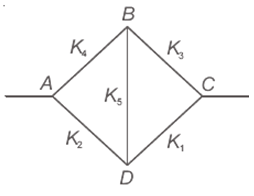
Five rods of same dimensions are arranged as shown in the figure. They have thermal conductivities K1, K2, K3, K4 and K5. When points A and C are maintained at different temperature, no heat flows through the central rod if

1. K1 = K4 and K2 = K3
2. K1K4 = K2K3
3. K1K2 = K3K4
4. \frac{K_{1}}{K_{4}}=\frac{K_{2}}{K_{3}}
View Answer

No heat flows through the central rod \(K_5\) if the system is balanced like a Wheatstone bridge. The condition for this is:

\[
\frac{K_1}{K_2} = \frac{K_3}{K_4}
\]

This ensures that the temperature difference between points B and D is zero, preventing any heat flow through \(K_5\).

Question 56: easy

The volume of a metal sphere increases by 0.24% when its temperature is raised by 40ºC. The coefficient of linear expansion of the metal is :

1. \[ 2\times 10^{-5} per ^{oC}\]
2. \[ 6\times 10^{-5} per ^{oC}\]
3. \[ 2.1\times 10^{-5} per ^{oC}\]
4. \[ 1.2\times 10^{-5} per ^{oC}\]
View Answer

The relationship between the coefficient of volume expansion (\( \beta \)) and the coefficient of linear expansion (\( \alpha \)) for a solid is:

\[
\beta = 3\alpha
\]

Given:
- Volume increase = 0.24%
- Temperature increase \( \Delta T = 40^\circ \text{C} \)

The coefficient of volume expansion \( \beta \) is given by:

\[
\beta = \frac{\text{Percentage increase in volume}}{\Delta T} = \frac{0.24}{40} = 0.006\% \, \text{per } ^\circ\text{C} = 6 \times 10^{-5} \, \text{per } ^\circ\text{C}
\]

Now, using \( \beta = 3\alpha \):

\[
\alpha = \frac{\beta}{3} = \frac{6 \times 10^{-5}}{3} = 2 \times 10^{-5} \, \text{per } ^\circ\text{C}
\]

Thus, the coefficient of linear expansion of the metal is \( 2 \times 10^{-5} \, \text{per } ^\circ\text{C} \).