Thermometer - NEET Physics Questions
Question 1: easy

The temperature on Celsius scale is 25ºC. What is the corresponding temperature on the Fahrenheit scale ?

1. 40ºF
2. 77ºF
3. 50ºF
4. 45ºF
View Answer

To convert from Celsius to Fahrenheit, we use the formula:

\[
F = \frac{9}{5}C + 32
\]

Given \( C = 25^\circ \):

\[
F = \frac{9}{5} \times 25 + 32
\]
\[
F = 45 + 32 = 77
\]

So, the corresponding temperature is 77ºF.

Question 2: moderate

If a thermometer reads freezing point of water as 20ºC and boiling point as 150ºC, how much thermometer read when the actual temperature is 60ºC ?

1. 98ºC
2. 110ºC
3. 40ºC
4. 60ºC
View Answer

To solve this, we can set up a linear relationship between the actual Celsius scale (0ºC to 100ºC) and the thermometer's faulty scale (20ºC to 150ºC).

1. Set up the linear equation:

The faulty thermometer's scale can be represented as:
\[
T_{\text{faulty}} = a \cdot T_{\text{actual}} + b
\]

Using the freezing point:
\[
20 = a \cdot 0 + b \Rightarrow b = 20
\]

Using the boiling point:
\[
150 = a \cdot 100 + 20
\]
\[
130 = 100a \Rightarrow a = 1.3
\]

So, the relation is:
\[
T_{\text{faulty}} = 1.3 \cdot T_{\text{actual}} + 20
\]

2. Find the faulty reading at 60ºC actual temperature:
\[
T_{\text{faulty}} = 1.3 \cdot 60 + 20 = 78 + 20 = 98
\]

Therefore, the thermometer will read 98ºC at an actual temperature of 60ºC.

Question 3: easy

Two temperature scales A and B are related by: \[ \frac{A-42}{100}=\frac{B-7}{220}\]

At which temperature two scales have the same reading ?

1. – 42º
2. – 72º
3. +12º
4. –40º
View Answer

Given the relation between temperature scales \( A \) and \( B \):

\[
\frac{A - 42}{100} = \frac{B - 7}{220}
\]

To find the temperature at which both scales show the same reading, set \( A = B = x \):

\[
\frac{x - 42}{100} = \frac{x - 7}{220}
\]

Cross-multiplying:

\[
220(x - 42) = 100(x - 7)
\]

Expanding and solving for \( x \):

\[
220x - 9240 = 100x - 700
\]
\[
120x = 8540
\]
\[
x = \frac{8540}{120} = 12
\]

Thus, the temperature at which both scales read the same is 12.

Question 4: difficult

A rod of length 20 cm is made of metal. It expands by 0.075 cm when its temperature is raised from 0ºC to 100ºC. Another rod of a different metal B having the same length expands by 0.045 cm for the same change in temperature. A third rod of the same length is composed of two parts, one of metal A and the other of metal B. This rod expands by 0.060 cm for the same change in temperature. The portion made of metal A has the length :

1. 20 cm
2. 10 cm
3. 15 cm
4. 18 cm
View Answer

Let the length of the part made of metal A be \( L_A \) and that of metal B be \( L_B \), with \( L_A + L_B = 20 \) cm.

Given:
- Expansion of metal A's rod = 0.075 cm, so expansion per cm for metal A = \( \frac{0.075}{20} = 0.00375 \) cm.
- Expansion of metal B's rod = 0.045 cm, so expansion per cm for metal B = \( \frac{0.045}{20} = 0.00225 \) cm.

The combined expansion of the third rod is 0.060 cm:

\[
L_A \cdot 0.00375 + L_B \cdot 0.00225 = 0.060
\]

Since \( L_B = 20 - L_A \), substitute:

\[
L_A \cdot 0.00375 + (20 - L_A) \cdot 0.00225 = 0.060
\]

Expanding and solving:

\[
0.00375L_A + 0.045 - 0.00225L_A = 0.060
\]
\[
0.0015L_A = 0.015
\]
\[
L_A = \frac{0.015}{0.0015} = 10 \text{ cm}
\]

So, the portion made of metal A has length 10 cm.
Question 5: easy

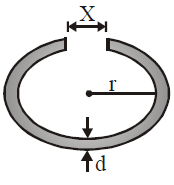
A cylindrical metal rod of length L0 is shaped into a ring with a small gap as shown. On heating the system.

1. x decreases, r and d increase
2. x and r increase, d decreases
3. x, r and d all increase
4. Data insufficient to arrive at a conclusion
View Answer

On heating an object its photographic expansion takes place. so, distance between any two point increases.

Question 6: easy

The absolute zero temperature in Fahrenheit scale is :

1. –273ºF
2. –32ºF
3. –460ºF
4. –132ºF
View Answer

To find absolute zero in Fahrenheit, we use the relationship between Celsius and Fahrenheit:

\[
F = \frac{9}{5}C + 32
\]

Absolute zero in Celsius is \(-273.15^\circ C\). Substitute this into the formula:

\[
F = \frac{9}{5}(-273.15) + 32
\]
\[
F = -491.67 + 32 = -459.67
\]

Rounding to the nearest whole number, we get \(-460^\circ F\).

Question 7: difficult

In some old science notes we come across a temperature scale called Z scale (gargi scale) on which boiling point of water is 65ºZ and freezing point is –14ºZ. It is found that a change of 1º on Z scale corresponds to change of xº on Fahrenheit scale. Then x is :

1. \[ \frac{79}{180}\]
2. \[ \frac{180}{79}\]
3. \[ \frac{79\times 32}{180}\]
4. \[ \frac{180}{79}\times \frac{1}{32}\]
View Answer

To find \( x \), we need to compare the Z scale with the Fahrenheit scale.

1. Range on the Z scale:
\[
65^\circ Z - (-14^\circ Z) = 65 + 14 = 79^\circ Z
\]

2. Range on the Fahrenheit scale:
The boiling and freezing points of water are 212ºF and 32ºF, respectively, so:
\[
212^\circ F - 32^\circ F = 180^\circ F
\]

3. Relationship between scales:
A change of \( 79^\circ Z \) corresponds to \( 180^\circ F \). Therefore:
\[
x = \frac{180}{79}
\]

So, \( x = \frac{180}{79} \).

Question 8: easy

A bar of iron is 10 cm at 20ºC. At 19ºC it will be (α of iron = 11 × 10–6/ºC)

1. \[ 11\times 10^{-6} cm longer\]
2. \[ 11\times 10^{-6} cm shorter \]
3. \[ 11\times 10^{-5} cm shorter\]
4. \[ 11\times 10^{-5} cm longer\]
View Answer

The change in length \( \Delta L \) due to temperature change is given by:

\[
\Delta L = L_0 \alpha \Delta T
\]

where:
- \( L_0 = 10 \, \text{cm} \)
- \( \alpha = 11 \times 10^{-6} / ^\circ \text{C} \)
- \( \Delta T = 20^\circ \text{C} - 19^\circ \text{C} = 1^\circ \text{C} \)

Substitute the values:

\[
\Delta L = 10 \times 11 \times 10^{-6} \times 1 = 11 \times 10^{-5} \, \text{cm}
\]

Thus, the bar will be \( 11 \times 10^{-5} \, \text{cm} \) shorter at 19ºC.