Thermal Physics - NEET Physics Questions
← All Chapters

Thermal Physics

Question 11: easy

Two gases A and B having the same temperature T, same pressure P and same volume V are mixed. If the mixture is at the same temperature T and occupies a volume V, the pressure of the mixture is :

1. 2P
2. P
3. P/2
4. 4P
View Answer

Since both gases \( A \) and \( B \) have the same temperature \( T \), pressure \( P \), and volume \( V \), each gas has the same number of moles, \( n \), by the ideal gas law:

\[
PV = nRT \Rightarrow n = \frac{PV}{RT}
\]

When gases \( A \) and \( B \) are mixed, the total number of moles becomes \( 2n \). Since temperature \( T \) and volume \( V \) remain the same, the total pressure \( P_{\text{mixture}} \) will be:

\[
P_{\text{mixture}} V = (2n)RT
\]

\[
P_{\text{mixture}} = 2P
\]

Answer: The pressure of the mixture is \( 2P \).
Question 12: easy

In the gas equation PV = nRT, the value of universal gas constant would depend only on :

1. The nature of the gas
2. The temperature of the gas
3. Pressure of the gas
4. The units of measurement
View Answer

In the gas equation \( PV = nRT \), the universal gas constant \( R \) has a fixed value but its numerical value depends on the units of \( P \), \( V \), and \( T \).

Answer: The value of the universal gas constant depends only on the units of measurement.

Question 13: easy

The quantity (PV/kT) represents :

1. Mass of the gas
2. KE of the gas
3. Number of moles of the gas
4. Number of molecules in the gas
View Answer

The expression \(\frac{PV}{kT}\) can be analyzed using the ideal gas law:

\[
PV = NkT
\]

where:
- \( P \) is pressure,
- \( V \) is volume,
- \( N \) is the number of molecules,
- \( k \) is Boltzmann's constant, and
- \( T \) is temperature.

Rearranging, we get:

\[
\frac{PV}{kT} = N
\]

Answer: This quantity represents the "number of molecules in the gas".

Question 14: easy

When the temperature of a gas in a metal box is increased from 27°C to 87°C, the initial pressure of 2 atmosphere changes to :

1. 1.0 atmosphere
2. 1.6 atmosphere
3. 2.4 atmosphere
4. 3 atmosphere
View Answer

Given:

- Initial temperature, \( T_1 = 27^\circ \text{C} = 300 \, \text{K} \)
- Final temperature, \( T_2 = 87^\circ \text{C} = 360 \, \text{K} \)
- Initial pressure, \( P_1 = 2 \, \text{atm} \)

Using the pressure-temperature relationship for a gas at constant volume:

\[
\frac{P_2}{P_1} = \frac{T_2}{T_1}
\]

Solving for \( P_2 \):

\[
P_2 = P_1 \times \frac{T_2}{T_1} = 2 \times \frac{360}{300} = 2 \times 1.2 = 2.4 \, \text{atm}
\]

Answer: \( P_2 = 2.4 \, \text{atm} \)

Question 15: easy

A large flask contains air at 27°C. In order to expel half the mass of air from the flask, the flask should be heated to :

1. 127°C
2. 327°C
3. 227°C
4. 183°C
View Answer

Given:

- Initial temperature, \( T_1 = 27^\circ \text{C} = 300 \, \text{K} \)
- We want to expel half the mass of air, meaning the final mass, \( m_2 = \frac{m_1}{2} \).

Using the ideal gas law, \( PV = nRT \), and since pressure and volume are constant, \( \frac{m}{T} = \text{constant} \).

Thus,

\[
\frac{m_1}{T_1} = \frac{m_2}{T_2}
\]

Substitute \( m_2 = \frac{m_1}{2} \):

\[
\frac{m_1}{300} = \frac{\frac{m_1}{2}}{T_2}
\]

Solving for \( T_2 \):

\[
T_2 = 2 \times 300 = 600 \, \text{K}
\]

Converting back to Celsius:

\[
T_2 = 600 - 273 = 327^\circ \text{C}
\]

Answer: \( T_2 = 327^\circ \text{C} \)

Question 16: easy

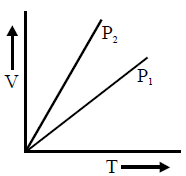
For V versus T curves at constant pressures P1 and P2 for an ideal gas shown in fig. :

1. P1 > P2
2. P1 < P2
3. P1 = P2
4. P1 ≥ P2
View Answer

To analyze the \( V \) versus \( T \) curves for an ideal gas at constant pressures \( P_1 \) and \( P_2 \):

According to Charles's Law:

\[
\frac{V}{T} = \frac{nR}{P}
\]

This implies:

1. At constant pressure, the volume \( V \) is directly proportional to the temperature \( T \), resulting in a straight line.

2. For a given temperature, the volume \( V \) will be greater at a lower pressure \( P \), because \( V \propto \frac{1}{P} \) for a fixed amount of gas.

In the graph:
- The line with a steeper slope corresponds to a lower pressure (since a lower \( P \) results in a larger \( V \) for the same \( T \)).

Since \( P_2 \) has a steeper slope than \( P_1 \), we conclude that:

\[
P_1 > P_2
\]

Therefore, the correct answer is \( P_1 > P_2 \).

Question 17: easy

The temperature at which the reading of a Fahrenheit thermometer will be double that of centigrade thermometer is :

1. 160°
2. 180°
3. 32°
4. 100°
View Answer
Question 18: easy

When a metal rod is heated it expands because :

1. the size of atoms increases.
2. the distance among its atoms increases.
3. atmospsheric air rushes into it.
4. the actual cause is still unknown.
View Answer

When a metal rod is heated, its atoms gain kinetic energy and vibrate more vigorously. As they vibrate, they tend to move slightly further apart because the increased energy weakens the attractive forces that hold them at a fixed distance. This increased atomic spacing results in the rod expanding in size.

Thus, the expansion of the metal rod occurs because the distance among its atoms increases with temperature. This phenomenon is the essence of thermal expansion.

Question 19: easy

Calculate amount of heat (in calorie) require to convert 5 gm ice 0°C to steam 100°C :

1. 3100
2. 3200
3. 3600
4. 4200
View Answer

To calculate the heat required to convert 5 g of ice at 0°C to steam at 100°C, we need to consider the following steps:

1. Heat to melt ice (latent heat of fusion):
\[
Q_1 = m \times L_f = 5 \, \text{g} \times 80 \, \text{cal/g} = 400 \, \text{cal}
\]

2. Heat to raise temperature of water from 0°C to 100°C:
\[
Q_2 = m \times c \times \Delta T = 5 \, \text{g} \times 1 \, \text{cal/g°C} \times (100 - 0) = 5 \times 100 = 500 \, \text{cal}
\]

3. Heat to convert water at 100°C to steam (latent heat of vaporization):
\[
Q_3 = m \times L_v = 5 \, \text{g} \times 540 \, \text{cal/g} = 2700 \, \text{cal}
\]

Total heat required:
\[
Q_{\text{total}} = Q_1 + Q_2 + Q_3 = 400 + 500 + 2700 = 3600 \, \text{cal}
\]

Thus, the total heat required is 3600 calories.

Question 20: easy

Two liquids A and B are at 32°C and 24°C respectively. When equal masses of both are mixed then temperature of mixture becomes 28°C. The ratio of specific heat is :

1. 3 : 2
2. 2 : 3
3. 1 : 1
4. 4 : 3
View Answer

To find the ratio of the specific heats of two liquids A and B when they are mixed, we can use the principle of conservation of energy, which states that the heat lost by the hotter liquid equals the heat gained by the colder liquid.

 Given:
- Temperature of liquid A, \( T_A = 32°C \)
- Temperature of liquid B, \( T_B = 24°C \)
- Final temperature of the mixture, \( T_f = 28°C \)

Let \( c_A \) and \( c_B \) be the specific heats of liquids A and B, respectively. Since equal masses of both liquids are mixed, we can denote the mass as \( m \).

 Heat Lost by A:
\[
Q_A = m \cdot c_A \cdot (T_A - T_f) = m \cdot c_A \cdot (32 - 28) = 4m c_A
\]

 Heat Gained by B:
\[
Q_B = m \cdot c_B \cdot (T_f - T_B) = m \cdot c_B \cdot (28 - 24) = 4m c_B
\]

 Setting Heat Lost Equal to Heat Gained:
\[
Q_A = Q_B
\]
\[
4m c_A = 4m c_B
\]

Canceling \( 4m \) from both sides:
\[
c_A = c_B
\]

Conclusion:
The ratio of the specific heats of liquids A and B is:
\[
\frac{c_A}{c_B} = 1
\]

Thus, the ratio of the specific heats is 1:1.