Thermal Physics - NEET Physics Questions
← All Chapters

Thermal Physics

Question 21: easy

In the gas equation PV = nRT, the value of universal gas constant would depend only on :

1. The nature of the gas
2. The temperature of the gas
3. Pressure of the gas
4. The units of measurement
View Answer

In the gas equation \( PV = nRT \), the universal gas constant \( R \) has a fixed value but its numerical value depends on the units of \( P \), \( V \), and \( T \).

Answer: The value of the universal gas constant depends only on the units of measurement.
Question 22: easy

The quantity (PV/kT) represents :

1. Mass of the gas
2. KE of the gas
3. Number of moles of the gas
4. Number of molecules in the gas
View Answer

The expression \(\frac{PV}{kT}\) can be analyzed using the ideal gas law:

\[
PV = NkT
\]

where:
- \( P \) is pressure,
- \( V \) is volume,
- \( N \) is the number of molecules,
- \( k \) is Boltzmann's constant, and
- \( T \) is temperature.

Rearranging, we get:

\[
\frac{PV}{kT} = N
\]

Answer: This quantity represents the "number of molecules in the gas".

Question 23: easy

When the temperature of a gas in a metal box is increased from 27°C to 87°C, the initial pressure of 2 atmosphere changes to :

1. 1.0 atmosphere
2. 1.6 atmosphere
3. 2.4 atmosphere
4. 3 atmosphere
View Answer

Given:

- Initial temperature, \( T_1 = 27^\circ \text{C} = 300 \, \text{K} \)
- Final temperature, \( T_2 = 87^\circ \text{C} = 360 \, \text{K} \)
- Initial pressure, \( P_1 = 2 \, \text{atm} \)

Using the pressure-temperature relationship for a gas at constant volume:

\[
\frac{P_2}{P_1} = \frac{T_2}{T_1}
\]

Solving for \( P_2 \):

\[
P_2 = P_1 \times \frac{T_2}{T_1} = 2 \times \frac{360}{300} = 2 \times 1.2 = 2.4 \, \text{atm}
\]

Answer: \( P_2 = 2.4 \, \text{atm} \)

Question 24: easy

A large flask contains air at 27°C. In order to expel half the mass of air from the flask, the flask should be heated to :

1. 127°C
2. 327°C
3. 227°C
4. 183°C
View Answer

Given:

- Initial temperature, \( T_1 = 27^\circ \text{C} = 300 \, \text{K} \)
- We want to expel half the mass of air, meaning the final mass, \( m_2 = \frac{m_1}{2} \).

Using the ideal gas law, \( PV = nRT \), and since pressure and volume are constant, \( \frac{m}{T} = \text{constant} \).

Thus,

\[
\frac{m_1}{T_1} = \frac{m_2}{T_2}
\]

Substitute \( m_2 = \frac{m_1}{2} \):

\[
\frac{m_1}{300} = \frac{\frac{m_1}{2}}{T_2}
\]

Solving for \( T_2 \):

\[
T_2 = 2 \times 300 = 600 \, \text{K}
\]

Converting back to Celsius:

\[
T_2 = 600 - 273 = 327^\circ \text{C}
\]

Answer: \( T_2 = 327^\circ \text{C} \)

Question 25: moderate

An ideal gas contained in a cylinder undergoes a thermodynamic process during which pressure relates to volume as \( P=\frac{A}{1+\left( \frac{B}{V} \right)^{2}}\), where A and B are constants. As the volume of the gas is changed from V = B to V = 2B, its change of temperature can be expressed as :

1. 6AB/5R
2. AB/2
3. -3AB/5R
4. 11AB/10R
View Answer

Given:

\[
P = \frac{A}{1 + \left( \frac{B}{V} \right)^2}
\]

Using the ideal gas equation, \( PV = nRT \), for initial and final states, we can express the temperature change.

 Step 1: Initial State (at \( V = B \))
\[
P_1 = \frac{A}{1 + \left( \frac{B}{B} \right)^2} = \frac{A}{2}
\]
\[
T_1 = \frac{P_1 V}{R} = \frac{\left(\frac{A}{2}\right) B}{R} = \frac{AB}{2R}
\]

Step 2: Final State (at \( V = 2B \))
\[
P_2 = \frac{A}{1 + \left( \frac{B}{2B} \right)^2} = \frac{A}{1 + \frac{1}{4}} = \frac{A}{\frac{5}{4}} = \frac{4A}{5}
\]
\[
T_2 = \frac{P_2 V}{R} = \frac{\left(\frac{4A}{5}\right) (2B)}{R} = \frac{8AB}{5R}
\]

 Step 3: Temperature Change
\[
\Delta T = T_2 - T_1 = \frac{8AB}{5R} - \frac{AB}{2R} = \frac{16AB - 5AB}{10R} = \frac{11AB}{10R}
\]

Answer: \(\frac{11AB}{10R}\)

Question 26: easy

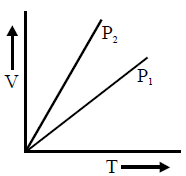
For V versus T curves at constant pressures P1 and P2 for an ideal gas shown in fig. :

1. P1 > P2
2. P1 < P2
3. P1 = P2
4. P1 ≥ P2
View Answer

To analyze the \( V \) versus \( T \) curves for an ideal gas at constant pressures \( P_1 \) and \( P_2 \):

According to Charles's Law:

\[
\frac{V}{T} = \frac{nR}{P}
\]

This implies:

1. At constant pressure, the volume \( V \) is directly proportional to the temperature \( T \), resulting in a straight line.

2. For a given temperature, the volume \( V \) will be greater at a lower pressure \( P \), because \( V \propto \frac{1}{P} \) for a fixed amount of gas.

In the graph:
- The line with a steeper slope corresponds to a lower pressure (since a lower \( P \) results in a larger \( V \) for the same \( T \)).

Since \( P_2 \) has a steeper slope than \( P_1 \), we conclude that:

\[
P_1 > P_2
\]

Therefore, the correct answer is \( P_1 > P_2 \).

Question 27: moderate

Reading of a temperature may be same on :
(i) Celsius and kelvin scale.
(ii) Fahrenheit and kelvin scale.
(iii) Celsius and Fahrenheit scale.
(iv) All the three scales.

1. (i, ii)
2. (ii, iii)
3. (i, iv)
4. (ii, iv)
View Answer
Question 28: moderate

The freezing point on a new thermometer is marked as 20° and the boiling point as 150°. A temperature of 60°C on this thermometer will be read as :

1. 40°
2. 65°
3. 98°
4. 110°
View Answer
Question 29: easy

The temperature at which the reading of a Fahrenheit thermometer will be double that of centigrade thermometer is :

1. 160°
2. 180°
3. 32°
4. 100°
View Answer
Question 30: easy

When a metal rod is heated it expands because :

1. the size of atoms increases.
2. the distance among its atoms increases.
3. atmospsheric air rushes into it.
4. the actual cause is still unknown.
View Answer

When a metal rod is heated, its atoms gain kinetic energy and vibrate more vigorously. As they vibrate, they tend to move slightly further apart because the increased energy weakens the attractive forces that hold them at a fixed distance. This increased atomic spacing results in the rod expanding in size.

Thus, the expansion of the metal rod occurs because the distance among its atoms increases with temperature. This phenomenon is the essence of thermal expansion.