Calorimetry - NEET Physics Questions
Question 1: easy

Heat is supplied to a certain homogeneous sample of matter at a uniform rate. Its temperature is plotted against time as shown, which of the following conclusion can be drawn ?
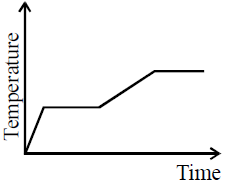
1. It's specific heat capacity is greater in the solid state than in liquid state
2. It's specific heat capacity is greater in the liquid state than in the solid state.
3. It specific heat capacity in liquid state is equal to that of in solid state.
4. data insufficient.
View Answer

Given the graph and your observation, we can analyze whether the specific heat capacity is greater in the liquid state than in the solid state.

In a temperature vs. time graph, under uniform heat supply, the slope of the graph during the temperature rise is inversely proportional to the specific heat capacity (\(C\)). Mathematically, for a given heat input rate:

\[
\text{Rate of temperature increase} \propto \frac{1}{C}
\]

- Solid phase: In the first sloped section (just before the first horizontal plateau), the slope is steeper, indicating a faster temperature increase. This implies that the specific heat capacity of the substance in the solid state is lower.

- Liquid phase: After the first plateau (phase change), the slope in the second sloped section (where the substance is in the liquid state) is less steep, indicating a slower temperature increase. This suggests that more heat is required to raise the temperature in this phase, which means the specific heat capacity is higher in the liquid state.

.
Question 2: difficult

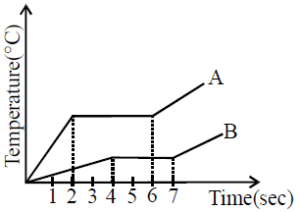
Two substances ‘A’ and ‘B’ equal mass m are heated by uniform rate of 6 cals–¹ under similar conditions. A graph between temperature and time is shown in figure. Ratio of heat absorbed HA/HB by them for complete fusion is :

1. 9/4
2. 4/9
3. 8/5
4. 5/8
View Answer

The heat absorbed during the fusion process is given by the formula:

\[
H = m \cdot L
\]

Where \( H \) is the heat absorbed, \( m \) is the mass, and \( L \) is the latent heat of fusion. Since both substances have the same mass and are being heated at the same rate (6 cal/s), the amount of heat absorbed depends on the duration of the phase change (the flat portion of the graph).

- For substance A: The time interval for fusion (flat portion of the graph) is from \( t = 3 \) to \( t = 5 \), so the time spent during fusion is \( 5 - 3 = 2 \) seconds.
- For substance B: The time interval for fusion is from \( t = 5 \) to \( t = 7 \), so the time spent during fusion is also \( 7 - 5 = 2 \) seconds.

However, the time during which each substance is being heated prior to the phase change is different, which affects the total heat absorbed by each. To calculate the heat absorbed for fusion alone (latent heat), we need to account for the heat absorbed during the temperature increase as well.

- For substance A: It takes 2 seconds to reach the fusion point, then 2 seconds to complete the fusion process.
- For substance B: It takes 3 seconds to reach the fusion point, then 2 seconds to complete the fusion.

Now, let's calculate the total heat absorbed for each substance:

\[
H_A = \text{Heat absorbed during heating phase} + \text{Heat absorbed during fusion}
\]

Substance A spends 2 seconds in the heating phase (at a rate of 6 cal/s), so it absorbs \( 2 \times 6 = 12 \) calories in the heating phase. For fusion, it absorbs heat for 2 seconds at the same rate:

\[
H_A = 12 + (2 \times 6) = 12 + 12 = 24 \, \text{cal}
\]

For substance B, it spends 3 seconds in the heating phase, absorbing \( 3 \times 6 = 18 \) calories. During the fusion, it also absorbs heat for 2 seconds:

\[
H_B = 18 + (2 \times 6) = 18 + 12 = 30 \, \text{cal}
\]

Now, the ratio of heat absorbed by substance A to substance B is:

\[
\frac{H_A}{H_B} = \frac{24}{30} = \frac{8}{5}
\]

Thus, the correct ratio of heat absorbed by substance A to substance B is indeed \(\frac{8}{5}\).

Question 3: easy

5g ice at 0°C is mixed with 5g steam at 100°C. What is final temperature ?

1. 0°C
2. 50°C
3. 100°C
4. 75°C
View Answer

To find the final temperature when 5 g of ice at 0°C is mixed with 5 g of steam at 100°C, we need to consider the energy exchange between the ice and the steam.

We proceed step by step:

1. Heat required to melt the ice into water at 0°C:

\[
Q_1 = m_{\text{ice}} \times L_f = 5 \, \text{g} \times 80 \, \text{cal/g} = 400 \, \text{cal}
\]
This is the heat required to convert 5 g of ice at 0°C into 5 g of water at 0°C.

2. Heat released by steam as it condenses into water at 100°C:

\[
Q_2 = m_{\text{steam}} \times L_v = 5 \, \text{g} \times 540 \, \text{cal/g} = 2700 \, \text{cal}
\]
This is the heat released when 5 g of steam condenses into water at 100°C.

3. Heat required to raise the temperature of 5 g of water from 0°C to 100°C:

\[
Q_3 = m_{\text{water}} \times c \times \Delta T = 5 \, \text{g} \times 1 \, \text{cal/g°C} \times (100 - 0) = 5 \times 100 = 500 \, \text{cal}
\]

 Total heat available from the steam:

- The steam releases 2700 cal by condensing.
- The ice requires 400 cal to melt, and then 500 cal to be heated from 0°C to 100°C, totaling 900 cal.

Since the heat available from the steam (2700 cal) is more than the 900 cal required to melt the ice and raise its temperature to 100°C, the final temperature will be 100°C.

In conclusion, all the ice melts and the final temperature of the mixture is 100°C.

Question 4: difficult

A block of mass 20 Kg, fall from a height of 20m. After colliding with ground 75% of energy goes in raising temperature of block. Find rise in temperature of block? (Take specific heat of block 100 J/Kg°C) :

1. 1/2°C
2. 1.5°C
3. 2°C
4. 1°C
View Answer

To find the rise in temperature of the block, we can follow these steps:

1. Calculate the potential energy of the block before it falls:
\[
\text{Potential energy} = m \times g \times h
\]
where:
- \( m = 20 \, \text{kg} \) (mass of the block)
- \( g = 10 \, \text{m/s}^2 \) (acceleration due to gravity)
- \( h = 20 \, \text{m} \) (height)

\[
\text{Potential energy} = 20 \times 10 \times 20 = 4000 \, \text{J}
\]

2. Energy converted to heat:
Since 75% of the energy goes into raising the temperature of the block:
\[
\text{Heat energy} = 0.75 \times 4000 = 3000 \, \text{J}
\]

3. Use the heat energy to calculate the rise in temperature:
The formula for heat energy is:
\[
Q = m \times c \times \Delta T
\]
where:
- \( Q = 3000 \, \text{J} \) (heat energy)
- \( m = 20 \, \text{kg} \)
- \( c = 100 \, \text{J/kg°C} \) (specific heat of the block)
- \( \Delta T \) is the rise in temperature (to be found)

Rearranging the formula to solve for \( \Delta T \):
\[
\Delta T = \frac{Q}{m \times c} = \frac{3000}{20 \times 100} = \frac{3000}{2000} = 1.5^\circ \text{C}
\]

Thus, the rise in temperature of the block is 1.5°C.

Question 5: easy

Find the quantity of heat required to convert 40g, ice at – 20°C into water at 20°C ?

1. 4400 cal
2. 2200 cal
3. 18480 cal
4. 1100 cal
View Answer

To calculate the heat required to convert 40 g of ice at –20°C into water at 20°C, we need to consider three steps:

1. Heating ice from -20°C to 0°C:
\[
Q_1 = m \times c_{\text{ice}} \times \Delta T = 40 \, \text{g} \times 0.5 \, \text{cal/g°C} \times (0 - (-20)) = 40 \times 0.5 \times 20 = 400 \, \text{cal}
\]

2. Melting ice at 0°C (latent heat of fusion):
\[
Q_2 = m \times L_f = 40 \, \text{g} \times 80 \, \text{cal/g} = 3200 \, \text{cal}
\]

3. Heating water from 0°C to 20°C:
\[
Q_3 = m \times c_{\text{water}} \times \Delta T = 40 \, \text{g} \times 1 \, \text{cal/g°C} \times (20 - 0) = 40 \times 1 \times 20 = 800 \, \text{cal}
\]

Total heat required:

\[
Q_{\text{total}} = Q_1 + Q_2 + Q_3 = 400 + 3200 + 800 = 4400 \, \text{cal}
\]

Thus, the total heat required is 4400 calories.

Question 6: easy

Calculate amount of heat (in calorie) require to convert 5 gm ice 0°C to steam 100°C :

1. 3100
2. 3200
3. 3600
4. 4200
View Answer

To calculate the heat required to convert 5 g of ice at 0°C to steam at 100°C, we need to consider the following steps:

1. Heat to melt ice (latent heat of fusion):
\[
Q_1 = m \times L_f = 5 \, \text{g} \times 80 \, \text{cal/g} = 400 \, \text{cal}
\]

2. Heat to raise temperature of water from 0°C to 100°C:
\[
Q_2 = m \times c \times \Delta T = 5 \, \text{g} \times 1 \, \text{cal/g°C} \times (100 - 0) = 5 \times 100 = 500 \, \text{cal}
\]

3. Heat to convert water at 100°C to steam (latent heat of vaporization):
\[
Q_3 = m \times L_v = 5 \, \text{g} \times 540 \, \text{cal/g} = 2700 \, \text{cal}
\]

Total heat required:
\[
Q_{\text{total}} = Q_1 + Q_2 + Q_3 = 400 + 500 + 2700 = 3600 \, \text{cal}
\]

Thus, the total heat required is 3600 calories.

Question 7: moderate

A tap supplies water at 10°C and another tap at 100°C. How much hot water must be taken so that we get 20 kg water at 35°C ?

1. 7.2 kg
2. 10 kg
3. 5.6 kg
4. 14.4 kg
View Answer

We can solve this problem using the concept of heat exchange. Let \( m_h \) be the mass of hot water at 100°C, and \( m_c \) be the mass of cold water at 10°C. The total mass of water is given as 20 kg, so:

\[
m_h + m_c = 20 \, \text{kg}
\]

We also know that the final temperature of the mixture is 35°C. The heat gained by cold water must equal the heat lost by hot water:

\[
\text{Heat gained by cold water} = \text{Heat lost by hot water}
\]

Let the specific heat of water be \( c = 4200 \, \text{J/kg}^\circ \text{C} \). Using the formula for heat change:

\[
m_c c (35 - 10) = m_h c (100 - 35)
\]

Since the specific heat \( c \) is the same for both, it cancels out:

\[
m_c (35 - 10) = m_h (100 - 35)
\]
\[
m_c \times 25 = m_h \times 65
\]

We also know \( m_h + m_c = 20 \), so \( m_c = 20 - m_h \). Substituting this into the equation:

\[
(20 - m_h) \times 25 = m_h \times 65
\]
\[
500 - 25 m_h = 65 m_h
\]
\[
500 = 90 m_h
\]
\[
m_h = \frac{500}{90} \approx 5.56 \, \text{kg}
\]

Thus, the mass of hot water needed is approximately 5.56 kg.

Question 8: difficult

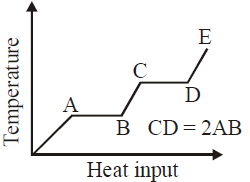
A solid material is supplied with heat at constant rate and the temperature of the material changes as shown below. From the graph, the false conclusion drawn is :

1. AB and CD of the graph represent phase changes
2. AB represent the change of state from solid to liquid
3. latent heat of fusion is twice the latent heat of vaporization
4. CD represents the change of state from liquid to gas
View Answer

In the provided graph, the temperature of the material increases with heat input. The flat portions of the graph (AB and CD) represent phase changes where heat is absorbed but the temperature remains constant. Specifically:

- Segment AB corresponds to the latent heat of fusion (solid to liquid).
- Segment CD corresponds to the latent heat of vaporization (liquid to gas).

The length of CD is given as twice the length of AB, meaning the heat input required for vaporization is twice that of fusion.

However, the false conclusion stated in the answer is that "the latent heat of fusion is twice the latent heat of vaporization." This contradicts the graph because CD represents vaporization and is twice the length of AB, implying that the latent heat of vaporization is actually twice the latent heat of fusion, not the other way around.

Hence, the false conclusion is that the latent heat of fusion is larger than the latent heat of vaporization. The correct interpretation from the graph is that the latent heat of vaporization is twice the latent heat of fusion.

Question 9: moderate

Solid ball of 200 gm at 20°C is dropped in an equal amount of water at 80°C. The resulting temperature is 60°C. This means the specific heat of solid is :

1. one fourth of water
2. one half of water
3. twice of water
4. four times of water
View Answer

Given:
- Mass of water \( m_w = 0.2 \, \text{kg} \)
- Initial temperature of water \( T_w = 80^\circ \text{C} \)
- Final temperature \( T_f = 60^\circ \text{C} \)
- Specific heat of water \( c_w = 4200 \, \text{J/kg}^\circ \text{C} \)
- Mass of solid \( m_s = 0.2 \, \text{kg} \)
- Initial temperature of solid \( T_s = 20^\circ \text{C} \)
- Specific heat of solid \( c_s \) (to be found)

Heat lost by water:
\[
Q_{\text{lost (water)}} = m_w c_w (T_w - T_f) = 0.2 \times 4200 \times (80 - 60) = 16800 \, \text{J}
\]

Heat gained by solid:
\[
Q_{\text{gained (solid)}} = m_s c_s (T_f - T_s) = 0.2 \times c_s \times (60 - 20) = 8 c_s
\]

From the heat exchange equation:
\[
16800 = 8 c_s
\]
\[
c_s = \frac{16800}{8} = 2100 \, \text{J/kg}^\circ \text{C}
\]

Since the specific heat of water is \( 4200 \, \text{J/kg}^\circ \text{C} \), we see that the specific heat of the solid is:

\[
c_s = \frac{4200}{2} = 2100 \, \text{J/kg}^\circ \text{C}
\]

Thus, the specific heat of the solid is indeed half of the specific heat of water.

Question 10: difficult

A calorimeter contains 0.2 kg of water at 30°C. 0.1 kg of water at 60°C is added to it, the mixture is well stirred and the resulting temperature is found to be 35°C. The water equivalent of the calorimeter is :

1. 6300 J/K
2. 1260 J/K
3. 4200 J/K
4. none of these
View Answer

To find the water equivalent of the calorimeter, we can use the principle of heat exchange:

\[
\text{Heat lost by hotter water} = \text{Heat gained by colder water} + \text{Heat gained by the calorimeter}
\]

Let \( m_1 = 0.2 \, \text{kg} \), \( T_1 = 30^\circ \text{C} \) (colder water), \( m_2 = 0.1 \, \text{kg} \), \( T_2 = 60^\circ \text{C} \) (hotter water), and the final temperature \( T_f = 35^\circ \text{C} \). Let \( W_c \) be the water equivalent of the calorimeter, and \( c = 4200 \, \text{J/kg}^\circ \text{C} \) be the specific heat capacity of water.

Heat lost by hotter water:
\[
Q_{\text{lost}} = m_2 c (T_2 - T_f) = 0.1 \times 4200 \times (60 - 35) = 0.1 \times 4200 \times 25 = 10500 \, \text{J}
\]

Heat gained by colder water:
\[
Q_{\text{gained (water)}} = m_1 c (T_f - T_1) = 0.2 \times 4200 \times (35 - 30) = 0.2 \times 4200 \times 5 = 4200 \, \text{J}
\]

Heat gained by calorimeter:
\[
Q_{\text{gained (calorimeter)}} = W_c \times c \times (T_f - T_1) = W_c \times 4200 \times 5
\]

Using heat balance equation:
\[
Q_{\text{lost}} = Q_{\text{gained (water)}} + Q_{\text{gained (calorimeter)}}
\]
\[
10500 = 4200 + W_c \times 4200 \times 5
\]
\[
10500 - 4200 = 21000 W_c
\]
\[
6300 = 21000 W_c
\]
\[
W_c = \frac{6300}{21000} = 0.3 \, \text{kg}
\]

Since the water equivalent is in terms of mass and \( c = 4200 \, \text{J/kg}^\circ \text{C} \), the water equivalent in \( \text{J/K} \) is:
\[
W_c \times c = 0.3 \times 4200 = 1260 \, \text{J/K}
\]

So, the water equivalent of the calorimeter is 1260 J/K.