Thermal Physics - NEET Physics Questions
← All Chapters

Thermal Physics

Question 1: easy

In a process the density of a gas remains constant. If the temperature is doubled, then the change in the pressure will be :

1. 100% increase
2. 200% increase
3. 50% decrease
4. 25% decrease
View Answer

Given that density \(\rho\) is constant, we use the ideal gas law:

\[
\frac{P}{T} = \text{constant (since } \rho \text{ is constant)}
\]

If the temperature \(T\) is doubled, then:

\[
\frac{P_2}{T_2} = \frac{P_1}{T_1} \Rightarrow \frac{P_2}{2T_1} = \frac{P_1}{T_1}
\]

Thus, \(P_2 = 2P_1\), meaning the pressure also doubles, resulting in a 100% increase.

Question 2: moderate

‘A’ is a closed vessel of volume V and contains O2 at pressure P and temperature T. ‘B’ is another closed vessel of same volume and it contains H2 at same temperature and 2P pressure. Ratio of masses of O2 and H2 in vessel ‘A’ and ‘B’ is :

1. 2 : 1
2. 4 : 1
3. 8 : 1
4. 1 : 8
View Answer

Using the ideal gas law \( PV = nRT \), we find the moles \( n \) in each vessel:

1. For vessel \( A \) with \( O_2 \):
\[
n_{\text{O}_2} = \frac{PV}{RT}
\]

2. For vessel \( B \) with \( H_2 \) at \( 2P \):
\[
n_{\text{H}_2} = \frac{2PV}{RT} = 2 \times \frac{PV}{RT}
\]

Now, the mass \( m = n \times \text{molar mass} \):

- Mass of \( O_2 \) in \( A = n_{\text{O}_2} \times 32 = \frac{PV}{RT} \times 32 \)
- Mass of \( H_2 \) in \( B = n_{\text{H}_2} \times 2 = 2 \times \frac{PV}{RT} \times 2 \)

So, the mass ratio is:
\[
\frac{\text{mass of } O_2}{\text{mass of } H_2} = \frac{\frac{PV}{RT} \times 32}{2 \times \frac{PV}{RT} \times 2} = \frac{32}{4} = 8:1
\]

Question 3: moderate

One mole of an ideal gas undergoes a process \( P=\frac{_{P_{0}}}{1+\left( \frac{V_{0}}{V} \right)^{2}} \) , Here P0 and V0 are constants. Change in temperature of the gas when volume is changed from V = V0 to V = 2V0 is :

1. \[ \frac{-2P_{0}V_{0}}{5R}\]
2. \[ \frac{11P_{0}V_{0}}{10R}\]
3. \[ \frac{-5P_{0}V_{0}}{4R}\]
4. \[ P_{0}V_{0}\]
View Answer

For one mole of an ideal gas, we use the ideal gas law:

\[
PV = RT
\]

Given \( P = \frac{P_0}{1 + \left( \frac{V_0}{V} \right)^2} \), find \( T \) at \( V = V_0 \) and \( V = 2V_0 \).

1. When \( V = V_0 \):
\[
P = \frac{P_0}{1 + \left( \frac{V_0}{V_0} \right)^2} = \frac{P_0}{1 + 1} = \frac{P_0}{2}
\]
\[
T_1 = \frac{PV}{R} = \frac{\frac{P_0}{2} \cdot V_0}{R} = \frac{P_0 V_0}{2R}
\]

2. When \( V = 2V_0 \):
\[
P = \frac{P_0}{1 + \left( \frac{V_0}{2V_0} \right)^2} = \frac{P_0}{1 + \frac{1}{4}} = \frac{P_0}{\frac{5}{4}} = \frac{4P_0}{5}
\]
\[
T_2 = \frac{PV}{R} = \frac{\frac{4P_0}{5} \cdot 2V_0}{R} = \frac{8P_0 V_0}{5R}
\]

3. Change in temperature:
\[
\Delta T = T_2 - T_1 = \frac{8P_0 V_0}{5R} - \frac{P_0 V_0}{2R} = \frac{11P_0 V_0}{10R}
\]

Question 4: moderate

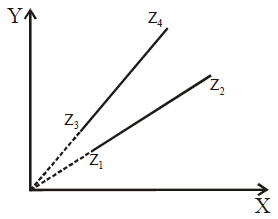
In the diagram as shown, find parameters representing x and y axis and also parameter z, if z1 = z2, z3 = z4 and z2 > z3 :

1. Volume, Pressure and temperature
2. Temperature, volume and pressure
3. Temperature, pressure and volume.
4. Both (2) and (3)
View Answer
Question 5: easy

Internal energy of n1 moles of hydrogen of temperature T is equal to the internal energy of n2 moles of helium at temperature 2T. The ratio n1/n2 is :

1. 3/5
2. 2/3
3. 6/5
4. 3/7
View Answer

The internal energy \( U \) of an ideal gas is given by:

\[
U = n \cdot C_V \cdot T
\]

For a diatomic gas like hydrogen (\( \text{H}_2 \)), \( C_V = \frac{5}{2} R \), and for a monoatomic gas like helium (\( \text{He} \)), \( C_V = \frac{3}{2} R \).

Given that the internal energy of \( n_1 \) moles of hydrogen at temperature \( T \) is equal to the internal energy of \( n_2 \) moles of helium at temperature \( 2T \), we have:

\[
n_1 \cdot \frac{5}{2} R \cdot T = n_2 \cdot \frac{3}{2} R \cdot (2T)
\]

Simplifying:

\[
\frac{5}{2} n_1 = 3 n_2
\]

Rearrange to find the ratio \( \frac{n_1}{n_2} \):

\[
\frac{n_1}{n_2} = \frac{3}{5} \cdot \frac{2}{1} = \frac{6}{5}
\]

Answer: The ratio \( \frac{n_1}{n_2} \) is \( \frac{6}{5} \).

Question 6: moderate

An ideal diatomic gas occupies a volume V1 at a pressure P1 undergoes a process in which the pressure is directly proportional to the volume.
At the end of the process the rms speed of gas molecules has doubled from its initial value. Heat supplied to the gas in the given process is :

1. \[ 7P_{1}V_{1}\]
2. \[ 8P_{1}V_{1} \]
3. \[ 9P_{1}V_{1} \]
4. \[ 10P_{1}V_{1}\]
View Answer

Since the pressure \( P \) is directly proportional to the volume \( V \), we have:

\[
P \propto V \Rightarrow P = kV
\]

where \( k \) is a constant. This process describes a line through the origin on a \( P \)-\( V \) graph, where work \( W \) done by the gas is given by the area under the line:

\[
W = \frac{P_{\text{final}} V_{\text{final}} - P_{\text{initial}} V_{\text{initial}}}{2}
\]

Given that the r.m.s. speed doubles, we know the temperature \( T \) has quadrupled (since \( v_{\text{rms}} \propto \sqrt{T} \)). Therefore:

\[
\frac{T_{\text{final}}}{T_{\text{initial}}} = 4
\]

For an ideal gas, \( PV = nRT \), so if \( T \) quadruples, \( PV \) also quadruples, making \( P_{\text{final}} V_{\text{final}} = 4 P_1 V_1 \).

Using the work formula above:

\[
W = \frac{4 P_1 V_1 - P_1 V_1}{2} = \frac{3 P_1 V_1}{2} = 3 P_1 V_1
\]

The change in internal energy \( \Delta U \) for a diatomic gas (\( C_V = \frac{5}{2}R \)) is:

\[
\Delta U = n C_V \Delta T = \frac{5}{2} (P_1 V_1) \cdot 3 = \frac{15}{2} P_1 V_1 = 7.5 P_1 V_1
\]

Using the first law of thermodynamics \( Q = \Delta U + W \):

\[
Q = 7.5 P_1 V_1 + 3 P_1 V_1 = 9 P_1 V_1
\]

Answer: The heat supplied to the gas is \( 9 P_1 V_1 \).

Question 7: easy

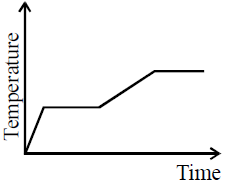
Heat is supplied to a certain homogeneous sample of matter at a uniform rate. Its temperature is plotted against time as shown, which of the following conclusion can be drawn ?

1. It's specific heat capacity is greater in the solid state than in liquid state
2. It's specific heat capacity is greater in the liquid state than in the solid state.
3. It specific heat capacity in liquid state is equal to that of in solid state.
4. data insufficient.
View Answer

Given the graph and your observation, we can analyze whether the specific heat capacity is greater in the liquid state than in the solid state.

In a temperature vs. time graph, under uniform heat supply, the slope of the graph during the temperature rise is inversely proportional to the specific heat capacity (\(C\)). Mathematically, for a given heat input rate:

\[
\text{Rate of temperature increase} \propto \frac{1}{C}
\]

- Solid phase: In the first sloped section (just before the first horizontal plateau), the slope is steeper, indicating a faster temperature increase. This implies that the specific heat capacity of the substance in the solid state is lower.

- Liquid phase: After the first plateau (phase change), the slope in the second sloped section (where the substance is in the liquid state) is less steep, indicating a slower temperature increase. This suggests that more heat is required to raise the temperature in this phase, which means the specific heat capacity is higher in the liquid state.

.

Question 8: difficult

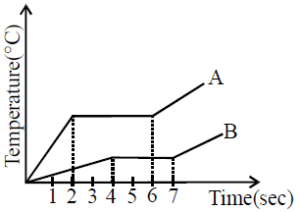
Two substances ‘A’ and ‘B’ equal mass m are heated by uniform rate of 6 cals–¹ under similar conditions. A graph between temperature and time is shown in figure. Ratio of heat absorbed HA/HB by them for complete fusion is :

1. 9/4
2. 4/9
3. 8/5
4. 5/8
View Answer

The heat absorbed during the fusion process is given by the formula:

\[
H = m \cdot L
\]

Where \( H \) is the heat absorbed, \( m \) is the mass, and \( L \) is the latent heat of fusion. Since both substances have the same mass and are being heated at the same rate (6 cal/s), the amount of heat absorbed depends on the duration of the phase change (the flat portion of the graph).

- For substance A: The time interval for fusion (flat portion of the graph) is from \( t = 3 \) to \( t = 5 \), so the time spent during fusion is \( 5 - 3 = 2 \) seconds.
- For substance B: The time interval for fusion is from \( t = 5 \) to \( t = 7 \), so the time spent during fusion is also \( 7 - 5 = 2 \) seconds.

However, the time during which each substance is being heated prior to the phase change is different, which affects the total heat absorbed by each. To calculate the heat absorbed for fusion alone (latent heat), we need to account for the heat absorbed during the temperature increase as well.

- For substance A: It takes 2 seconds to reach the fusion point, then 2 seconds to complete the fusion process.
- For substance B: It takes 3 seconds to reach the fusion point, then 2 seconds to complete the fusion.

Now, let's calculate the total heat absorbed for each substance:

\[
H_A = \text{Heat absorbed during heating phase} + \text{Heat absorbed during fusion}
\]

Substance A spends 2 seconds in the heating phase (at a rate of 6 cal/s), so it absorbs \( 2 \times 6 = 12 \) calories in the heating phase. For fusion, it absorbs heat for 2 seconds at the same rate:

\[
H_A = 12 + (2 \times 6) = 12 + 12 = 24 \, \text{cal}
\]

For substance B, it spends 3 seconds in the heating phase, absorbing \( 3 \times 6 = 18 \) calories. During the fusion, it also absorbs heat for 2 seconds:

\[
H_B = 18 + (2 \times 6) = 18 + 12 = 30 \, \text{cal}
\]

Now, the ratio of heat absorbed by substance A to substance B is:

\[
\frac{H_A}{H_B} = \frac{24}{30} = \frac{8}{5}
\]

Thus, the correct ratio of heat absorbed by substance A to substance B is indeed \(\frac{8}{5}\).
Question 9: easy

The temperature on Celsius scale is 25ºC. What is the corresponding temperature on the Fahrenheit scale ?

1. 40ºF
2. 77ºF
3. 50ºF
4. 45ºF
View Answer

To convert from Celsius to Fahrenheit, we use the formula:

\[
F = \frac{9}{5}C + 32
\]

Given \( C = 25^\circ \):

\[
F = \frac{9}{5} \times 25 + 32
\]
\[
F = 45 + 32 = 77
\]

So, the corresponding temperature is 77ºF.

Question 10: moderate

If a thermometer reads freezing point of water as 20ºC and boiling point as 150ºC, how much thermometer read when the actual temperature is 60ºC ?

1. 98ºC
2. 110ºC
3. 40ºC
4. 60ºC
View Answer

To solve this, we can set up a linear relationship between the actual Celsius scale (0ºC to 100ºC) and the thermometer's faulty scale (20ºC to 150ºC).

1. Set up the linear equation:

The faulty thermometer's scale can be represented as:
\[
T_{\text{faulty}} = a \cdot T_{\text{actual}} + b
\]

Using the freezing point:
\[
20 = a \cdot 0 + b \Rightarrow b = 20
\]

Using the boiling point:
\[
150 = a \cdot 100 + 20
\]
\[
130 = 100a \Rightarrow a = 1.3
\]

So, the relation is:
\[
T_{\text{faulty}} = 1.3 \cdot T_{\text{actual}} + 20
\]

2. Find the faulty reading at 60ºC actual temperature:
\[
T_{\text{faulty}} = 1.3 \cdot 60 + 20 = 78 + 20 = 98
\]

Therefore, the thermometer will read 98ºC at an actual temperature of 60ºC.