Thermal Expansion - NEET Physics Questions
Question 1: easy

When a metal rod is heated it expands because :

1. the size of atoms increases.
2. the distance among its atoms increases.
3. atmospsheric air rushes into it.
4. the actual cause is still unknown.
View Answer

When a metal rod is heated, its atoms gain kinetic energy and vibrate more vigorously. As they vibrate, they tend to move slightly further apart because the increased energy weakens the attractive forces that hold them at a fixed distance. This increased atomic spacing results in the rod expanding in size.

Thus, the expansion of the metal rod occurs because the distance among its atoms increases with temperature. This phenomenon is the essence of thermal expansion.
Question 2: moderate

A beaker is completely filled with water at 4°C. It will overflow if :

1. heated above 4°C
2. cooled below 4°C
3. (1) & (2) both
4. none of the above
View Answer

Water has a unique property: it reaches its maximum density at 4°C. This means that as water is heated or cooled from 4°C, it expands. Here’s why:

1. If the water is heated above 4°C: It begins to expand, decreasing in density. Since the beaker is already full, this expansion causes water to overflow.

2. If the water is cooled below 4°C: Water also expands when cooled below 4°C due to the formation of an open, hexagonal structure in its molecules (especially as it approaches freezing). This expansion also leads to overflow.

Therefore, the beaker will overflow if the temperature changes from 4°C in either direction: heating above 4°C or cooling below 4°C.

Question 3: moderate

Coefficient of apparent expansion of mercury in a glass vessel is \( 153 × 10^{–6}/°C \) and in a steel vessel is \(144 × 10^{–6}/°C\) . If α for steel is \(12 × 10^{–6}/°C\) then that of glass is :

1. \[ 36\times 10^{-6}/°C\]
2. \[ 6\times 10^{-6}/°C\]
3. \[ 27\times 10^{-6}/°C\]
4. \[ 9\times 10^{-6}/°C\]
View Answer

The coefficient of apparent expansion of mercury in a vessel is given by:

\[
\gamma_{\text{apparent}} = \gamma_{\text{mercury}} - \alpha_{\text{vessel}}
\]

For the glass vessel:
\[
153 \times 10^{-6} = \gamma_{\text{mercury}} - \alpha_{\text{glass}}
\]

For the steel vessel:
\[
144 \times 10^{-6} = \gamma_{\text{mercury}} - \alpha_{\text{steel}}
\]

Subtracting these two equations, we get:

\[
153 \times 10^{-6} - 144 \times 10^{-6} = \alpha_{\text{steel}} - \alpha_{\text{glass}}
\]

Substitute \(\alpha_{\text{steel}} = 12 \times 10^{-6}/^\circ \text{C}\):

\[
9 \times 10^{-6} = 12 \times 10^{-6} - \alpha_{\text{glass}}
\]

Solving for \(\alpha_{\text{glass}}\):
\[
\alpha_{\text{glass}} = 3 \times 10^{-6}/^\circ \text{C}
\]

Question 4: moderate

A rod of 40 cm has the coefficient of linear expansion α1 = 6 × 10⁻⁶/°C. The other rod has coefficient of linear expansion α2 = 4 × 10⁻⁶/°C. If the difference in their lengths at all temperatures remains the same, the length of the other rod is:

1. 26 cm
2. 32 cm
3. 60 cm
4. 80 cm
View Answer

Let the length of the other rod be \( L \).

Since the difference in their lengths remains the same at all temperatures, the expansion of each rod must be identical.

For the first rod:
\[
\Delta L_1 = 40 \times \alpha_1 \times \Delta T
\]

For the second rod:
\[
\Delta L_2 = L \times \alpha_2 \times \Delta T
\]

Since \(\Delta L_1 = \Delta L_2\):
\[
40 \times \alpha_1 = L \times \alpha_2
\]

Substitute \(\alpha_1 = 6 \times 10^{-6}/^\circ \text{C}\) and \(\alpha_2 = 4 \times 10^{-6}/^\circ \text{C}\):
\[
40 \times 6 \times 10^{-6} = L \times 4 \times 10^{-6}
\]

Dividing both sides by \(4 \times 10^{-6}\):
\[
L = \frac{40 \times 6}{4} = 60 \, \text{cm}
\]

So, the length of the other rod is \( 60 \, \text{cm} \).

Question 5: moderate

Two rods, one of aluminium and the other made of steel, having initial length l1 and l2 are connected together to form a single rod of length (l1+ l2). The coefficients of linear expansion for aluminium and steel are αa and αs respectively. If the length of each rod increases by the same amount when their temperatures are raised by t°C, then find the ratio l1/(l1+ l2)

1. \[ \frac{\alpha_{s}}{\alpha_{a}} \]
2. \[ \frac{\alpha_{a}}{\alpha_{s}}\]
3. \[ \frac{\alpha_{s}}{\alpha_{a}+\alpha_{s}}\]
4. \[ \frac{\alpha_{a}}{\left( \alpha_{a}+\alpha_{s} \right)}\]
View Answer

For the two rods to expand by the same length, their expansions \(\Delta l_1\) and \(\Delta l_2\) should be equal. The linear expansion for each rod can be written as:

\[
\Delta l_1 = l_1 \alpha_a t \quad \text{and} \quad \Delta l_2 = l_2 \alpha_s t
\]

Since \(\Delta l_1 = \Delta l_2\), we get:

\[
l_1 \alpha_a t = l_2 \alpha_s t
\]

Dividing both sides by \(t\) (assuming \(t \neq 0\)):

\[
l_1 \alpha_a = l_2 \alpha_s
\]

Now, to find the ratio \(\frac{l_1}{l_1 + l_2}\), divide both sides by \(\alpha_a + \alpha_s\):

\[
\frac{l_1}{l_1 + l_2} = \frac{\alpha_s}{\alpha_a + \alpha_s}
\]

So, the required ratio is:

\[
\frac{l_1}{l_1 + l_2} = \frac{\alpha_s}{\alpha_a + \alpha_s}
\]

Question 6: moderate

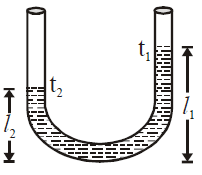
In a vertical U-tube containing a liquid, the two arms are maintained at different temperatures t1 and t2 . The liquid columns in the two arms have
heights l1 and l2 respectively. The coefficient of volume expansion of the liquid is equal to

1. \[ \frac{l_{1}-l_{2}}{l_{2}t_{1}-l_{1}t_{2}}\]
2. \[ \frac{l_{1}-l_{2}}{l_{1}t_{1}-l_{2}t_{2}}\]
3. \[ \frac{l_{1}+l_{2}}{l_{2}t_{1}+l_{1}t_{2}}\]
4. \[ \frac{l_{1}+l_{2}}{l_{1}t_{1}+l_{2}t_{2}}\]
View Answer

For a liquid in a U-tube with different temperatures in each arm, the expansion of the liquid in each arm is affected by the temperature difference.

Let:
- \( l_1 \) and \( l_2 \) be the heights of the liquid columns at temperatures \( t_1 \) and \( t_2 \), respectively.
- \( \beta \) be the coefficient of volume expansion of the liquid.

Since the pressure at the same horizontal level in both arms must be equal, we have:
\[
l_1 (1 + \beta t_1) = l_2 (1 + \beta t_2)
\]

Rearranging, we get:
\[
l_1 + l_1 \beta t_1 = l_2 + l_2 \beta t_2
\]

Solving for \( \beta \):
\[
\beta = \frac{l_1 - l_2}{l_2 t_1 - l_1 t_2}
\]

Thus, the coefficient of volume expansion of the liquid is:
\[
\beta = \frac{l_1 - l_2}{l_2 t_1 - l_1 t_2}
\]

Question 7: easy

The volume of a metal sphere increases by 0.24% when its temperature is raised by 40ºC. The coefficient of linear expansion of the metal is :

1. \[ 2\times 10^{-5} per ^{oC}\]
2. \[ 6\times 10^{-5} per ^{oC}\]
3. \[ 2.1\times 10^{-5} per ^{oC}\]
4. \[ 1.2\times 10^{-5} per ^{oC}\]
View Answer

The relationship between the coefficient of volume expansion (\( \beta \)) and the coefficient of linear expansion (\( \alpha \)) for a solid is:

\[
\beta = 3\alpha
\]

Given:
- Volume increase = 0.24%
- Temperature increase \( \Delta T = 40^\circ \text{C} \)

The coefficient of volume expansion \( \beta \) is given by:

\[
\beta = \frac{\text{Percentage increase in volume}}{\Delta T} = \frac{0.24}{40} = 0.006\% \, \text{per } ^\circ\text{C} = 6 \times 10^{-5} \, \text{per } ^\circ\text{C}
\]

Now, using \( \beta = 3\alpha \):

\[
\alpha = \frac{\beta}{3} = \frac{6 \times 10^{-5}}{3} = 2 \times 10^{-5} \, \text{per } ^\circ\text{C}
\]

Thus, the coefficient of linear expansion of the metal is \( 2 \times 10^{-5} \, \text{per } ^\circ\text{C} \).