Question 31:
moderate
As shown in the diagram, two fixed charges, q1 = +1.00 μC and q2 = –4.00 μC, are 0.200 m apart. Where is the total field zero?

As shown in the diagram, two fixed charges, q1 = +1.00 μC and q2 = –4.00 μC, are 0.200 m apart. Where is the total field zero?
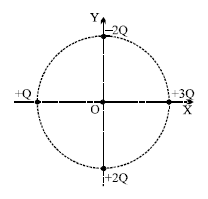
Four charges are placed on the circumference of a circle of radius R, 90° apart as shown in the figure . The electric field strength at the centre of the circle is
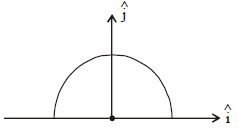
A thin semi-circular ring of radius r has a positive charge q distributed uniformly over it. The net field \overrightarrow{E} at the centre O is :
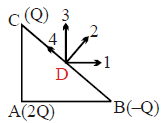
In the figure , ΔABC is in an isosceles triangle with A = 90°. D is the mid point of BC. Three charges 2Q, –Q and Q are placed at A, B, C respectively.
The net electric field at D due to three charges is directed along the numbered arrow :
Find the electric field due to a circular arc of radius R and charge / length λ at the origin. The arc is in xy plane and extends from θ = π/3 to θ = π w .r.t.x-axis .
The figure shows the electric field lines in the vicinity of two point charges . Which one of the following statements concerning this situation is true ?
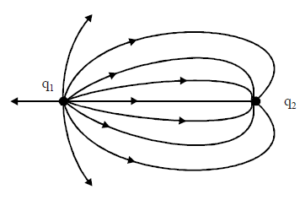
Number of electric field lines coming out of a charge represents magnitude of charge. Here number of field line coming out of q1 is more than that of q2 so, |q2/q1 |<1.
Three positive charges of equal value q are placed at the vertices of an equilateral triangle . The resulting lines of force should be sketched as in
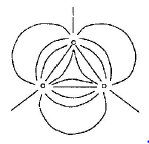
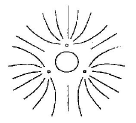
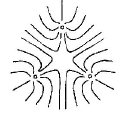
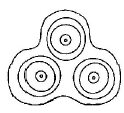
Option 1 is wrong as electric field lines will emerge out of +ve charge and should submerge only at -ve charge.
Option 2 is wrong as electric field lines can not be circular loop.
Option 3 is correct.
Option 4 is wrong because it is representing equipotential surface not field lines
Three charged particles are placed on a straight line as shown in Fig. q1 and q2 are fixed, but q3 can be moved. Under the action of the forces from q1 and q2, q3 is in equilibrium. What is the relation between q1 and q2 ?
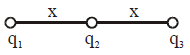
To find the relation between \( q_1 \) and \( q_2 \) for \( q_3 \) to be in equilibrium, let's analyze the forces on \( q_3 \).
1. Forces on \( q_3 \):
- The force due to \( q_1 \) on \( q_3 \) is:
\[
F_{13} = \frac{k |q_1| |q_3|}{(2x)^2} = \frac{k |q_1| |q_3|}{4x^2}
\]
(directed towards \( q_1 \) if \( q_1 \) and \( q_3 \) have opposite signs).
- The force due to \( q_2 \) on \( q_3 \) is:
\[
F_{23} = \frac{k |q_2| |q_3|}{x^2}
\]
(directed towards \( q_2 \) if \( q_2 \) and \( q_3 \) have opposite signs).
2. Equilibrium Condition for \( q_3 \):
For \( q_3 \) to be in equilibrium, these forces must be equal in magnitude:
\[
F_{13} = F_{23}
\]
Substituting the values:
\[
\frac{k |q_1| |q_3|}{4x^2} = \frac{k |q_2| |q_3|}{x^2}
\]
Cancelling \( k \), \( |q_3| \), and \( x^2 \) from both sides, we get:
\[
\frac{|q_1|}{4} = |q_2|
\]
Therefore:
\[
q_1 = -4q_2
\]
Answer:
The relation between \( q_1 \) and \( q_2 \) is:
\[
q_1 = -4q_2
\]
Two particles A and B (B is right of A) having charges \( 8\times 10^{-6}C \)and ( -2\times 10^{-6}C\), respectively, are held fixed with separation of 20 cm. Where should a third charged particle be placed so that it does not experience a net electric force :
Let's solve this briefly.
1. Charges and Positions:
- Charge on \( A = 8 \times 10^{-6} \, \text{C} \).
- Charge on \( B = -2 \times 10^{-6} \, \text{C} \).
- Distance between \( A \) and \( B = 20 \, \text{cm} \).
2. Equilibrium Condition for Third Charge \( Q \):
- For the third charge \( Q \) to experience zero net force, it must be positioned where the attractive force from \( A \) and the repulsive force from \( B \) on \( Q \) are equal in magnitude.
- Since \( |A| > |B| \), \( Q \) must be placed on the right side of \( B \) (further from \( A \)).
3. Distance Calculation:
- Let the distance of \( Q \) from \( B \) be \( x \).
- The distance of \( Q \) from \( A \) is then \( 20 + x \).
Using Coulomb's law, we set the magnitudes of the forces equal:
\[
\frac{k \cdot (8 \times 10^{-6}) \cdot Q}{(20 + x)^2} = \frac{k \cdot (2 \times 10^{-6}) \cdot Q}{x^2}
\]
Simplify by cancelling \( k \) and \( Q \):
\[
\frac{8}{(20 + x)^2} = \frac{2}{x^2}
\]
Cross-multiplying gives:
\[
8x^2 = 2(20 + x)^2
\]
Simplifying, we find \( x = 20 \, \text{cm} \).
Answer:
The third charge should be placed 20 cm to the right of \( B \) for zero net force.
Two point charges repel each other with a force of 100 N. One of the charges is increased by 10%, and the other is reduced by 10%. The new force of repulsion at the same distance would be :
The initial force \( F \) between two charges \( q_1 \) and \( q_2 \) is given by:
\[
F = k \frac{q_1 q_2}{r^2} = 100 \, \text{N}
\]
After changing the charges:
- \( q_1 \) increases by 10%, so \( q_1' = 1.1 q_1 \).
- \( q_2 \) decreases by 10%, so \( q_2' = 0.9 q_2 \).
The new force \( F' \) is:
\[
F' = k \frac{q_1' q_2'}{r^2} = k \frac{(1.1 q_1)(0.9 q_2)}{r^2} = (1.1 \times 0.9) F
\]
Calculating \( 1.1 \times 0.9 = 0.99 \), so:
\[
F' = 0.99 \times 100 = 99 \, \text{N}
\]