Electrostatics - NEET Physics Questions
← All Chapters

Electrostatics

Question 21: moderate

An electric dipole with dipole moment

\( \overrightarrow{p}=\left( 3\hat{i}+4\hat{j} \right) \) C-m, is kept in electric field \(\overrightarrow{E}=0.4kN/C\hat{i} \). What is the torque acting on it & the potential energy of the dipole ?

1. \[ 1600\left( N\times m \right)\hat{k},-1200J\]
2. \[ -1600\left( N\times m \right)\hat{k},1200J\]
3. \[ -1600\left( N\times m \right)\hat{k},-1200J \]
4. \[ 1600\left( N\times m \right)\hat{k},1200J \]
View Answer

Given:
- Dipole moment: \( \overrightarrow{p} = 3\hat{i} + 4\hat{j} \) C·m
- Electric field: \( \overrightarrow{E} = 0.4 \, \text{kN/C} \hat{i} = 400 \, \text{N/C} \hat{i} \)

Torque (\( \overrightarrow{\tau} \)):
\[
\overrightarrow{\tau} = \overrightarrow{p} \times \overrightarrow{E}
\]

\[
\overrightarrow{\tau} = \begin{vmatrix}
\hat{i} & \hat{j} & \hat{k} \\
3 & 4 & 0 \\
400 & 0 & 0
\end{vmatrix} = \hat{k} \big(3(0) - 4(400)\big) = -1600\hat{k} \, \text{N·m}
\]

Potential Energy (\( U \)):
\[
U = -\overrightarrow{p} \cdot \overrightarrow{E}
\]
\[
U = -(3 \times 400 + 4 \times 0) = -1200 \, \text{J}
\]

Final Answer:
- Torque: \( -1600 \, \text{N·m} \hat{k} \)
- Potential energy: \( -1200 \, \text{J} \)

Question 22: moderate

An electric dipole with dipole moment \( 2\times 10^{-9} \)Cm is aligned at 30º with the direction of a uniform electric field of magnitude \( 4\times 10^{4} NC^{-1}\). The magnitude of the torque acting on the dipole is :

1. \[ 2\times 10^{-5} Nm\]
2. \[ 2\times 10^{-4} Nm\]
3. \[ 4\times 10^{-4} Nm\]
4. \[ 4\times 10^{-5} Nm\]
View Answer

Given:
- Dipole moment: \( p = 2 \times 10^{-9} \, \text{C·m} \)
- Electric field: \( E = 4 \times 10^{4} \, \text{N/C} \)
- Angle: \( \theta = 30^\circ \)

Torque (\( \tau \)):
\[
\tau = pE \sin\theta
\]
\[
\tau = (2 \times 10^{-9})(4 \times 10^{4}) \sin 30^\circ
\]
\[
\tau = (8 \times 10^{-5}) \times \frac{1}{2} = 4 \times 10^{-5} \, \text{N·m}
\]

Final Answer:
\[
\tau = 4 \times 10^{-5} \, \text{N·m}
\]

Question 23: moderate

A dipole of electric dipole moment p is placed in a uniform electric field of strength E. If θ is the angle between positive directions of p and E, then the potential energy of the electric dipole is largest when θ is :

1. π/4
2. π/2
3. π
4. Zero
View Answer

The potential energy (\(U\)) of an electric dipole in a uniform electric field is given by:

\[
U = -\mathbf{p} \cdot \mathbf{E} = -pE \cos\theta
\]

Here:
- \(p\) is the magnitude of the dipole moment,
- \(E\) is the magnitude of the electric field,
- \(\theta\) is the angle between \(\mathbf{p}\) and \(\mathbf{E}\).

The potential energy is largest when \(-\cos\theta\) is most positive, i.e., when \(\cos\theta = -1\). This happens at:

\[
\theta = \pi \ (\text{180°})
\]

At this angle, the dipole is aligned opposite to the electric field, and the potential energy is \(U = +pE\), its maximum value.

Question 24: easy

A point charge + Q is positioned at the center of the base of a square pyramid as shown. The flux through one of the four identical upper faces of the pyramid is


1. \[ \frac{Q}{16\varepsilon_{0}}\]
2. \[ \frac{Q}{4\varepsilon_{0}}\]
3. \[ \frac{Q}{8\varepsilon_{0}}\]
4. None of these
View Answer

Step-by-Step Explanation:

1. Flux through the Entire Pyramid:
The total charge enclosed by the pyramid is \(+Q\), and the total flux through the entire closed surface of the pyramid is given by Gauss's law:
\[
\Phi_{\text{total}} = \frac{Q}{\varepsilon_0}.
\]

2. Flux Distribution:
The pyramid has a square base and four triangular faces. However, **the charge \(+Q\) is located at the center of the base, not at the geometric center of the pyramid.** This means the flux through the base is not zero and contributes to the total flux.

3. Flux Through the Base:
Due to symmetry, half of the total flux passes through the square base:
\[
\Phi_{\text{base}} = \frac{\Phi_{\text{total}}}{2} = \frac{Q}{2\varepsilon_0}.
\]

4. Flux Through the Four Triangular Faces:
The remaining half of the total flux passes through the four triangular faces combined:
\[
\Phi_{\text{triangular (total)}} = \frac{\Phi_{\text{total}}}{2} = \frac{Q}{2\varepsilon_0}.
\]

5. Flux Through One Triangular Face:
Since the four triangular faces are identical, the flux is equally distributed among them:
\[
\Phi_{\text{face}} = \frac{\Phi_{\text{triangular (total)}}}{4} = \frac{\frac{Q}{2\varepsilon_0}}{4} = \frac{Q}{8\varepsilon_0}.
\]

Final Answer:
The flux through one triangular face is:
\[
{\frac{Q}{8\varepsilon_0}}.
\]

Question 25: moderate

The electric field in a region is give n by \[ \overrightarrow{E}=200\hat{i}N/C for x > 0 and -200\hat{i}N/C for x < 0 \]

A closed cylinder of length 2m and cross -section area 10² m² is kept in such away that the axis of cylinder is along X-axis and its centre coincides with origin. The total charge inside the cylinder is
(Take \(e_{0}=8.85\times 10^{-12} C^{2}m^{2}N)\)

1. zero
2. \[ 1.86\times 10^{-5}C\]
3. \[ 1.77\times 10^{-11}C\]
4. \[ 35.4\times 10^{-8}C\]
View Answer

To calculate the total charge inside the cylinder, we use Gauss's law:

\[
\Phi_E = \frac{q_{\text{inside}}}{\epsilon_0}
\]

Here:
- \(\Phi_E\) is the total electric flux through the surface of the cylinder,
- \(q_{\text{inside}}\) is the total charge enclosed by the cylinder,
- \(\epsilon_0 = 8.85 \times 10^{-12} \, \text{C}^2/(\text{N·m}^2)\).

Step 1: Electric flux through the cylinder
The cylinder has two flat faces (at \(x = +1\) m and \(x = -1\) m) and a curved surface. The electric field is parallel to the axis, so the flux through the curved surface is **zero**. Thus, only the two flat faces contribute to the flux.

- For the face at \(x = +1\) m:
\(\Phi_E^+ = E \cdot A = 200 \cdot 10^{-2} = 2 \, \text{N·m}^2/\text{C}\),

- For the face at \(x = -1\) m:
\(\Phi_E^- = E \cdot A = -200 \cdot 10^{-2} = -2 \, \text{N·m}^2/\text{C}\).

The total flux is:

\[
\Phi_E = \Phi_E^+ + \Phi_E^- = 2 - (-2) = 4 \, \text{N·m}^2/\text{C}
\]

Step 2: Total charge inside the cylinder
Using Gauss's law:

\[
q_{\text{inside}} = \Phi_E \cdot \epsilon_0 = 4 \cdot (8.85 \times 10^{-12})
\]

Simplify:

\[
q_{\text{inside}} = 35.4 \times 10^{-8} \, \text{C}
\]

Thus, the total charge inside the cylinder is:

\[
{35.4 \times 10^{-8} \, \text{C}}
\]

Question 26: moderate

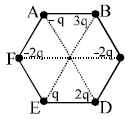
Six charges are placed at the corner of a regular hexagon as shown. If an electron is placed at its centre O , force on it will be :

1. Zero
2. Along OF
3. Along OC
4. None of these
View Answer
Question 27: moderate

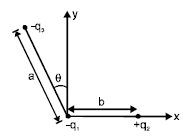
Three charges –q1, +q2 and –q3 are placed as shown in figure . The x-component of the force on –q1 is proportional to

1. \[ \frac{q_{2}}{b^{2}}+\frac{q_{3}}{a^{2}}sin\theta\]
2. \[ \frac{q_{2}}{b^{2}}+\frac{q_{3}}{a^{2}}cos\theta\]
3. \[ \frac{q_{2}}{b^{2}}-\frac{q_{3}}{a^{2}}sin\theta\]
4. \[ \frac{q_{2}}{b^{2}}-\frac{q_{3}}{a^{2}}cos\theta\]
View Answer

To find the \( x \)-component of the force on charge \(-q_1\) in the given setup, let's break down the forces due to \( +q_2 \) and \( -q_3 \) on \( -q_1 \).

1. Force due to \( +q_2 \):
The force \( F_{12} \) between \( -q_1 \) and \( +q_2 \) acts along the \( x \)-axis (horizontally) and has a magnitude:
\[
F_{12} = \frac{k |q_1| |q_2|}{b^2}
\]
Since this force acts along the positive \( x \)-direction, the \( x \)-component of this force is simply:
\[
F_{12x} = \frac{k |q_1| q_2}{b^2}
\]

2. Force due to \( -q_3 \):
The force \( F_{13} \) between \( -q_1 \) and \( -q_3 \) acts along the line joining them, which makes an angle \( \theta \) with the \( y \)-axis. The magnitude of this force is:
\[
F_{13} = \frac{k |q_1| |q_3|}{a^2}
\]
To find the \( x \)-component of \( F_{13} \), we use the angle \( \theta \) with the \( y \)-axis. The \( x \)-component of \( F_{13} \) is:
\[
F_{13x} = \frac{k |q_1| |q_3|}{a^2} \sin \theta
\]
(positive, as it points in the \( +x \)-direction due to the symmetry).

3. Total \( x \)-component of the force on \( -q_1 \):
Adding the \( x \)-components of both forces, we get:
\[
F_x = F_{12x} + F_{13x} = \frac{k |q_1| q_2}{b^2} + \frac{k |q_1| |q_3|}{a^2} \sin \theta
\]

Final Answer
After dividing by \( k |q_1| \) to find the proportional relation, the \( x \)-component of the force on \( -q_1 \) is proportional to:
\[
\frac{q_2}{b^2} + \frac{q_3}{a^2} \sin \theta
\]


Question 28: moderate

Two spherical conductors B and C having equal radii and carrying equal charges on them repel each other with a force F when kept apart at some distance . A third spherical conductor having same radius as that of B but uncharged is brought in contact with B, the n brought in contact with C and finally removed away from both . The new force of repulsion between B and C is 

1. F/4
2. 3F/4
3. F/8
4. 3F/8
View Answer

Given Data
- Two spherical conductors \( B \) and \( C \) have equal radii and equal charges.
- They repel each other with a force \( F \) when kept at a certain distance apart.

Step-by-Step Solution
1. Initial Charge on B and C:
Let's assume the initial charge on both \( B \) and \( C \) is \( q \).
Since they are at a certain distance \( r \) apart, the initial force of repulsion between \( B \) and \( C \) is given by Coulomb's law:
\[
F = \frac{k q^2}{r^2}
\]

2. Introducing the Third Conductor (A):
- A third conductor \( A \) with the same radius as \( B \) and \( C \) is initially uncharged.
- \( A \) is first brought in contact with \( B \), allowing charges to redistribute.

3. Charge Redistribution (First Contact with B):
- When \( A \) (initially uncharged) is brought into contact with \( B \) (which has charge \( q \)), the charge will distribute equally between \( A \) and \( B \) because they have the same radius.
- After contact, the charge on each (both \( A \) and \( B \)) will be:
\[
\frac{q}{2}
\]

4. Charge Redistribution (Then Contact with C):
- Next, \( A \) (which now has charge \( \frac{q}{2} \)) is brought in contact with \( C \) (which has charge \( q \)).
- The charge will again distribute equally between \( A \) and \( C \) because they have the same radius.
- After contact, the charge on each (both \( A \) and \( C \)) will be:
\[
\frac{q}{2} + \frac{q}{2} = \frac{3q}{4}
\]
- So, now \( C \) has a charge of \( \frac{3q}{4} \), and \( A \) also has \( \frac{3q}{4} \).

5. Final Charges on B and C:
- After removing \( A \), the charges on \( B \) and \( C \) are as follows:
- \( B \) has \( \frac{q}{2} \).
- \( C \) has \( \frac{3q}{4} \).

6. New Force of Repulsion between \( B \) and \( C \):
- The new force \( F' \) between \( B \) and \( C \), separated by the same distance \( r \), is given by:
\[
F' = \frac{k \left(\frac{q}{2}\right) \left(\frac{3q}{4}\right)}{r^2}
\]
- Simplifying, we get:
\[
F' = \frac{k \cdot q^2 \cdot 3}{8r^2} = \frac{3}{8} \cdot \frac{k q^2}{r^2}
\]
- Since \( F = \frac{k q^2}{r^2} \), we can write:
\[
F' = \frac{3}{8} F
\]

Final Answer
The new force of repulsion between \( B \) and \( C \) is:
\[
\frac{3F}{8}
\]

Question 29: moderate

When 2 point charges +q and +3q are held at a distance r from each other are released, they have an acceleration of a and 2a respectively. When we distribute the total charge equally between them , keep them at same distance as the original and release them , their accelerations now would be:

1. 2a and 4a
2. 4a/3 and 8a/3
3. 9a/4 and 9a/2
4. 2a/3 and 4a/3
View Answer

Initial Setup:
1. Charges and Forces:
- Two charges \( +q \) and \( +3q \) are separated by distance \( r \).
- The force between them initially is:
\[
F = \frac{k \cdot q \cdot 3q}{r^2} = \frac{3kq^2}{r^2}
\]

2. Accelerations:
- Let the masses of the charges be \( m_1 \) and \( m_2 \).
- Given that the initial accelerations are \( a \) and \( 2a \) for charges \( +q \) and \( +3q \) respectively, we have:
\[
F = m_1 a \quad \text{and} \quad F = m_2 \cdot 2a
\]

Step 1: Determine Mass Ratio
From the equations \( m_1 a = m_2 \cdot 2a \), we get:
\[
m_2 = \frac{m_1}{2}
\]

Step 2: New Charges After Redistribution
When the total charge \( q + 3q = 4q \) is equally distributed, each charge will be:
\[
\frac{4q}{2} = 2q
\]

Step 3: New Force Between Charges
With the new charges \( +2q \) and \( +2q \) at the same distance \( r \), the new force \( F' \) is:
\[
F' = \frac{k \cdot 2q \cdot 2q}{r^2} = \frac{4kq^2}{r^2}
\]

Step 4: New Accelerations
Using \( F' = m_1 a_1' \) and \( F' = m_2 a_2' \), we get:
1. For the first charge (\( m_1 \)):
\[
a_1' = \frac{F'}{m_1} = \frac{4kq^2 / r^2}{m_1} = \frac{4a}{3}
\]

2. For the second charge (\( m_2 = \frac{m_1}{2} \)):
\[
a_2' = \frac{F'}{m_2} = \frac{4kq^2 / r^2}{m_1 / 2} = \frac{8a}{3}
\]

Answer
The new accelerations are:
\[
\frac{4a}{3} \quad \text{and} \quad \frac{8a}{3}
\]

Question 30: moderate

Two conducting sphere s of radii R each are given charges +Q and –Q and are separated by a distance r (>2R). Th e force of attraction between them is \( \overrightarrow{F} \)If instead of charges +Q and –Q, we were to give them charges +Q each , the force of interaction between them would be

1. \[ \overrightarrow{F}\]
2. \[ - \overrightarrow{F}\]
3. direction opposite to \( \overrightarrow{F} \)but magnitude lesser than it
4. direction opposite to \( \overrightarrow{F} \) but magnitude more than it
View Answer

When the spheres have charges \( +Q \) and \( -Q \), they attract each other with force \( \overrightarrow{F} \).

If we replace \( -Q \) with \( +Q \), both spheres will have \( +Q \) charge, causing a repulsive force instead of attraction.

Since \( r > 2R \), there will be induced charges on the surfaces due to electrostatic induction, reducing the effective repulsive force compared to the attractive force \( \overrightarrow{F} \) in the initial configuration.

Conclusion:
The new force will be in the opposite direction to \( \overrightarrow{F} \) (repulsive) but with a magnitude less than \( F \) due to the effect of induced charges.