Electrostatics - NEET Physics Questions
← All Chapters

Electrostatics

Question 1: difficult

Electric field at a distance x from origin is given as E = 100/x², then potential difference between points situated at x = 10 m and x = 20 m.

1. 5 V
2. 10 V
3. 15 V
4. 4 V
View Answer

The electric field \( E \) is related to the potential difference \( \Delta V \) by:

\[
\Delta V = -\int_{x_1}^{x_2} E \, dx
\]

Given \( E = \frac{100}{x^2} \), the potential difference between \( x = 10 \) m and \( x = 20 \) m is:

\[
\Delta V = -\int_{10}^{20} \frac{100}{x^2} \, dx
\]

\[
\Delta V = -\left[ \frac{100}{x} \right]_{10}^{20}
\]

\[
\Delta V = -\left( \frac{100}{20} - \frac{100}{10} \right)
\]

\[
\Delta V = -\left( 5 - 10 \right) = 5 \, \text{V}
\]

Thus, the potential difference is \( 5 \, \text{V} \).
Question 2: moderate

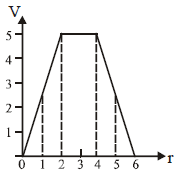
The variation of potential with distance r from a fixed point is as shown in the figure. The electric field at R = 5 m is :

1. 2.5 V/m
2. – 2.5 V/m
3. (2/5) V/m
4. – (2/5) V/m
View Answer

\[ E=-\frac{d V}{dr}= -(\frac{-5}{2})= 2.5 V/m \]

Question 3: difficult

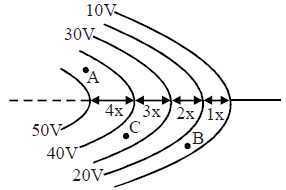
The figure shows lines of constant potential in a region in which electric field is present. The values of the potential are written in brackets. Of the points A, B and C, the magnitude of the electric field is greatest at the point :

1. A
2. B
3. C
4. unpredictable
View Answer

Electric potential decreases in the direction of Electric Field. So Field will be maximum at A

Question 4: difficult

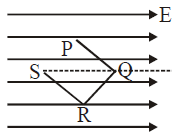
Point charge (q) moves from point (P) to point (S) along the path PQRS as shown in fig. in a uniform electric field E pointing co parallel to the positive direction of the x-axis. The co-ordinates of the points P,Q,R and S are (a, b, 0), (2a, 0, 0), (a, –b, 0) and (0, 0, 0) respectively. The work done by the field in the above process is given by the expression

1. Q E a
2. –Q E a
3. Q E a√2
4. \[ QE\sqrt{\left[ \left( 2a \right)^{2}+b^{2} \right]}\]
View Answer

Work done in a conservative field is not dependent on path taken by the object so,

\[ dV= - \overrightarrow{E}.\overrightarrow{dr}\]

\[ V= - E\widehat{i}.(-a\widehat{i}-b\widehat{j})\]

so, Potential difference = -E.a

Work Done= -Q. E.a

Question 5: difficult

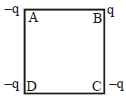
Charges are placed on the vertices of a square as shown. Let \overrightarrow{E} be the electric field and V the potential at the centre. If the charges on A and B are interchanged with those on D and C respectively, then

1. \( \overrightarrow{E}\) remains unchanged, V changes
2. Both \(\overrightarrow{E}\) and V change
3. \(\overrightarrow{E} \) and V remain unchanged
4. \(\overrightarrow{E} \)changes, V remains unchanged
View Answer

On interchanging A and B with C and D direction of electric field will get reversed. But potential being scaler quantity remains unchanged.

Question 6: moderate

A half-ring of radius r has linear charge density λ. The electric potential at the centre of the half-ring is

1. \[ \frac{\lambda}{4\varepsilon_{0}}\]
2. \[ \frac{\lambda}{4\pi^{2}\varepsilon_{0}r}\]
3. \[ \frac{\lambda}{4\pi\varepsilon_{0}r}\]
4. \[ \frac{\lambda}{4\varepsilon_{0}r}\]
View Answer

The electric potential \( V \) at the center of a charged half-ring is given by:

\[
V = \frac{1}{4\pi \epsilon_0} \int \frac{\lambda \, dl}{r}
\]

For a half-ring of radius \( r \), the total length is \( \pi r \), and the potential at the center is:

\[
V = \frac{\lambda}{4\pi \epsilon_0} \cdot \pi r \cdot \frac{1}{r} = \frac{\lambda}{4\epsilon_0}
\]

Thus, the electric potential at the center of the half-ring is:

\[
V = \frac{\lambda}{4 \epsilon_0}
\]

Question 7: moderate

The electric potential at a point (x, y, z) is given by
V = – x² y – xz³ + 4

The electric field E at that point is

1. E = i (2xy + z³) + j x² + k 3xz²
2. E = i 2xy + j (x² + y²) + k (3xz – y²)
3. E = i z³ + j xyz + k z²
4. E = i (2xy – z³) + j xy² + k 3z²x
View Answer

The electric field \(\vec{E}\) is related to the electric potential \(V\) by:

\[
\vec{E} = -\nabla V
\]

Given \(V = -x^2 y - xz^3 + 4\), we calculate the gradient of \(V\):

\[
E_x = -\frac{\partial V}{\partial x} = 2xy + z^3
\]
\[
E_y = -\frac{\partial V}{\partial y} = x^2
\]
\[
E_z = -\frac{\partial V}{\partial z} = 3xz^2
\]

Thus, the electric field is:

\[
\vec{E} = i(2xy + z^3) + j(x^2) + k(3xz^2)
\]

Question 8: moderate

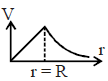
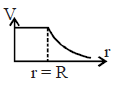
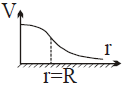
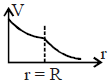
A solid non-conducting sphere is uniformly charged through its volume. Electric potential (V) at a distance (r) from the center of the sphere can be plotted qualitatively as:

1.
2.
3.
4.
View Answer

For a solid, non-conducting sphere uniformly charged throughout its volume, the electric potential \( V(r) \) is determined as follows:

---

Inside the sphere (\( r \leq R \)):
Using Gauss's law, the electric field inside the sphere is:
\[
E = \frac{\rho r}{3\epsilon_0},
\]
where \( \rho \) is the charge density, and \( R \) is the sphere's radius.

The potential \( V(r) \) at a distance \( r \) from the center is obtained by integrating the electric field:
\[
V(r) = V(R) - \int_r^R E \, dr = V(R) - \int_r^R \frac{\rho r}{3\epsilon_0} \, dr.
\]
Simplifying:
\[
V(r) = V(R) - \frac{\rho}{6\epsilon_0} \left( R^2 - r^2 \right).
\]
Thus, inside the sphere, \( V(r) \) is a quadratic function of \( r \), decreasing as \( r^2 \).

---

Outside the sphere (\( r > R \)):
The sphere acts as a point charge with total charge \( Q = \frac{4}{3} \pi R^3 \rho \). The potential outside is:
\[
V(r) = \frac{1}{4\pi\epsilon_0} \frac{Q}{r}.
\]
Here, \( V(r) \) decreases inversely with \( r \).


Behavior of the Graph:
1. At \( r = R \): The potential is continuous, with its value matching between the inside and outside solutions.
2. Inside the sphere (\( r < R \)): \( V(r) \) decreases quadratically as \( r^2 \).
3. Outside the sphere (\( r > R \)): \( V(r) \) decreases inversely with \( r \).

Thus, the graph shows a continuous potential that decreases quadratically inside the sphere and decreases inversely outside the sphere, matching the provided curve.

Question 9: moderate

The electric potential in a certain region of space depends only on x coordinate as V = 3 – 2x³. Find the charge enclosed by a cube of side 1m whose one vertex is at origin and its 3 adjacent sides are oriented along x, y and z axes. If answer is n ∈0, then n is :

1. 6
2. 12
3. 8
4. 10
View Answer

To find the charge enclosed, we use Gauss's law:

\[
Q = \oint \vec{E} \cdot d\vec{A} = \epsilon_0 \frac{dV}{dx} \cdot A
\]

Given \( V(x) = 3 - 2x^3 \), we compute the electric field:

\[
E_x = -\frac{dV}{dx} = 6x^2
\]

Now, for a cube with side 1m and one vertex at the origin, the flux through the cube's face on the x-axis is:

\[
\text{Flux} = E_x \cdot A = 6x^2 \cdot 1 = 6
\]

Since only the face along the x-axis contributes to the flux, the total charge enclosed is:

\[
Q = \epsilon_0 \cdot 6
\]

Thus, \( n = 6 \).

Question 10: moderate

Four point charges –Q, –q, 2q and 2Q are placed one at each corner of the square. The relation between Q and q for which the potential at the centre of the square is zero is

1. Q = q
2. Q = 1/q
3. Q = -q
4. Q = -1/q
View Answer

The potential at the center of the square is the sum of the potentials due to each charge. Since potential is a scalar quantity, the total potential at the center is the algebraic sum of individual potentials.

For the potential to be zero, the sum of the potentials must cancel out. The relationship between \( Q \) and \( q \) for this condition is:

\[
\frac{-Q}{r} + \frac{-q}{r} + \frac{2q}{r} + \frac{2Q}{r} = 0
\]

Simplifying:

\[
(-Q + 2Q) + (-q + 2q) = 0
\]

\[
Q = -q
\]

Thus, the relation is \( Q = -q \).