Electrostatics - NEET Physics Questions
← All Chapters

Electrostatics

Question 31: moderate

An electric dipole with dipole moment \( 2\times 10^{-9} \)Cm is aligned at 30º with the direction of a uniform electric field of magnitude \( 4\times 10^{4} NC^{-1}\). The magnitude of the torque acting on the dipole is :

1. \[ 2\times 10^{-5} Nm\]
2. \[ 2\times 10^{-4} Nm\]
3. \[ 4\times 10^{-4} Nm\]
4. \[ 4\times 10^{-5} Nm\]
View Answer

Given:
- Dipole moment: \( p = 2 \times 10^{-9} \, \text{C·m} \)
- Electric field: \( E = 4 \times 10^{4} \, \text{N/C} \)
- Angle: \( \theta = 30^\circ \)

Torque (\( \tau \)):
\[
\tau = pE \sin\theta
\]
\[
\tau = (2 \times 10^{-9})(4 \times 10^{4}) \sin 30^\circ
\]
\[
\tau = (8 \times 10^{-5}) \times \frac{1}{2} = 4 \times 10^{-5} \, \text{N·m}
\]

Final Answer:
\[
\tau = 4 \times 10^{-5} \, \text{N·m}
\]

Question 32: moderate

A dipole of electric dipole moment p is placed in a uniform electric field of strength E. If θ is the angle between positive directions of p and E, then the potential energy of the electric dipole is largest when θ is :

1. π/4
2. π/2
3. π
4. Zero
View Answer

The potential energy (\(U\)) of an electric dipole in a uniform electric field is given by:

\[
U = -\mathbf{p} \cdot \mathbf{E} = -pE \cos\theta
\]

Here:
- \(p\) is the magnitude of the dipole moment,
- \(E\) is the magnitude of the electric field,
- \(\theta\) is the angle between \(\mathbf{p}\) and \(\mathbf{E}\).

The potential energy is largest when \(-\cos\theta\) is most positive, i.e., when \(\cos\theta = -1\). This happens at:

\[
\theta = \pi \ (\text{180°})
\]

At this angle, the dipole is aligned opposite to the electric field, and the potential energy is \(U = +pE\), its maximum value.

Question 33: easy

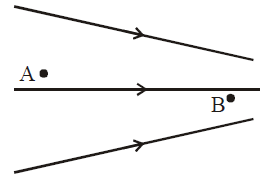
Find out correct relation between electric field intensity EA & EB present at two points in an electric field shown in the figure.

1. \[ E_{A}=E_{B}\]
2. \[ E_{A}>E_{B}\]
3. \[ E_{A}< E_{B}\]
4. Data insufficient
View Answer

Distance between electric field lines represents magnitude of electric field lines. Large is the separation between electric field line lesser is electric field. so ,

\[ E_{A}< E_{B}\]

Question 34: easy

A point charge + Q is positioned at the center of the base of a square pyramid as shown. The flux through one of the four identical upper faces of the pyramid is


1. \[ \frac{Q}{16\varepsilon_{0}}\]
2. \[ \frac{Q}{4\varepsilon_{0}}\]
3. \[ \frac{Q}{8\varepsilon_{0}}\]
4. None of these
View Answer

Step-by-Step Explanation:

1. Flux through the Entire Pyramid:
The total charge enclosed by the pyramid is \(+Q\), and the total flux through the entire closed surface of the pyramid is given by Gauss's law:
\[
\Phi_{\text{total}} = \frac{Q}{\varepsilon_0}.
\]

2. Flux Distribution:
The pyramid has a square base and four triangular faces. However, **the charge \(+Q\) is located at the center of the base, not at the geometric center of the pyramid.** This means the flux through the base is not zero and contributes to the total flux.

3. Flux Through the Base:
Due to symmetry, half of the total flux passes through the square base:
\[
\Phi_{\text{base}} = \frac{\Phi_{\text{total}}}{2} = \frac{Q}{2\varepsilon_0}.
\]

4. Flux Through the Four Triangular Faces:
The remaining half of the total flux passes through the four triangular faces combined:
\[
\Phi_{\text{triangular (total)}} = \frac{\Phi_{\text{total}}}{2} = \frac{Q}{2\varepsilon_0}.
\]

5. Flux Through One Triangular Face:
Since the four triangular faces are identical, the flux is equally distributed among them:
\[
\Phi_{\text{face}} = \frac{\Phi_{\text{triangular (total)}}}{4} = \frac{\frac{Q}{2\varepsilon_0}}{4} = \frac{Q}{8\varepsilon_0}.
\]

Final Answer:
The flux through one triangular face is:
\[
{\frac{Q}{8\varepsilon_0}}.
\]

Question 35: moderate

The electric field in a region is give n by \[ \overrightarrow{E}=200\hat{i}N/C for x > 0 and -200\hat{i}N/C for x < 0 \]

A closed cylinder of length 2m and cross -section area 10² m² is kept in such away that the axis of cylinder is along X-axis and its centre coincides with origin. The total charge inside the cylinder is
(Take \(e_{0}=8.85\times 10^{-12} C^{2}m^{2}N)\)

1. zero
2. \[ 1.86\times 10^{-5}C\]
3. \[ 1.77\times 10^{-11}C\]
4. \[ 35.4\times 10^{-8}C\]
View Answer

To calculate the total charge inside the cylinder, we use Gauss's law:

\[
\Phi_E = \frac{q_{\text{inside}}}{\epsilon_0}
\]

Here:
- \(\Phi_E\) is the total electric flux through the surface of the cylinder,
- \(q_{\text{inside}}\) is the total charge enclosed by the cylinder,
- \(\epsilon_0 = 8.85 \times 10^{-12} \, \text{C}^2/(\text{N·m}^2)\).

Step 1: Electric flux through the cylinder
The cylinder has two flat faces (at \(x = +1\) m and \(x = -1\) m) and a curved surface. The electric field is parallel to the axis, so the flux through the curved surface is **zero**. Thus, only the two flat faces contribute to the flux.

- For the face at \(x = +1\) m:
\(\Phi_E^+ = E \cdot A = 200 \cdot 10^{-2} = 2 \, \text{N·m}^2/\text{C}\),

- For the face at \(x = -1\) m:
\(\Phi_E^- = E \cdot A = -200 \cdot 10^{-2} = -2 \, \text{N·m}^2/\text{C}\).

The total flux is:

\[
\Phi_E = \Phi_E^+ + \Phi_E^- = 2 - (-2) = 4 \, \text{N·m}^2/\text{C}
\]

Step 2: Total charge inside the cylinder
Using Gauss's law:

\[
q_{\text{inside}} = \Phi_E \cdot \epsilon_0 = 4 \cdot (8.85 \times 10^{-12})
\]

Simplify:

\[
q_{\text{inside}} = 35.4 \times 10^{-8} \, \text{C}
\]

Thus, the total charge inside the cylinder is:

\[
{35.4 \times 10^{-8} \, \text{C}}
\]

Question 36:

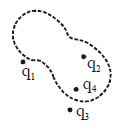
In the arrangement of charges shown, the dotted boundary represents a Gaussian surface . For this surface , Gauss’s law has the form

\[ \oint_{}^{}\overrightarrow{E}.\overrightarrow{ds}=\frac{q}{\varepsilon_{0}} .\]

Select the correct alternative \[ \overrightarrow{E_{1}},\overrightarrow{E_{2}}, \overrightarrow{E_{3}} and \overrightarrow{E_{4}} \] are electric field vectors due to these four

charges respectively.

1. \[ q=q_{2}+q_{4}\]
2. \[ q=q_{2}+q_{4}-q_{1}-q_{3}\]
3. \[ \overrightarrow{E}=\overrightarrow{E_{1}}+\overrightarrow{E_{2}}+\overrightarrow{E_{3}}+\overrightarrow{E_{4}}\]
4. \[ \overrightarrow{E}=\overrightarrow{E_{2}}+\overrightarrow{E_{4}}\]
View Answer

In Gauss law q represents total charge enclosed within the gaussian surface. so,

\[ q= q_{2} + q_{4}\]

Question 37: moderate

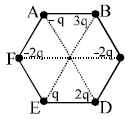
Six charges are placed at the corner of a regular hexagon as shown. If an electron is placed at its centre O , force on it will be :

1. Zero
2. Along OF
3. Along OC
4. None of these
View Answer
Question 38: difficult

When two charges Q each are placed at a distance ‘d’ apart. Find the magnitude of third charge which is placed at mid point the line joining the charge. So that system is in equilibrium 

1. -Q/4
2. -Q/2
3. -Q/3
4. -Q1
View Answer

To find the magnitude of the third charge that will keep the system in equilibrium, follow these steps:

Setup:
- Two charges \( Q \) are placed at a distance \( d \) apart.
- A third charge \( q \) is placed at the midpoint of the line joining the two charges.

For the system to be in equilibrium, the net force on all the charges must be zero.

Forces on the third charge \( q \) at the midpoint:
- The two charges \( Q \) exert forces on \( q \) from opposite directions.
- These forces will be equal in magnitude but opposite in direction, so we need to balance them by choosing the right value for \( q \).

Using Coulomb's law, the force between \( Q \) and \( q \) (at a distance \( d/2 \)) is given by:

\[
F = k \frac{|Q \cdot q|}{(d/2)^2} = k \frac{4|Q \cdot q|}{d^2}
\]

Forces on one of the charges \( Q \) (let's take the left charge):
- The charge \( q \) at the midpoint exerts a force on \( Q \) in one direction.
- The other charge \( Q \) exerts a repulsive force on this charge from the opposite direction.

For equilibrium, the force between the two \( Q \)'s must balance the force due to \( q \) on \( Q \).

1. Force between the two \( Q \)'s:

\[
F_{QQ} = k \frac{Q^2}{d^2}
\]

2. Force between \( Q \) and \( q \) (distance \( d/2 \)):

\[
F_{Qq} = k \frac{4|Q \cdot q|}{d^2}
\]

Condition for equilibrium:
The force between the two \( Q \)'s must equal the force between \( Q \) and \( q \):

\[
k \frac{Q^2}{d^2} = k \frac{4|Q \cdot q|}{d^2}
\]

Canceling out the common terms:

\[
Q^2 = 4|Q \cdot q|
\]

\[
q = \frac{Q}{4}
\]

Conclusion:
The magnitude of the third charge \( q \) that should be placed at the midpoint for equilibrium is:

\[
q = \frac{- Q}{4}
\]
Question 39: moderate

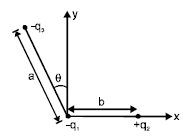
Three charges –q1, +q2 and –q3 are placed as shown in figure . The x-component of the force on –q1 is proportional to

1. \[ \frac{q_{2}}{b^{2}}+\frac{q_{3}}{a^{2}}sin\theta\]
2. \[ \frac{q_{2}}{b^{2}}+\frac{q_{3}}{a^{2}}cos\theta\]
3. \[ \frac{q_{2}}{b^{2}}-\frac{q_{3}}{a^{2}}sin\theta\]
4. \[ \frac{q_{2}}{b^{2}}-\frac{q_{3}}{a^{2}}cos\theta\]
View Answer

To find the \( x \)-component of the force on charge \(-q_1\) in the given setup, let's break down the forces due to \( +q_2 \) and \( -q_3 \) on \( -q_1 \).

1. Force due to \( +q_2 \):
The force \( F_{12} \) between \( -q_1 \) and \( +q_2 \) acts along the \( x \)-axis (horizontally) and has a magnitude:
\[
F_{12} = \frac{k |q_1| |q_2|}{b^2}
\]
Since this force acts along the positive \( x \)-direction, the \( x \)-component of this force is simply:
\[
F_{12x} = \frac{k |q_1| q_2}{b^2}
\]

2. Force due to \( -q_3 \):
The force \( F_{13} \) between \( -q_1 \) and \( -q_3 \) acts along the line joining them, which makes an angle \( \theta \) with the \( y \)-axis. The magnitude of this force is:
\[
F_{13} = \frac{k |q_1| |q_3|}{a^2}
\]
To find the \( x \)-component of \( F_{13} \), we use the angle \( \theta \) with the \( y \)-axis. The \( x \)-component of \( F_{13} \) is:
\[
F_{13x} = \frac{k |q_1| |q_3|}{a^2} \sin \theta
\]
(positive, as it points in the \( +x \)-direction due to the symmetry).

3. Total \( x \)-component of the force on \( -q_1 \):
Adding the \( x \)-components of both forces, we get:
\[
F_x = F_{12x} + F_{13x} = \frac{k |q_1| q_2}{b^2} + \frac{k |q_1| |q_3|}{a^2} \sin \theta
\]

Final Answer
After dividing by \( k |q_1| \) to find the proportional relation, the \( x \)-component of the force on \( -q_1 \) is proportional to:
\[
\frac{q_2}{b^2} + \frac{q_3}{a^2} \sin \theta
\]


Question 40: moderate

Two spherical conductors B and C having equal radii and carrying equal charges on them repel each other with a force F when kept apart at some distance . A third spherical conductor having same radius as that of B but uncharged is brought in contact with B, the n brought in contact with C and finally removed away from both . The new force of repulsion between B and C is 

1. F/4
2. 3F/4
3. F/8
4. 3F/8
View Answer

Given Data
- Two spherical conductors \( B \) and \( C \) have equal radii and equal charges.
- They repel each other with a force \( F \) when kept at a certain distance apart.

Step-by-Step Solution
1. Initial Charge on B and C:
Let's assume the initial charge on both \( B \) and \( C \) is \( q \).
Since they are at a certain distance \( r \) apart, the initial force of repulsion between \( B \) and \( C \) is given by Coulomb's law:
\[
F = \frac{k q^2}{r^2}
\]

2. Introducing the Third Conductor (A):
- A third conductor \( A \) with the same radius as \( B \) and \( C \) is initially uncharged.
- \( A \) is first brought in contact with \( B \), allowing charges to redistribute.

3. Charge Redistribution (First Contact with B):
- When \( A \) (initially uncharged) is brought into contact with \( B \) (which has charge \( q \)), the charge will distribute equally between \( A \) and \( B \) because they have the same radius.
- After contact, the charge on each (both \( A \) and \( B \)) will be:
\[
\frac{q}{2}
\]

4. Charge Redistribution (Then Contact with C):
- Next, \( A \) (which now has charge \( \frac{q}{2} \)) is brought in contact with \( C \) (which has charge \( q \)).
- The charge will again distribute equally between \( A \) and \( C \) because they have the same radius.
- After contact, the charge on each (both \( A \) and \( C \)) will be:
\[
\frac{q}{2} + \frac{q}{2} = \frac{3q}{4}
\]
- So, now \( C \) has a charge of \( \frac{3q}{4} \), and \( A \) also has \( \frac{3q}{4} \).

5. Final Charges on B and C:
- After removing \( A \), the charges on \( B \) and \( C \) are as follows:
- \( B \) has \( \frac{q}{2} \).
- \( C \) has \( \frac{3q}{4} \).

6. New Force of Repulsion between \( B \) and \( C \):
- The new force \( F' \) between \( B \) and \( C \), separated by the same distance \( r \), is given by:
\[
F' = \frac{k \left(\frac{q}{2}\right) \left(\frac{3q}{4}\right)}{r^2}
\]
- Simplifying, we get:
\[
F' = \frac{k \cdot q^2 \cdot 3}{8r^2} = \frac{3}{8} \cdot \frac{k q^2}{r^2}
\]
- Since \( F = \frac{k q^2}{r^2} \), we can write:
\[
F' = \frac{3}{8} F
\]

Final Answer
The new force of repulsion between \( B \) and \( C \) is:
\[
\frac{3F}{8}
\]