The figure shows the electric field lines in the vicinity of two point charges . Which one of the following statements concerning this situation is true ?
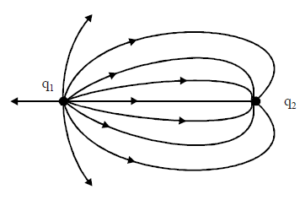
1. q1 is negative and q2 is positive
2. The magnitude of the ratio (q2/q1) is less than one
3. Both q1 and q2 have the same sign of charge
4. The electric field is strongest midway between the charges .
View Answer
Number of electric field lines coming out of a charge represents magnitude of charge. Here number of field line coming out of q1 is more than that of q2 so, |q2/q1 |<1.
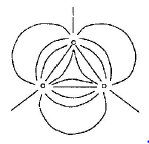
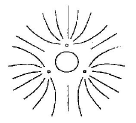
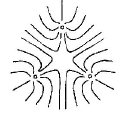
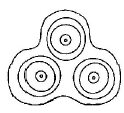
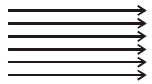
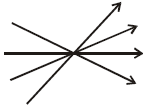
Three positive charges of equal value q are placed at the vertices of an equilateral triangle . The resulting lines of force should be sketched as in
View Answer
Option 1 is wrong as electric field lines will emerge out of +ve charge and should submerge only at -ve charge.
Option 2 is wrong as electric field lines can not be circular loop.
Option 3 is correct.
Option 4 is wrong because it is representing equipotential surface not field lines
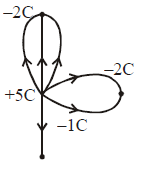
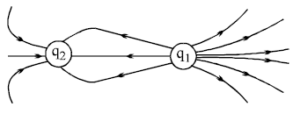
For the figure shown, what is the ratio of the charges q2/q1, where the figure shown has a representation of the field lines in the space near the charges
1. –3/2
2. –2/3
3. 2/3
4. 3/2
View Answer
Number of Electric Field line is proportional to amount of charge. so,
\[ \frac{Q_{2}}{Q_{1}}=\frac{-6}{9}=\frac{-2}{3} \]
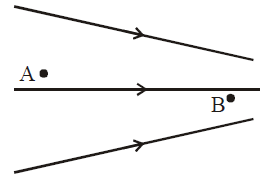
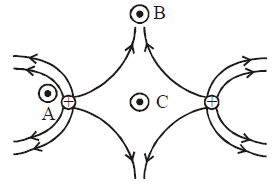
The figure below shows the electric field lines due to two positive charges. The magnitudes \(E_{A},E_{B} and E_{C}\) of the electric fields at points A, B, and C respectively are related as :
1. \[E_{A}>E_{B}>E_{C}\]
2. \[E_{B}>E_{A}>E_{C}\]
3. \[E_{A}=E_{B}>E_{C}\]
4. \[E_{A}>E_{B}=E_{C}\]
View Answer
Number of Electric field line in space represents electric field intensity. As number of field line is maximum at A followed by B then at C. so, \(E_{A}>E_{B}>E_{C}\)
Assertion (A): If a charge is released from rest in an electric field, it will always move along an electric field line.
Reason (R): Force on a charged particle is always in the direction of electric field.
1. Both (A) & (R) are true and the (R) is the correct explanation of the (A)
2. Both (A) & (R) are true but the (R) is not the correct explanation of the (A)
3. (A) is true but (R) is false
4. Both (A) and (R) are false
View Answer
Assertion (A) is false; a particle released from rest follows a field line only if it is straight. If the field line is curved, inertia causes deviation. Reason (R) is false; for a negative charge, the force \(\vec{F} = q\vec{E}\) is opposite to the electric field \(\vec{E}\). Thus, both A and R are false.
Assertion (A): A charged particle is free to move in an electric field. It may or may not move along an electric line of force.
Reason (R): Initial conditions affect the motion of charged particle.
1. Both (A) & (R) are true and the (R) is the correct explanation of the (A)
2. Both (A) & (R) are true but the (R) is not the correct explanation of the (A)
3. (A) is true but (R) is false
4. Both (A) and (R) are false
View Answer
Assertion (A) is true; a charged particle's path in an electric field depends on its initial velocity and the field's curvature. Reason (R) is also true, as the initial velocity and position are crucial 'initial conditions' determining the trajectory. Reason (R) directly explains why the particle's path may or may not follow a field line.