Electrostatics - NEET Physics Questions
← All Chapters

Electrostatics

Question 81: moderate

A point Q lies on the perpendicular bisector of an electric dipole of dipole moment p. If the distance of Q from the dipole is r (much larger than the size of the dipole) then electric field at Q is proportional to :

1. \(p^{-1} \)and \( r^{-2}\)
2. p and \( r^{-2}\)
3. \(p^{2}\)  and \(r^{-3}\)
4. p and \( r^{-3}\)
View Answer

For a point \( Q \) on the perpendicular bisector of an electric dipole (distance \( r \) from the center, where \( r \gg \text{dipole length} \)):

1. Electric Field on Perpendicular Bisector: The electric field \( E \) at a point on the perpendicular bisector of a dipole is given by:
\[
E \propto \frac{p}{r^3}
\]

2. Dependence:
- Directly proportional to the dipole moment \( p \).
- Inversely proportional to \( r^3 \).

Answer:
The electric field at \( Q \) is proportional to:
\[
p \quad \text{and} \quad r^{-3}
\]
Question 82: moderate

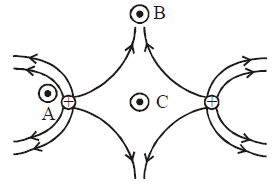
The figure below shows the electric field lines due to two positive charges. The magnitudes \(E_{A},E_{B} and E_{C}\) of the electric fields at points A, B, and C respectively are related as :


1. \[E_{A}>E_{B}>E_{C}\]
2. \[E_{B}>E_{A}>E_{C}\]
3. \[E_{A}=E_{B}>E_{C}\]
4. \[E_{A}>E_{B}=E_{C}\]
View Answer

Number of Electric field line in space represents electric field intensity. As number of field line is maximum at A followed by B then at C. so, \(E_{A}>E_{B}>E_{C}\)

Question 83: moderate

A charge \(Q\) \(mu\text{C}\) is placed at the centre of a cube. The flux coming out from any one of its faces will be (in SI unit)

1. \(\frac{Q}{6ε_0} times 10^{-3}\)
2. \( \frac{Q}{6ε_0} times 10^{-6}\)
3. \( \frac{Q}{ε_0} times 10^{-6}\)
4. \( \frac{2Q}{3ε_0} times 10^{-3}\)
View Answer

By Gauss's law, the total flux through the cube is \(\Phi = \frac{q_{\text{enclosed}}}{ε_0}\). Since the charge is at the center, the flux through one of the six faces is \(\Phi_1 = \frac{\Phi}{6} = \frac{Q \times 10^{-6}}{6ε_0}\).