Gauss's Law - NEET Physics Questions
Question 1: moderate

Two parallel plates of infinite dimensions are uniformly charged. The surface charge density on one is \(\sigma_{A} \)and on the other is \(\sigma_{B}\), field intensity at point C will be

1. Proportional to \[\left( \sigma_{A}-\sigma_{B} \right)\]
2. Proportional to \[\left( \sigma_{A}+\sigma_{B} \right)\]
3. zero
4. \[2\sigma_{A}\]
View Answer

Net Electric Point at Point C will be directed downwards

\[ \overrightarrow{E}=\frac{\sigma_{A}}{2\varepsilon_{0}} + \frac{\sigma_{B}}{2\varepsilon_{0}}\]

Question 2: easy

A uniform electric field E = 2 × 10³ NC–¹ is acting along the positive x-axis. The flux of this field through a square of 10 cm on a side whose plane is parallel to the yz plane is :


1. \[20NC^{-1}m^{2}\]
2. \[ 30NC^{-1}m^{2}\]
3. \[ 10NC^{-1}m^{2}\]
4. \[ 40NC^{-1}m^{2}\]
View Answer

To calculate the flux \(\Phi_E\) of the electric field \(\vec{E}\) through the square, we use the formula:

\[
\Phi_E = \vec{E} \cdot \vec{A}
\]

Here:
- \(\vec{E} = 2 \times 10^3 \, \text{N/C}\) (along the positive x-axis),
- \(\vec{A}\) is the area vector, perpendicular to the plane of the square.

Since the square lies in the yz-plane, its area vector points along the x-axis (same direction as \(\vec{E}\)), and its magnitude is the area of the square:

\[
\text{Side of square} = 10 \, \text{cm} = 0.1 \, \text{m}, \quad \text{Area} = (0.1)^2 = 0.01 \, \text{m}^2
\]

The flux is:

\[
\Phi_E = |\vec{E}| \cdot |\vec{A}| \cdot \cos\theta
\]

Here, \(\theta = 0^\circ\) (since \(\vec{E}\) is parallel to \(\vec{A}\)):

\[
\Phi_E = (2 \times 10^3) \cdot 0.01 \cdot \cos 0^\circ = 20 \, \text{N·m}^2/\text{C}
\]

Thus, the flux is:

\[
{20 \, \text{N·m}^2/\text{C}}
\]

Question 3: moderate

Two large thin metal plates are parallel and close to each other. On their inner faces, the plates have surface charge densities of opposite signs and magnitude 27\times 10^{-22}Cm^{-2}. The electric field \overrightarrow{E} in region II in between the plates is :

1. \[ 4.25\times 10^{-8}NC^{-1}\]
2. \[ 6.28\times 10^{-10}NC^{-1}\]
3. \[ 3.05\times 10^{-10}NC^{-1}\]
4. \[ 5.03\times 10^{-10}NC^{-1}\]
View Answer

Electric field at Point II will be due to both the sheets so,

\[\overrightarrow{E}=\frac{\sigma}{2\varepsilon_{0}} + \frac{\sigma}{2\varepsilon_{0}}=\frac{\sigma}{\varepsilon_{0}}\]

Question 4: moderate

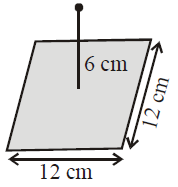
A point charge +20 μC is at a distance 6 cm directly above the centre of a square of side 12 cm as shown is figure. The magnitude of electric flux through the square is :


1. \[ 2.5\times 10^{6}Nm^{2}C^{-1}\]
2. \[ 3.8\times 10^{5}Nm^{2}C^{-1}\]
3. \[ 4.2\times 10^{5}Nm^{2}C^{-1}\]
4. \[ 2.9\times 10^{6}Nm^{2}C^{-1}\]
View Answer

To calculate the electric flux through the square, we use Gauss's law and symmetry principles.

The total flux from a point charge \(q = +20 \, \mu\text{C}\) is:

\[
\Phi_{\text{total}} = \frac{q}{\epsilon_0}
\]

Here:
- \(q = 20 \times 10^{-6} \, \text{C}\),
- \(\epsilon_0 = 8.854 \times 10^{-12} \, \text{C}^2/\text{N·m}^2\).

The square is part of an imaginary cube with the charge at its center. The flux through one face of the cube (the square in question) is:

\[
\Phi_{\text{square}} = \frac{\Phi_{\text{total}}}{6} = \frac{q}{6\epsilon_0}
\]

Substitute the values:

\[
\Phi_{\text{square}} = \frac{20 \times 10^{-6}}{6 \times 8.854 \times 10^{-12}}
\]

Simplify:

\[
\Phi_{\text{square}} = 3.77 \times 10^5 \, \text{N·m}^2/\text{C}
\]

Thus, the flux through the square is approximately:

\[
{3.8 \times 10^5 \, \text{N·m}^2/\text{C}}
\]

Question 5: moderate

The electric field in a region is give n by \[ \overrightarrow{E}=200\hat{i}N/C for x > 0 and -200\hat{i}N/C for x < 0 \]

A closed cylinder of length 2m and cross -section area 10² m² is kept in such away that the axis of cylinder is along X-axis and its centre coincides with origin. The total charge inside the cylinder is
(Take \(e_{0}=8.85\times 10^{-12} C^{2}m^{2}N)\)

1. zero
2. \[ 1.86\times 10^{-5}C\]
3. \[ 1.77\times 10^{-11}C\]
4. \[ 35.4\times 10^{-8}C\]
View Answer

To calculate the total charge inside the cylinder, we use Gauss's law:

\[
\Phi_E = \frac{q_{\text{inside}}}{\epsilon_0}
\]

Here:
- \(\Phi_E\) is the total electric flux through the surface of the cylinder,
- \(q_{\text{inside}}\) is the total charge enclosed by the cylinder,
- \(\epsilon_0 = 8.85 \times 10^{-12} \, \text{C}^2/(\text{N·m}^2)\).

Step 1: Electric flux through the cylinder
The cylinder has two flat faces (at \(x = +1\) m and \(x = -1\) m) and a curved surface. The electric field is parallel to the axis, so the flux through the curved surface is **zero**. Thus, only the two flat faces contribute to the flux.

- For the face at \(x = +1\) m:
\(\Phi_E^+ = E \cdot A = 200 \cdot 10^{-2} = 2 \, \text{N·m}^2/\text{C}\),

- For the face at \(x = -1\) m:
\(\Phi_E^- = E \cdot A = -200 \cdot 10^{-2} = -2 \, \text{N·m}^2/\text{C}\).

The total flux is:

\[
\Phi_E = \Phi_E^+ + \Phi_E^- = 2 - (-2) = 4 \, \text{N·m}^2/\text{C}
\]

Step 2: Total charge inside the cylinder
Using Gauss's law:

\[
q_{\text{inside}} = \Phi_E \cdot \epsilon_0 = 4 \cdot (8.85 \times 10^{-12})
\]

Simplify:

\[
q_{\text{inside}} = 35.4 \times 10^{-8} \, \text{C}
\]

Thus, the total charge inside the cylinder is:

\[
{35.4 \times 10^{-8} \, \text{C}}
\]

Question 6:

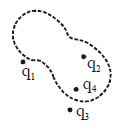
In the arrangement of charges shown, the dotted boundary represents a Gaussian surface . For this surface , Gauss’s law has the form

\[ \oint_{}^{}\overrightarrow{E}.\overrightarrow{ds}=\frac{q}{\varepsilon_{0}} .\]

Select the correct alternative \[ \overrightarrow{E_{1}},\overrightarrow{E_{2}}, \overrightarrow{E_{3}} and \overrightarrow{E_{4}} \] are electric field vectors due to these four

charges respectively.

1. \[ q=q_{2}+q_{4}\]
2. \[ q=q_{2}+q_{4}-q_{1}-q_{3}\]
3. \[ \overrightarrow{E}=\overrightarrow{E_{1}}+\overrightarrow{E_{2}}+\overrightarrow{E_{3}}+\overrightarrow{E_{4}}\]
4. \[ \overrightarrow{E}=\overrightarrow{E_{2}}+\overrightarrow{E_{4}}\]
View Answer

In Gauss law q represents total charge enclosed within the gaussian surface. so,

\[ q= q_{2} + q_{4}\]

Question 7: difficult

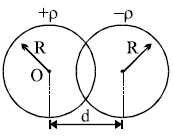
There are two non-conducting spheres having uniform volume charge densities ρ and –ρ . Both spheres have equal radius R. The spheres are
now laid down such that they overlaps as shown in the figure. The electric field \(\overrightarrow{E}\) in the overlap region is

1. non uniform
2. zero
3. \[ \frac{\rho}{3\epsilon_{0}}\overrightarrow{d}\]
4. \[ \frac{\rho}{3\epsilon_{0}}\overrightarrow{r}\]
View Answer

To calculate the electric field in the overlap region, we use the principle of superposition of electric fields. Let's analyze:

Step 1: Electric field due to one sphere
For a uniformly charged non-conducting sphere, the electric field inside the sphere at a distance \(\vec{r}\) from the center is:

\[
\vec{E}_{\text{sphere}} = \frac{\rho}{3\epsilon_0} \vec{r}
\]

Here:
- \(\rho\) is the charge density of the sphere,
- \(\epsilon_0\) is the permittivity of free space,
- \(\vec{r}\) is the position vector from the center of the sphere.

Step 2: Contribution of both spheres in the overlap region
- For the positively charged sphere (\(+\rho\)), the electric field at any point in the overlap region is directed **away** from its center, proportional to \(\vec{r}_1\) (distance from its center).
- For the negatively charged sphere (\(-\rho\)), the electric field at any point in the overlap region is directed **toward** its center, proportional to \(\vec{r}_2\) (distance from its center).

Thus, the net electric field is the vector sum:

\[
\vec{E}_{\text{net}} = \frac{\rho}{3\epsilon_0} \vec{r}_1 + \frac{-\rho}{3\epsilon_0} \vec{r}_2
\]

Step 3: Relation between \(\vec{r}_1\), \(\vec{r}_2\), and \(\vec{d}\)
In the overlap region, \(\vec{r}_1 - \vec{r}_2 = \vec{d}\), where \(\vec{d}\) is the displacement vector between the centers of the two spheres.

Substitute this into the expression for \(\vec{E}_{\text{net}}\):

\[
\vec{E}_{\text{net}} = \frac{\rho}{3\epsilon_0} (\vec{r}_1 - \vec{r}_2) = \frac{\rho}{3\epsilon_0} \vec{d}
\]

Final Answer:

The electric field in the overlap region is:

\[
{\frac{\rho}{3\epsilon_0} \vec{d}}
\]

Question 8: moderate

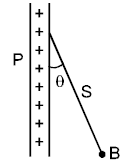
A charged ball B hangs from a silk thread S which makes an angle θ with a large charged conducting sheet P, as shown in the figure. The surface charge density ρ of the sheet is proportional to :


1. cos θ
2. cot θ
3. sin θ
4. tan θ
View Answer

To solve for the proportionality of the surface charge density \(\sigma\) with \(\tan\theta\), we analyze the forces acting on the charged ball \(B\):

Step 1: Forces acting on the ball
1. Gravitational force (\(F_g\)): Acts vertically downward, magnitude \(F_g = mg\), where \(m\) is the mass of the ball.
2. Electric force (\(F_e\)): Acts horizontally, due to the electric field produced by the charged conducting sheet.
3. Tension (\(T\)): Acts along the silk thread, balancing the net forces in both horizontal and vertical directions.

The electric field near a charged conducting sheet with surface charge density \(\sigma\) is:

\[
E = \frac{\sigma}{2\epsilon_0}
\]

The electric force on the ball is:

\[
F_e = qE = q \cdot \frac{\sigma}{2\epsilon_0}
\]

Step 2: Force balance
At equilibrium:
- In the vertical direction: \(T \cos\theta = mg\)
- In the horizontal direction: \(T \sin\theta = F_e = q \cdot \frac{\sigma}{2\epsilon_0}\)

Taking the ratio of the horizontal and vertical components:

\[
\tan\theta = \frac{T \sin\theta}{T \cos\theta} = \frac{F_e}{F_g} = \frac{q \cdot \frac{\sigma}{2\epsilon_0}}{mg}
\]

\[
\tan\theta \propto \sigma
\]

Final Answer:
The surface charge density \(\sigma\) of the sheet is proportional to:

\[
{\tan\theta}
\]

Question 9: easy

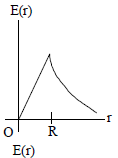
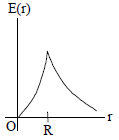
A thin spherical shell of radius R has charge Q spread uniformly over its surface. Which of the following graphs most closely represents the electric field E (r) produced by the shell in the range 0 ≤ r < ∞, where r is the distance from the centre of the shell?

1.
2.
3.
4.
View Answer

The graph in the uploaded image is correct. Here's the explanation with equations:

For a spherical shell of radius \( R \) with charge \( Q \), the electric field \( E(r) \) is given by:

1. Inside the shell (\( 0 \leq r < R \)):
By Gauss's law, the electric field inside a spherical shell is zero:
\[
E(r) = 0, \quad \text{for } r < R
\]

2. On or outside the shell (\( r \geq R \)):
The shell behaves like a point charge located at its center. The electric field at a distance \( r \) is:
\[
E(r) = \frac{1}{4 \pi \epsilon_0} \cdot \frac{Q}{r^2}, \quad \text{for } r \geq R
\]

Graph Representation:
- For \( r < R \), \( E(r) = 0 \), so the graph is flat (on the \( x \)-axis).
- For \( r \geq R \), \( E(r) \propto \frac{1}{r^2} \), so the graph decreases as \( r \) increases, starting from a maximum value at \( r = R \).

Question 10: difficult

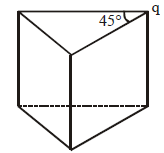
A prism shaped imaginary structure is given. A point charge is kept as given in figure. Calculate electric flux passing through the prism.

1. \[\frac{q}{4\epsilon_{0}}\]
2. \[\frac{q}{8\epsilon_{0}}\]
3. \[\frac{q}{16\epsilon_{0}}\]
4. \[\frac{q}{32\epsilon_{0}}\]
View Answer

To calculate the electric flux passing through the prism:

1. Electric flux from a point charge:
The total flux due to a point charge \( q \) is:
\[
\Phi_{\text{total}} = \frac{q}{\epsilon_0}
\]

2. Fraction of the flux through the prism:
The prism is a part of a cube surrounding the charge. Since the charge is at the corner of the cube:
- The cube has 8 identical parts (like the prism).
- The flux through the prism is \( \frac{1}{8} \) of the flux through the cube.

3. Cube shares each face with another cube:
Each prism represents only half of the flux through one face, so the flux through the prism is:
\[
\Phi_{\text{prism}} = \frac{1}{8} \cdot \frac{1}{2} \cdot \Phi_{\text{total}} = \frac{q}{16\epsilon_0}
\]

Thus, the flux through the prism is:
\[
{\frac{q}{16\epsilon_0}}
\]