Properties of Charges - NEET Physics Questions
← Back to Electrostatics

Properties of Charges

Question 1: moderate

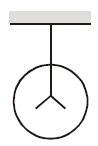
An electroscope is given a positive charge, causing its foil leaves to separate. When an object is brought near the top plate of the electrosope, the foils
separate even further. We conclude :
 

1. that the object is positively charged
2. that the object is electrically neutral
3. that the object is negatively charged
4. none of these
View Answer

The behavior of the electroscope can be explained as follows:

  • The electroscope is already positively charged, causing its foil leaves to separate due to the like charges repelling each other.
  • When the object is brought near the top plate and the foils separate even further, it indicates that more positive charge is being induced on the leaves. This happens when the object is also positively charged, as it repels positive charges towards the leaves, increasing the repulsion.

Thus, we conclude that the object is positively charged.

Question 2: moderate

Mark correct option :

1. Like charged bodies always repel each other
2. Like charged bodies always attract each other
3. Like charged bodies may attract each other
4. None of the above
View Answer

The statement "Like charged bodies may attract each other" is correct in certain situations due to charge redistribution. Here's the explanation:

  • When two like-charged bodies are brought close to each other, the distribution of charges on their surfaces may become non-uniform. This happens due to polarization effects caused by the electric fields of each body.
  • If the bodies are not perfectly conducting or have uneven shapes, the induced charge distributions may result in regions of opposite charge between the bodies, leading to localized attraction despite the overall like charges.

Thus, under specific conditions, like-charged bodies can exhibit attraction.

Question 3: easy

If a body has a charge of /(10^{-12}\) coulomb :

1. the body has \(6.25\times 10^{6} \)excess of electrons
2. the body has \( 625\times 10^{6}\) excess of electrons
3. the body has \(6.25\times 10^{6}\) deficiency of electrons
4. the body has \(6.25\times 10^{3} \)deficiency of electrons
View Answer

To determine the deficiency of electrons for a body with a charge of

1012C10^{-12} \, \text{C}

, follow these steps:

  1. Charge of a single electron: The charge of one electron is
    e=1.6×10¹⁹Ce = 1.6 \times 10^{-19} \, \text{C}
     

    .

  2. Number of electrons (deficiency): The total number of electrons causing the charge is given by: 

    n=Total chargeCharge of one electron=10121.6×1019=6.25×106.n = \frac{\text{Total charge}}{\text{Charge of one electron}} = \frac{10^{-12}}{1.6 \times 10^{-19}} = 6.25 \times 10^{6}. 

  3. Interpretation: Since the body is positively charged, it has a deficiency of
    6.25×1066.25 \times 10^6
     

    electrons.

Question 4: moderate

Two metallic spheres of same mass are given equal and opposite charges; then :

1. the mass of positively charged sphere increases
2. the mass of both remains the same
3. the mass of negatively charged sphere increased
4. the mass of both spheres increases
View Answer

The mass of the negatively charged sphere increases because:

  • When a sphere becomes negatively charged, it gains extra electrons. Since electrons have mass (
    9.1×1031kg9.1 \times 10^{-31} \, \text{kg}
     

    ), the addition of electrons increases the mass of the negatively charged sphere.

  • Conversely, the positively charged sphere loses electrons, resulting in a slight decrease in its mass.

Thus, the mass of the negatively charged sphere increases due to the addition of electrons.

Question 5: easy

A body is charged by rubbing it, its weight :

1. always decreases slightly
2. always increases slightly
3. may increase or decrease slightly
4. remains precisely the same
View Answer

When a body is charged by rubbing, its weight may increase or decrease slightly because:

  1. Gain of electrons (negative charge):
    • If the body gains electrons during the process, it becomes negatively charged.
    • Since electrons have mass (
      9.1×1031kg9.1 \times 10^{-31} \, \text{kg}
       

      ), the body’s weight will increase slightly due to the addition of electrons.

  2. Loss of electrons (positive charge):
    • If the body loses electrons during rubbing, it becomes positively charged.
    • The loss of electrons reduces the body's total mass, so its weight will decrease slightly.

Thus, depending on whether the body gains or loses electrons, its weight may increase or decrease slightly.

Question 6: easy

Unit of dielectric constant of a medium is :

1. coulomb/newton-metre
2. newton-metre²/coulomb²
3. coulomb²/(newton-metre)²
4. none of the above
View Answer

The dielectric constant (also called the relative permittivity,

εr\varepsilon_r

) is a dimensionless quantity because it is defined as the ratio:


εr=εε0\varepsilon_r = \frac{\varepsilon}{\varepsilon_0}


Where:


  • ε\varepsilon
     

    = permittivity of the medium (units: F/m\text{F/m} 

    , farads per meter)


  • ε0\varepsilon_0
     

    = permittivity of free space ( F/m\text{F/m} 

    , farads per meter)

Since it is a ratio of two quantities with the same unit, the dielectric constant has no unit (it is dimensionless).

Question 7: easy

Select the correct statement :

1. the total charge of the universe is constant
2. the total number of the charged particles is constant
3. the total positive charge of the universe remains constant
4. the total negative charge of the universe remains constant
View Answer

The correct statement is "the total charge of the universe is constant" because:

  • Conservation of charge is a fundamental principle in physics. It states that the total electric charge in an isolated system remains constant, regardless of the processes occurring within the system.
  • This principle applies to all known interactions and processes, such as chemical reactions, particle collisions, and even cosmic events, meaning that charge cannot be created or destroyed—only transferred between objects.

Thus, the total charge in the universe remains constant.

Question 8: easy

The electric charge in accelerated motion produces:

1. an electric field
2. a magnetic field
3. electromagnetic radiation
4. all of the above
View Answer

The electric charge in accelerated motion produces electromagnetic radiation.

Here’s why:

  • When a charged particle accelerates (changes velocity), it disturbs the surrounding electromagnetic field. These disturbances propagate as electromagnetic waves, which include light, radio waves, X-rays, etc.
  • This is a fundamental result of Maxwell's equations, which describe how electric and magnetic fields interact with charged particles.

Thus, an accelerating electric charge produces electromagnetic radiation, which can be detected as waves of energy moving through space.

Question 9: easy

A soap bubble is given a negative charge then its radius:

1. decreases
2. increases
3. remains unchanged
4. nothing can be predicted as information is insufficient
View Answer

When a soap bubble is given a negative charge, the radius of the bubble increases. Here's why:

  • A soap bubble with charge experiences electrostatic repulsion between the like charges distributed on its surface. This repulsion causes the surface to expand.
  • The electrostatic pressure
    PP
     

    on the surface of a charged sphere (or bubble) is given by the formula:


P=2σ2ε0P = \frac{2 \sigma^2}{\varepsilon_0}


where

σ\sigma

is the surface charge density, and

ε0\varepsilon_0

is the permittivity of free space. This pressure acts to push the bubble outward.

  • To counteract this, the bubble expands, increasing its radius in response to the electrostatic repulsion.

Thus, when a soap bubble is negatively charged, the repulsion between the charges causes the bubble's radius to increase.

Question 10: easy

Two metallic spheres carry equal charges. The distance between the spheres cannot be considered large in comparison with the diameters of the spheres. In which case, will the force of interaction between the spheres be greater ?

1. Like charges
2. Unlike charges
3. One is neutral and other is charged
4. None of the above
View Answer

When the two metallic spheres are close to each other, their charges induce redistribution of charges on their surfaces due to proximity. This redistribution impacts the force of interaction:

  • For like charges (both positive or both negative): The redistribution of charge reduces the repulsive force because the induced charges create opposing electric fields, weakening the overall repulsion.
  • For unlike charges (one positive, one negative): The redistribution enhances the attractive force because the induced charges increase the local electric field, strengthening the attraction.

Thus, the force of interaction is greater for unlike charges due to this enhancement caused by charge redistribution.