Electrostatics - NEET Physics Questions
← All Chapters

Electrostatics

Question 51: moderate

Two metallic spheres of same mass are given equal and opposite charges; then :

1. the mass of positively charged sphere increases
2. the mass of both remains the same
3. the mass of negatively charged sphere increased
4. the mass of both spheres increases
View Answer

The mass of the negatively charged sphere increases because:

  • When a sphere becomes negatively charged, it gains extra electrons. Since electrons have mass (
    9.1×1031kg9.1 \times 10^{-31} \, \text{kg}
     

    ), the addition of electrons increases the mass of the negatively charged sphere.

  • Conversely, the positively charged sphere loses electrons, resulting in a slight decrease in its mass.

Thus, the mass of the negatively charged sphere increases due to the addition of electrons.

Question 52: easy

Two metallic spheres carry equal charges. The distance between the spheres cannot be considered large in comparison with the diameters of the spheres. In which case, will the force of interaction between the spheres be greater ?

1. Like charges
2. Unlike charges
3. One is neutral and other is charged
4. None of the above
View Answer

When the two metallic spheres are close to each other, their charges induce redistribution of charges on their surfaces due to proximity. This redistribution impacts the force of interaction:

  • For like charges (both positive or both negative): The redistribution of charge reduces the repulsive force because the induced charges create opposing electric fields, weakening the overall repulsion.
  • For unlike charges (one positive, one negative): The redistribution enhances the attractive force because the induced charges increase the local electric field, strengthening the attraction.

Thus, the force of interaction is greater for unlike charges due to this enhancement caused by charge redistribution.

Question 53: moderate

Choose incorrect statement/s :

(A) In friction (method of charging), body having high work function will aquire positive charge.

(B) In conduction charge transfer takes place till potential of both bodies becomes equal.

(C) Inducing body will get opposite nature of charge.

(D) Induction is a body phenomena.

1. Only A
2. Only B
3. Both A and C
4. Both C and D
View Answer

Here’s the reasoning behind the incorrect statements A and C:

(A) Incorrect:

  • In frictional charging, the body with a lower work function (which requires less energy to remove electrons) will lose electrons and acquire a positive charge, while the one with a higher work function will gain electrons and acquire a negative charge. Thus, the statement is reversed.

(C) Incorrect:

  • In induction, the inducing body does not get an opposite charge. Instead, the induced charge on the other body is opposite in nature to the inducing charge, while the inducing body retains its original charge. Therefore, this statement is wrong.

Additional Notes:

  • (B) Correct: In conduction, charge transfer continues until both bodies achieve the same potential.
  • (D) Correct: Induction involves the rearrangement of charges within a body due to the presence of a nearby charged object. It is a property of the body itself.
Question 54: moderate

Dimensions of \( \frac{Kq^{2}}{Gm^{2}} \) are where \( K=\frac{1}{4\pi\varepsilon_{0}} \)

1. \[ \left[ M^{1}L^{1}T^{-2} \right]\]
2. \[ \left[ M^{1}L^{-3}T^{-2} \right] \]
3. \[ \left[ M^{1}L^{3}T^{-2} \right]\]
4. No Dimensions
View Answer

To find the dimensions of \(\frac{Kq^{2}}{Gm^{2}}\), we analyze the dimensions of each component.

1. Dimensions of \( K \):
- Given \( K = \frac{1}{4\pi \varepsilon_0} \), where \(\varepsilon_0\) is the permittivity of free space.
- \( K \) has dimensions of \(\left[ \text{Force} \cdot \text{Distance}^2 \cdot \text{Charge}^{-2} \right] = \left[ M^1 L^3 T^{-4} A^{-2} \right] \).

2. Dimensions of \( q^2 \):
- The charge \( q \) has dimensions \(\left[ A T \right]\), so \( q^2 \) has dimensions \(\left[ A^2 T^2 \right]\).

3. Dimensions of \( G \):
- \( G \) is the gravitational constant with dimensions \(\left[ M^{-1} L^3 T^{-2} \right]\).

4. Dimensions of \( m^2 \):
- The mass \( m \) has dimensions \(\left[ M \right]\), so \( m^2 \) has dimensions \(\left[ M^2 \right]\).

5. Combine Everything:
- Now, \(\frac{Kq^2}{Gm^2}\) has dimensions:
\[
\frac{\left[ M^1 L^3 T^{-4} A^{-2} \right] \cdot \left[ A^2 T^2 \right]}{\left[ M^{-1} L^3 T^{-2} \right] \cdot \left[ M^2 \right]}
\]

6. Simplify:
- This simplifies to \(\left[ M^0 L^0 T^0 A^0 \right] = \text{No Dimensions}\).

Conclusion:
The expression \(\frac{Kq^2}{Gm^2}\) is dimensionless.

Question 55: moderate

A charge Q is placed at the mouth of a conical flask. The flux of the electric field through the flask is

1. \[ \frac{Q}{3\varepsilon_{0}}\]
2. \[ \frac{Q}{\varepsilon_{0}}\]
3. \[ \frac{Q}{2\varepsilon_{0}}\]
4. \[ \frac{2Q}{\varepsilon_{0}}\]
View Answer

The total flux due to a charge \(Q\) is given by Gauss's law:

\[
\Phi_{\text{total}} = \frac{Q}{\varepsilon_0}.
\]

Since the charge \(Q\) is placed at the mouth of the conical flask, the flux through the flask corresponds to half the total flux (because the charge is symmetrically distributed above and below the mouth):

\[
\Phi_{\text{flask}} = \frac{1}{2} \cdot \Phi_{\text{total}} = \frac{1}{2} \cdot \frac{Q}{\varepsilon_0}.
\]

Thus, the flux through the conical flask is:

\[
\Phi = \frac{Q}{2\varepsilon_0}.
\]

Question 56: moderate

In a certain region of surface there exists a uniform electric field of \( 2\times 10^{3}\hat{k} \) V/m. A rectangular coil of dimensions 10 cm × 20 cm is placed in x-y plane. The electric flux through the coil is 

1. zero
2. 4 × 10–³ V-m
3. 40 V-m
4. \[ 4\times 10^{5} V-m\]
View Answer

The electric flux is given by:

\[
\Phi = \vec{E} \cdot \vec{A} = E A \cos\theta,
\]

where:
- \(E = 2 \times 10^3 \, \text{V/m}\),
- \(A = \text{area of the coil} = 10 \, \text{cm} \times 20 \, \text{cm} = 0.1 \, \text{m} \times 0.2 \, \text{m} = 0.02 \, \text{m}^2\),
- \(\theta = 0^\circ\) (field is perpendicular to the coil, as the coil is in the \(xy\)-plane and the field is along \(\hat{k}\)).

Substitute values:
\[
\Phi = (2 \times 10^3) \cdot (0.02) \cdot \cos(0^\circ),
\]
\[
\Phi = 40 \, \text{V·m}.
\]

Thus, the electric flux is:

\[
40 \, \text{V·m}
\]

Question 57: moderate

The length of each side of a cubical closed surface is l. If charge q is situated on one of the vertices of the cube, then find the flux passing through shaded face of the cube.

1. \[ \frac{q}{6\varepsilon_{0}}\]
2. \[ \frac{q}{8\varepsilon_{0}}\]
3. \[ \frac{q}{24\varepsilon_{0}}\]
4. \[ \frac{q}{\varepsilon_{0}}\]
View Answer

To find the flux through the shaded face of the cube, we use symmetry:

1. The total flux through a closed surface is given by Gauss's law:
\[
\Phi_{\text{total}} = \frac{q}{\varepsilon_0}.
\]

2. The charge \(q\) is at one vertex of the cube. It is shared equally among 8 cubes because the vertex belongs to 8 adjacent cubes. Hence, the charge effectively enclosed in one cube is:
\[
q_{\text{enclosed}} = \frac{q}{8}.
\]

3. The flux through the entire surface of one cube is:
\[
\Phi_{\text{cube}} = \frac{q_{\text{enclosed}}}{\varepsilon_0} = \frac{q}{8\varepsilon_0}.
\]

4. A cube has 6 faces, and due to symmetry, the flux through each face is the same. Therefore, the flux through one face is:
\[
\Phi_{\text{one face}} = \frac{\Phi_{\text{cube}}}{6} = \frac{q}{48\varepsilon_0}.
\]

5. The shaded face is shared by 2 adjacent cubes, so it will receive twice the flux compared to one face:
\[
\Phi_{\text{shaded face}} = 2 \times \frac{q}{48\varepsilon_0} = \frac{q}{24\varepsilon_0}.
\]

Thus, the flux through the shaded face is:

\[
\Phi = \frac{q}{24\varepsilon_0}.
\]

Question 58: moderate

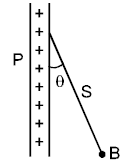
A charged ball B hangs from a silk thread S which makes an angle θ with a large charged conducting sheet P, as shown in the figure. The surface charge density ρ of the sheet is proportional to :


1. cos θ
2. cot θ
3. sin θ
4. tan θ
View Answer

To solve for the proportionality of the surface charge density \(\sigma\) with \(\tan\theta\), we analyze the forces acting on the charged ball \(B\):

Step 1: Forces acting on the ball
1. Gravitational force (\(F_g\)): Acts vertically downward, magnitude \(F_g = mg\), where \(m\) is the mass of the ball.
2. Electric force (\(F_e\)): Acts horizontally, due to the electric field produced by the charged conducting sheet.
3. Tension (\(T\)): Acts along the silk thread, balancing the net forces in both horizontal and vertical directions.

The electric field near a charged conducting sheet with surface charge density \(\sigma\) is:

\[
E = \frac{\sigma}{2\epsilon_0}
\]

The electric force on the ball is:

\[
F_e = qE = q \cdot \frac{\sigma}{2\epsilon_0}
\]

Step 2: Force balance
At equilibrium:
- In the vertical direction: \(T \cos\theta = mg\)
- In the horizontal direction: \(T \sin\theta = F_e = q \cdot \frac{\sigma}{2\epsilon_0}\)

Taking the ratio of the horizontal and vertical components:

\[
\tan\theta = \frac{T \sin\theta}{T \cos\theta} = \frac{F_e}{F_g} = \frac{q \cdot \frac{\sigma}{2\epsilon_0}}{mg}
\]

\[
\tan\theta \propto \sigma
\]

Final Answer:
The surface charge density \(\sigma\) of the sheet is proportional to:

\[
{\tan\theta}
\]

Question 59: moderate

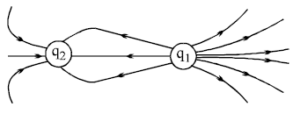
For the figure shown, what is the ratio of the charges q2/q1, where the figure shown has a representation of the field lines in the space near the charges

1. –3/2
2. –2/3
3. 2/3
4. 3/2
View Answer

Number of Electric Field line is proportional to amount of charge. so,

\[ \frac{Q_{2}}{Q_{1}}=\frac{-6}{9}=\frac{-2}{3} \]

Question 60: moderate

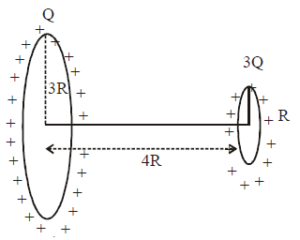
Two uniformly charged co axial rings are present as shown in the figure. Find electric field intensity at the centre of the smaller ring.

1. \[ \frac{Q}{4\pi \varepsilon_{0}R^{2}}\]
2. \[ \frac{Q}{25\pi \varepsilon_{0}R^{2}}\]
3. \[ \frac{Q}{125\pi \varepsilon_{0}R^{2}}\]
4. \[ \frac{4Q}{125\pi \varepsilon_{0}R^{2}}\]
View Answer

Given:
Two coaxial rings:
- Larger ring: Charge \( Q \), radius \( 3R \), distance \( 4R \) from the center of the smaller ring.
- Smaller ring: Charge \( 3Q \), radius \( R \).
We need the electric field at the center of the smaller ring.

Step 1: Electric Field due to the Larger Ring
The electric field at a distance \( x = 4R \) on the axis of a uniformly charged ring of radius \( R \) is:

\[
E = \frac{kQx}{(R^2 + x^2)^{3/2}}
\]

For the larger ring:
- \( Q = Q \), \( R = 3R \), \( x = 4R \):
\[
E_{\text{large}} = \frac{kQ(4R)}{((3R)^2 + (4R)^2)^{3/2}}
\]

\[
E_{\text{large}} = \frac{kQ(4R)}{(9R^2 + 16R^2)^{3/2}} = \frac{kQ(4R)}{(25R^2)^{3/2}}
\]

\[
E_{\text{large}} = \frac{kQ(4R)}{125R^3} = \frac{Q}{125\pi\varepsilon_0R^2}
\]

Step 2: Electric Field due to the Smaller Ring
The center of the smaller ring is its own center, so the net electric field due to its charge distribution is **zero**.

Step 3: Net Electric Field
The total electric field at the center of the smaller ring is due to the **larger ring only**:
\[
E = \frac{Q}{125\pi\varepsilon_0R^2}
\]

Final Answer:
\[
E = \frac{Q}{125\pi\varepsilon_0R^2}
\]