Electrostatics - NEET Physics Questions
← All Chapters

Electrostatics

Question 21: easy

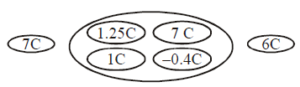
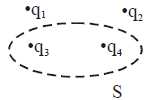
Figure shows four charges q1, q2, q3 and q4 fixed in space. Then the total flux of electric field through a closed surface S, due to all charges q1, q2, q3, and q4 is :

1. not equal to the total flux through S due to charges q3 and q4.
2. equal to the total flux through S due to charges q3 and q4.
3. zero if q1 + q2 = q3 + q4
4. twice the total flux through S due to charges q3 and q4 if q1 + q2 = q3 + q4
View Answer

Gauss's law states that the total electric flux passing through a closed surface is equal to the charge enclosed within the surface divided by the permittivity of the medium.

In short: The net electric field around a closed surface depends on the charge inside it.

Question 22: easy

The mathematical form of Gauss’ law is :

\[\varepsilon_{0}\oint_{}^{}\overrightarrow{E}.d\overrightarrow{S}=q\]
In this reference which of the following is correct?

1. E depends on the charge q which is enclosed within the Gaussian surface only
2. E depends on the charge which is inside and outside the Gaussian surface.
3. E does not depend on the magnitude of charge q
4. All of the above
View Answer

The question states the mathematical form of Gauss's law as:

\[
\varepsilon_{0}\oint \overrightarrow{E} \cdot d\overrightarrow{S} = q
\]

Where:
- \(\varepsilon_0\) is the permittivity of free space,
- \(\overrightarrow{E}\) is the electric field vector,
- \(d\overrightarrow{S}\) is the infinitesimal area vector on the Gaussian surface,
- \(q\) is the total charge enclosed within the Gaussian surface.

Key Points in Gauss's Law:

1. The electric flux through the Gaussian surface (\(\oint \overrightarrow{E} \cdot d\overrightarrow{S}\)) depends only on the charge enclosed (\(q\)) within the surface.

2. The electric field \(\overrightarrow{E}\) at any point on the Gaussian surface depends on all charges in the system—both inside and outside the Gaussian surface.

Why Does \(E\) Depend on Charges Outside the Gaussian Surface?

While Gauss's law calculates flux based only on enclosed charge, the electric field \(\overrightarrow{E}\) at a point on the Gaussian surface is influenced by all charges, regardless of their location (inside or outside the surface). Here's why:

- Charges inside the Gaussian surface: These contribute directly to the net flux as per Gauss's law.
- Charges outside the Gaussian surface: These do not contribute to the net flux (their contributions cancel out overall due to symmetry), but they **still influence the local value of \(\overrightarrow{E}\)**.

Example:

- Imagine a spherical Gaussian surface around a point charge \(q_1\). If another charge \(q_2\) is placed outside the sphere, it doesn't affect the total flux, but it does contribute to the electric field at various points on the sphere.

Thus, the electric field \(\overrightarrow{E}\) depends on all charges in the vicinity, while the total flux (as per Gauss's law) depends solely on the charges enclosed. This is why the correct answer is:

"E depends on the charge which is inside and outside the Gaussian surface."
Question 23: easy

What is the electric flux linked with closed surface?

1. /[10^{11} N-m^{2}/C/]
2. /[10^{12} N-m^{2}/C/]
3. /[10^{10} N-m^{2}/C/]
4. /[8.86\times 10^{13} N-m^{2}/C/]
View Answer
Question 24: easy

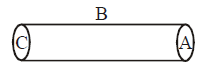
A hollow cylinder has charge q coulomb within it. If Φ is the electric flux in units of V-m associated with the curved surface B, the flux linked with the plane surface A in unit of V-m will be :

1. /[\frac{q}{2\varepsilon_{0}}/]
2. /[\frac{\phi}{3}/]
3. /[\frac{q}{\varepsilon_{0}}-\phi/]
4. /[\frac{1}{2}\left( \frac{q}{\varepsilon_{0}}-\phi \right)/]
View Answer
Question 25: easy

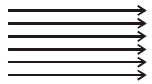
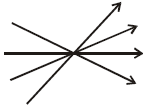
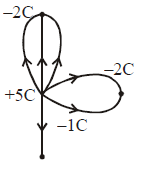
Which of the following configurations of electric lines of force is not possible ?

1.
2.
3.
4. both (2) and (3)
View Answer

Option 2 is wrong because electric field lines emerge out of +ve charge and submerge into -ve charge.

In option 3 number of electric field lines is proportional to amount of charge. From +5C charge 6 field lines are emerging out where as from 1C charge only one electric field line is present.

Question 26: easy

According to Gauss law of electrostatics, electric flux through a closed surface depends on

1. The shape of the surface
2. The volume enclosed by the surface
3. The area of the surface
4. The quantity of charges enclosed by the surface
View Answer

By Gauss's law, \(\Phi_E = \frac{q_{\text{enclosed}}}{ε_0}\). The flux depends only on the net charge enclosed inside the surface, and is independent of the size and shape of the closed surface.

Question 27: easy

If a conducting sphere of radius R is charged. Then the electric field at a distance \(r\) (\(r > R\)) from the centre of the sphere would be, (V = potential on the surface of the sphere)

1. \(\frac{RV}{r^2}\)
2. \(\frac{V}{r}\)
3. \(\frac{rV}{R^2}\)
4. \(\frac{R^2 V}{r^3}\)
View Answer

The electric potential at the surface of a conducting sphere is \(V = \frac{kQ}{R} \implies kQ = VR\). The electric field at any point outside the sphere (\(r > R\)) is \(E = \frac{kQ}{r^2} = \frac{VR}{r^2}\).

Question 28: easy

Two particle of equal mass m and charge q are placed at a distance of 16 cm. They do not experience any force. The value of \( \frac{q}{m} \) is:

1. 1
2. \( \sqrt{\frac{\pi \varepsilon_0}{G}} \)
3. \( \sqrt{\frac{G}{4 \pi \varepsilon_0}} \)
4. \( \sqrt{4 \pi \varepsilon_0 G} \)
View Answer

For no net force, electrostatic force must equal gravitational force: \( \frac{q^2}{4 \pi \varepsilon_0 r^2} = \frac{G m^2}{r^2} \). Rearranging this formula yields \( \frac{q^2}{m^2} = 4 \pi \varepsilon_0 G \Rightarrow \frac{q}{m} = \sqrt{4 \pi \varepsilon_0 G} \).

Question 29: easy

Two small spheres each carrying a charge q are placed r meter apart. If one of the sphere is taken around the other one in a circular path of radius r, the work done will be equal to:

1. (Force between them) \( \times \) r
2. (Force between them) \( \times 2\pi r \)
3. (Force between them)/\( 2\pi r \)
4. Zero
View Answer

The electrostatic force is conservative and directed radially. When moving in a circular path, the displacement is always perpendicular to the force, resulting in zero work done.

Question 30: easy

An \( \alpha \)-particle of mass \( 6.4 \times 10^{-27}\text{ kg} \) and charge \( 3.2 \times 10^{-19}\text{ C} \) is situated in a uniform electric field of \( 1.6 \times 10^5\text{ Vm}^{-1} \). The velocity of the particle at the end of \( 2 \times 10^{-2}\text{ m} \) path when it starts from rest is:

1. \( 2\sqrt{3} \times 10^5\text{ ms}^{-1} \)
2. \( 8 \times 10^5\text{ ms}^{-1} \)
3. \( 16 \times 10^5\text{ ms}^{-1} \)
4. \( 4\sqrt{2} \times 10^5\text{ ms}^{-1} \)
View Answer

Using the work-energy theorem, \( qEd = \frac{1}{2}mv^2 \). Rearranging gives \( v = \sqrt{\frac{2qEd}{m}} = \sqrt{\frac{2 \times 3.2 \times 10^{-19} \times 1.6 \times 10^5 \times 2 \times 10^{-2}}{6.4 \times 10^{-27}}} = 4\sqrt{2} \times 10^5\text{ m/s} \).