Electrostatics - NEET Physics Questions
← All Chapters

Electrostatics

Question 1: easy

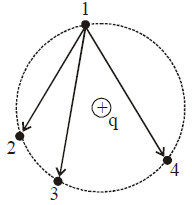
In the electrostatic field of a point charge q from point 1(Figure) we moved one and the same charge to points 2, 3, 4. Find work done on the charge during the movement in each case and compare them.
 

1. W2 < W3 > W4
2. W2 < W3 < W4
3. W2 = W3 = W4
4. W2 = W4 < W3
View Answer

Explanation and Solution

The work done by an electrostatic field in moving a charge from one point to another depends only on the electric potential difference between the two points, since the electrostatic force is conservative.

---

Given:
- We have a point charge \(q\) at the center of a circle.
- Points 1, 2, 3, and 4 lie on the same circle around the charge \(q\).

Step 1: Understand the electric potential
The electric potential \(V\) at any point on a circle centered around the charge \(q\) is the same because:

\[
V = \frac{kq}{r}
\]

where \(r\) is the radius of the circle. Since points 1, 2, 3, and 4 are equidistant from \(q\), the potential at all these points is identical.

---

Step 2: Work done in moving a charge
The work done \(W\) in moving a charge \(Q\) from one point to another in an electrostatic field is given by:

\[
W = Q (V_{\text{final}} - V_{\text{initial}})
\]

Since the potential \(V\) is the same at points 2, 3, and 4, the potential difference for each movement is zero:

\[
V_{\text{final}} = V_{\text{initial}}
\]

Thus, for movements from point 1 to points 2, 3, and 4, the work done:

\[
W_2 = W_3 = W_4 = 0
\]

---

Final Comparison:
The work done \(W_2\), \(W_3\), and \(W_4\) are all equal. Hence:

\[
{W_2 = W_3 = W_4 = 0}
\]

This result arises because the electric field is conservative and the movement is along an equipotential surface.
Question 2: easy

How much electric flux will come out through a surface of area vector \(\overrightarrow{S}=10\hat{j}\) kept in an electrostatic field \(E=2\hat{j}+4\hat{j}+3\hat{k} \)?

1. 20 units
2. 40 units
3. 30 units
4. 90 units
View Answer

The electric flux is given by:

\[
\Phi = \overrightarrow{E} \cdot \overrightarrow{S}
\]

Here, \(\overrightarrow{E} = 2\hat{i} + 4\hat{j} + 3\hat{k}\) and \(\overrightarrow{S} = 10\hat{j}\).

\[
\Phi = (2\hat{i} + 4\hat{j} + 3\hat{k}) \cdot (10\hat{j}) = 0 + 4 \cdot 10 + 0 = 40 \, \text{units}.
\]

Question 3: easy

A uniform electric field E = 2 × 10³ NC–¹ is acting along the positive x-axis. The flux of this field through a square of 10 cm on a side whose plane is parallel to the yz plane is :


1. \[20NC^{-1}m^{2}\]
2. \[ 30NC^{-1}m^{2}\]
3. \[ 10NC^{-1}m^{2}\]
4. \[ 40NC^{-1}m^{2}\]
View Answer

To calculate the flux \(\Phi_E\) of the electric field \(\vec{E}\) through the square, we use the formula:

\[
\Phi_E = \vec{E} \cdot \vec{A}
\]

Here:
- \(\vec{E} = 2 \times 10^3 \, \text{N/C}\) (along the positive x-axis),
- \(\vec{A}\) is the area vector, perpendicular to the plane of the square.

Since the square lies in the yz-plane, its area vector points along the x-axis (same direction as \(\vec{E}\)), and its magnitude is the area of the square:

\[
\text{Side of square} = 10 \, \text{cm} = 0.1 \, \text{m}, \quad \text{Area} = (0.1)^2 = 0.01 \, \text{m}^2
\]

The flux is:

\[
\Phi_E = |\vec{E}| \cdot |\vec{A}| \cdot \cos\theta
\]

Here, \(\theta = 0^\circ\) (since \(\vec{E}\) is parallel to \(\vec{A}\)):

\[
\Phi_E = (2 \times 10^3) \cdot 0.01 \cdot \cos 0^\circ = 20 \, \text{N·m}^2/\text{C}
\]

Thus, the flux is:

\[
{20 \, \text{N·m}^2/\text{C}}
\]

Question 4: easy

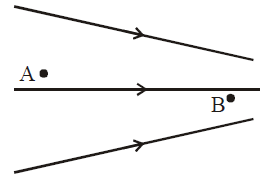
Find out correct relation between electric field intensity EA & EB present at two points in an electric field shown in the figure.

1. \[ E_{A}=E_{B}\]
2. \[ E_{A}>E_{B}\]
3. \[ E_{A}< E_{B}\]
4. Data insufficient
View Answer

Distance between electric field lines represents magnitude of electric field lines. Large is the separation between electric field line lesser is electric field. so ,

\[ E_{A}< E_{B}\]

Question 5: easy

A point charge + Q is positioned at the center of the base of a square pyramid as shown. The flux through one of the four identical upper faces of the pyramid is


1. \[ \frac{Q}{16\varepsilon_{0}}\]
2. \[ \frac{Q}{4\varepsilon_{0}}\]
3. \[ \frac{Q}{8\varepsilon_{0}}\]
4. None of these
View Answer

Step-by-Step Explanation:

1. Flux through the Entire Pyramid:
The total charge enclosed by the pyramid is \(+Q\), and the total flux through the entire closed surface of the pyramid is given by Gauss's law:
\[
\Phi_{\text{total}} = \frac{Q}{\varepsilon_0}.
\]

2. Flux Distribution:
The pyramid has a square base and four triangular faces. However, **the charge \(+Q\) is located at the center of the base, not at the geometric center of the pyramid.** This means the flux through the base is not zero and contributes to the total flux.

3. Flux Through the Base:
Due to symmetry, half of the total flux passes through the square base:
\[
\Phi_{\text{base}} = \frac{\Phi_{\text{total}}}{2} = \frac{Q}{2\varepsilon_0}.
\]

4. Flux Through the Four Triangular Faces:
The remaining half of the total flux passes through the four triangular faces combined:
\[
\Phi_{\text{triangular (total)}} = \frac{\Phi_{\text{total}}}{2} = \frac{Q}{2\varepsilon_0}.
\]

5. Flux Through One Triangular Face:
Since the four triangular faces are identical, the flux is equally distributed among them:
\[
\Phi_{\text{face}} = \frac{\Phi_{\text{triangular (total)}}}{4} = \frac{\frac{Q}{2\varepsilon_0}}{4} = \frac{Q}{8\varepsilon_0}.
\]

Final Answer:
The flux through one triangular face is:
\[
{\frac{Q}{8\varepsilon_0}}.
\]

Question 6: easy

If a body has a charge of /(10^{-12}\) coulomb :

1. the body has \(6.25\times 10^{6} \)excess of electrons
2. the body has \( 625\times 10^{6}\) excess of electrons
3. the body has \(6.25\times 10^{6}\) deficiency of electrons
4. the body has \(6.25\times 10^{3} \)deficiency of electrons
View Answer

To determine the deficiency of electrons for a body with a charge of

1012C10^{-12} \, \text{C}

, follow these steps:

  1. Charge of a single electron: The charge of one electron is
    e=1.6×10¹⁹Ce = 1.6 \times 10^{-19} \, \text{C}
     

    .

  2. Number of electrons (deficiency): The total number of electrons causing the charge is given by: 

    n=Total chargeCharge of one electron=10121.6×1019=6.25×106.n = \frac{\text{Total charge}}{\text{Charge of one electron}} = \frac{10^{-12}}{1.6 \times 10^{-19}} = 6.25 \times 10^{6}. 

  3. Interpretation: Since the body is positively charged, it has a deficiency of
    6.25×1066.25 \times 10^6
     

    electrons.

Question 7: easy

A body is charged by rubbing it, its weight :

1. always decreases slightly
2. always increases slightly
3. may increase or decrease slightly
4. remains precisely the same
View Answer

When a body is charged by rubbing, its weight may increase or decrease slightly because:

  1. Gain of electrons (negative charge):
    • If the body gains electrons during the process, it becomes negatively charged.
    • Since electrons have mass (
      9.1×1031kg9.1 \times 10^{-31} \, \text{kg}
       

      ), the body’s weight will increase slightly due to the addition of electrons.

  2. Loss of electrons (positive charge):
    • If the body loses electrons during rubbing, it becomes positively charged.
    • The loss of electrons reduces the body's total mass, so its weight will decrease slightly.

Thus, depending on whether the body gains or loses electrons, its weight may increase or decrease slightly.

Question 8: easy

Unit of dielectric constant of a medium is :

1. coulomb/newton-metre
2. newton-metre²/coulomb²
3. coulomb²/(newton-metre)²
4. none of the above
View Answer

The dielectric constant (also called the relative permittivity,

εr\varepsilon_r

) is a dimensionless quantity because it is defined as the ratio:


εr=εε0\varepsilon_r = \frac{\varepsilon}{\varepsilon_0}


Where:


  • ε\varepsilon
     

    = permittivity of the medium (units: F/m\text{F/m} 

    , farads per meter)


  • ε0\varepsilon_0
     

    = permittivity of free space ( F/m\text{F/m} 

    , farads per meter)

Since it is a ratio of two quantities with the same unit, the dielectric constant has no unit (it is dimensionless).

Question 9: easy

Select the correct statement :

1. the total charge of the universe is constant
2. the total number of the charged particles is constant
3. the total positive charge of the universe remains constant
4. the total negative charge of the universe remains constant
View Answer

The correct statement is "the total charge of the universe is constant" because:

  • Conservation of charge is a fundamental principle in physics. It states that the total electric charge in an isolated system remains constant, regardless of the processes occurring within the system.
  • This principle applies to all known interactions and processes, such as chemical reactions, particle collisions, and even cosmic events, meaning that charge cannot be created or destroyed—only transferred between objects.

Thus, the total charge in the universe remains constant.

Question 10: easy

The electric charge in accelerated motion produces:

1. an electric field
2. a magnetic field
3. electromagnetic radiation
4. all of the above
View Answer

The electric charge in accelerated motion produces electromagnetic radiation.

Here’s why:

  • When a charged particle accelerates (changes velocity), it disturbs the surrounding electromagnetic field. These disturbances propagate as electromagnetic waves, which include light, radio waves, X-rays, etc.
  • This is a fundamental result of Maxwell's equations, which describe how electric and magnetic fields interact with charged particles.

Thus, an accelerating electric charge produces electromagnetic radiation, which can be detected as waves of energy moving through space.