Electrostatics - NEET Physics Questions
← All Chapters

Electrostatics

Question 11: easy

A soap bubble is given a negative charge then its radius:

1. decreases
2. increases
3. remains unchanged
4. nothing can be predicted as information is insufficient
View Answer

When a soap bubble is given a negative charge, the radius of the bubble increases. Here's why:

  • A soap bubble with charge experiences electrostatic repulsion between the like charges distributed on its surface. This repulsion causes the surface to expand.
  • The electrostatic pressure
    PP
     

    on the surface of a charged sphere (or bubble) is given by the formula:


P=2Οƒ2Ξ΅0P = \frac{2 \sigma^2}{\varepsilon_0}


where

Οƒ\sigma

is the surface charge density, and

Ξ΅0\varepsilon_0

is the permittivity of free space. This pressure acts to push the bubble outward.

  • To counteract this, the bubble expands, increasing its radius in response to the electrostatic repulsion.

Thus, when a soap bubble is negatively charged, the repulsion between the charges causes the bubble's radius to increase.

Question 12: easy

Two metallic spheres carry equal charges. The distance between the spheres cannot be considered large in comparison with the diameters of the spheres. In which case, will the force of interaction between the spheres be greater ?

1. Like charges
2. Unlike charges
3. One is neutral and other is charged
4. None of the above
View Answer

When the two metallic spheres are close to each other, their charges induce redistribution of charges on their surfaces due to proximity. This redistribution impacts the force of interaction:

  • For like charges (both positive or both negative): The redistribution of charge reduces the repulsive force because the induced charges create opposing electric fields, weakening the overall repulsion.
  • For unlike charges (one positive, one negative): The redistribution enhances the attractive force because the induced charges increase the local electric field, strengthening the attraction.

Thus, the force of interaction is greater for unlike charges due to this enhancement caused by charge redistribution.

Question 13: easy

Mark correct option :

1. The electric charge without mass is possible
2. The charge without mass is not possible
3. The electric charge may be transferred without transferring mass
4. Mass without electric charge is not possible
View Answer

The statement "The charge without mass is not possible" is correct based on our current understanding of physics because:

  • All known charged particles, such as electrons, protons, and ions, have mass associated with them. There is no experimental evidence of a physical entity that carries charge but has zero mass.
  • Even in the case of hypothetical particles like the photon, which is massless, it does not carry electric charge. Charged particles inherently possess mass due to their nature in both classical and quantum physics.

Thus, charge is always associated with some mass in all observed phenomena.

Question 14: easy

In relativistic mechanics \(m=\frac{m_{0}}{\sqrt{\left( 1-\frac{v^{2}}{c^{2}} \right)}} \) the equivalent relation in electricity for electric charge is:

1. q = q0
2. \[q=\frac{q_{0}}{\sqrt{\left( 1-\frac{v^{2}}{c^{2}} \right)}}\]
3. \[ q_{0}=\frac{q}{\sqrt{\left( 1-\frac{v^{2}}{c^{2}} \right)}}\]
4. \[ q=\frac{q_{0}v}{c}\]
View Answer

The relativistic formula for mass,


m=m01βˆ’v2c2m = \frac{m_0}{\sqrt{1 - \frac{v^2}{c^2}}}


accounts for how mass increases with velocity. This behavior arises because mass is a form of energy, and energy is affected by motion under relativity.

However, electric charge (

qq

) is invariant under relativistic mechanics. Charge does not depend on the velocity of the particle. It remains constant in all inertial reference frames, which is a fundamental principle in physics.

Thus, the equivalent relation for electric charge is simply:


q=q0q = q_0


This reflects the fact that charge does not vary with velocity, unlike mass.

Question 15: easy

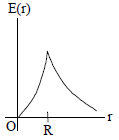
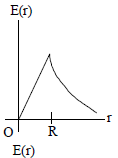
A thin spherical shell of radius R has charge Q spread uniformly over its surface. Which of the following graphs most closely represents the electric field E (r) produced by the shell in the range 0 ≀ r < ∞, where r is the distance from the centre of the shell?

1.
2.
3.
4.
View Answer

The graph in the uploaded image is correct. Here's the explanation with equations:

For a spherical shell of radius \( R \) with charge \( Q \), the electric field \( E(r) \) is given by:

1. Inside the shell (\( 0 \leq r < R \)):
By Gauss's law, the electric field inside a spherical shell is zero:
\[
E(r) = 0, \quad \text{for } r < R
\]

2. On or outside the shell (\( r \geq R \)):
The shell behaves like a point charge located at its center. The electric field at a distance \( r \) is:
\[
E(r) = \frac{1}{4 \pi \epsilon_0} \cdot \frac{Q}{r^2}, \quad \text{for } r \geq R
\]

Graph Representation:
- For \( r < R \), \( E(r) = 0 \), so the graph is flat (on the \( x \)-axis).
- For \( r \geq R \), \( E(r) \propto \frac{1}{r^2} \), so the graph decreases as \( r \) increases, starting from a maximum value at \( r = R \).

Question 16: easy

At the centre of a uniformaly charged ring :

1. E = 0, V = 0
2. E = maximum, V = 0
3. E = maximum, V = maximum
4. E = 0, V = maximum
View Answer

At the centre of a uniformly charge ring electric field becomes zero because being a vector quantity it will cancel out each.

Electric potential is a scaler quantity so will be present at the centre of ring.

E = 0, V = maximum

Question 17: easy

When a positive charge is released and moves in electric field, it moves towards a position of

1. lower electric potential and lower potential energy
2. lower electric potential and higher potential energy
3. higher electric potential and lower potential energy
4. higher electric potential and higher potential energy
View Answer

A positive charge, when released in an electric field:

- Moves along the direction of the electric field.
- Electric field lines point from higher potential to lower potential.
- As the charge moves to a lower electric potential, its potential energyΒ also decreases because:

\[
U = qV
\]

For a positive charge (\(q > 0\)), both \(V\) and \(U\) decrease. Hence, the charge moves toward lower electric potential and lower potential energy.

Question 18: easy

The electric potential at a point due to an electric dipole is :

1. \[k(\overrightarrow{p}.\overrightarrow{r}/r^{3})\]
2. \[k(\overrightarrow{p}.\overrightarrow{r}/r^{2})\]
3. \[ k(\overrightarrow{p}\times \overrightarrow{r}/r^{3})\]
4. \[k(\overrightarrow{p}\times \overrightarrow{r}/r^{2})\]
View Answer

The electric potential \( V \) at a point \( P \) due to an electric dipole with dipole moment \( \overrightarrow{p} \) is given by:

\[
V = \frac{k \, \overrightarrow{p} \cdot \overrightarrow{r}}{r^3}
\]

Explanation:
1. Dipole Moment: The dipole moment \( \overrightarrow{p} = q \cdot d \), where \( q \) is the charge and \( d \) is the separation between charges.

2. Position Vector \( \overrightarrow{r} \): This is the vector from the center of the dipole to the point \( P \).

3. Dot Product: The potential depends on the angle between \( \overrightarrow{p} \) and \( \overrightarrow{r} \), hence \( \overrightarrow{p} \cdot \overrightarrow{r} = p r \cos \theta \).

4. Result: The formula is:
\[
V = \frac{k (\overrightarrow{p} \cdot \overrightarrow{r})}{r^3}
\]

This matches the correct answer:
\[
V = \frac{k (\overrightarrow{p} \cdot \overrightarrow{r})}{r^3}
\]

Question 19: easy

A cylinder of radius R and length L is placed in a uniform electric field E parallel to the cylinder axis. The total flux from the surface of the cylinder is:

1. \[2\pi R^{2}E\]
2. \[\pi R^{2}E\]
3. \[\left( \pi R^{2}+\pi R^{2} \right)/E\]
4. zero
View Answer

Since the electric field \( E \) is parallel to the cylinder's axis, the field lines enter and exit symmetrically through the two flat circular ends. The curved surface has no perpendicular component of the field, so no flux passes through it.

By Gauss's law, the net flux through the entire surface is:
\[
\Phi = \text{Charge enclosed} / \varepsilon_0
\]

As no charge is enclosed, \( \Phi = 0 \).

Question 20: easy

The electric flux Ξ¦ through a hemisphere surface of radius R, placed in a uniform electric field of intensity E parallel to the axis of its circular plane is:

1. \[2\pi RE\]
2. \[2\pi R^{2}E\]
3. \[\pi R^{2}E\]
4. \[\left( 4/3 \right)\pi R^{3}E\]
View Answer

The electric flux through the hemisphere is due to the uniform electric field passing perpendicularly through the circular plane of radius \( R \).

Flux through the circular plane:
\[
\Phi = E \cdot \text{Area of circular plane} = E \cdot \pi R^2
\]

Since no flux passes through the curved surface (field is parallel to it), the total flux is:
\[
\Phi = \pi R^2 E
\]