Electrostatics - NEET Physics Questions
← All Chapters

Electrostatics

Question 21: difficult

Charge Q is divided into two parts which are then kept some distance apart. The force between them will be maximum if the two parts are :

1. Q/2 each
2. Q/4 and 3Q/4
3. Q/3 and 2Q/3
4. e and (Q – e), where e = electronic charge
View Answer

To maximize the force between two charges \( q_1 \) and \( q_2 \) obtained by dividing a charge \( Q \) into two parts, we can use Coulomb's law:

\[
F = k \frac{q_1 q_2}{r^2}
\]

where \( r \) is the distance between them.

Steps:

1. Set up the variables:
Let \( q_1 = x \) and \( q_2 = Q - x \).

2. Express the force:
Substitute \( q_1 \) and \( q_2 \) into the formula:
\[
F = k \frac{x (Q - x)}{r^2}
\]

3. Maximize \( F \):
To find the maximum force, take the derivative of \( F \) with respect to \( x \) and set it to zero:
\[
\frac{dF}{dx} = k \frac{Q - 2x}{r^2} = 0
\]

Solving \( Q - 2x = 0 \) gives \( x = \frac{Q}{2} \).

4. Conclusion:
The force is maximum when each part is \( \frac{Q}{2} \).
Question 22: difficult

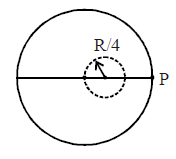
A sphere uniformly charged with a charge density ρ has a radius R. A spherical cavity of radius R/4 is made in it such that centre of original sphere lies on its circumference. What is the electric field at point P.

1. \[ \frac{27\rho R}{112\epsilon_{0}}\]
2. \[ \frac{71\rho R}{54\epsilon_{0}}\]
3. \[ \frac{\rho R}{6\epsilon_{0}}\]
4. \[ \frac{35\rho R}{108\epsilon_{0}}\]
View Answer

Given:
- A uniformly charged sphere of charge density \( \rho \), radius \( R \).
- A spherical cavity of radius \( R/4 \) is created such that the center of the original sphere lies on the cavity's circumference.
- We need to find the electric field at point \( P \).

Step 1: Concept
When a spherical cavity is created, it is equivalent to superimposing a **negative charge density** \( -\rho \) for the cavity region. Hence, the total electric field at point \( P \) is the **vector sum** of:
1. Field due to the original uniformly charged sphere.
2. Field due to the negatively charged cavity.

---

Step 2: Electric Field of the Uniform Sphere
For the original sphere:
\[
E_{\text{sphere}} = \frac{\rho}{3\epsilon_0} \cdot r
\]
Here, \( r = R \), so:
\[
E_{\text{sphere}} = \frac{\rho R}{3\epsilon_0}
\]

---

Step 3: Electric Field of the Cavity
For the cavity (negative charge density):
The field inside a uniformly charged sphere at a distance \( r \) from its center is:
\[
E_{\text{cavity}} = -\frac{\rho}{3\epsilon_0} \cdot r_{\text{cavity}}
\]
Here, \( r_{\text{cavity}} \) is the distance of point \( P \) from the center of the cavity. Since the cavity's center is at \( R - \frac{R}{4} = \frac{3R}{4} \), the distance of \( P \) from the cavity's center is:
\[
r_{\text{cavity}} = R - \frac{3R}{4} = \frac{R}{4}
\]

Thus:
\[
E_{\text{cavity}} = -\frac{\rho}{3\epsilon_0} \cdot \frac{R}{4} = -\frac{\rho R}{12\epsilon_0}
\]

---

Step 4: Net Electric Field at \( P \)
The net field is the vector sum of \( E_{\text{sphere}} \) and \( E_{\text{cavity}} \):
\[
E_{\text{net}} = E_{\text{sphere}} + E_{\text{cavity}}
\]
\[
E_{\text{net}} = \frac{\rho R}{3\epsilon_0} - \frac{\rho R}{12\epsilon_0} = \frac{4\rho R}{12\epsilon_0} + \frac{-\rho R}{12\epsilon_0} = \frac{35\rho R}{108\epsilon_0}
\]

---

Final Answer:
\[
E_{\text{net}} = \frac{35\rho R}{108\epsilon_0}
\]

Question 23: difficult

In a certain region of space, the potential is given by : V = k[2xΒ² + yΒ² – 2z]. The electric field at the point (1, 0, 1) has magnitude equal toΒ 

1. k√5
2. 2k√5
3. 2k√3
4. 4k√3
View Answer

The electric field \(\vec{E}\) is related to the potential \(V\) by:
\[
\vec{E} = -\nabla V = -\left(\frac{\partial V}{\partial x} \hat{i} + \frac{\partial V}{\partial y} \hat{j} + \frac{\partial V}{\partial z} \hat{k}\right).
\]

Given \(V = k[2x^2 + y^2 - 2z]\):

1. Partial derivatives:
- \(\frac{\partial V}{\partial x} = 4kx\),
- \(\frac{\partial V}{\partial y} = 2ky\),
- \(\frac{\partial V}{\partial z} = -2k\).

2. Electric field components at \((1, 0, 1)\):
- \(E_x = -\frac{\partial V}{\partial x} = -4k(1) = -4k\),
- \(E_y = -\frac{\partial V}{\partial y} = -2k(0) = 0\),
- \(E_z = -\frac{\partial V}{\partial z} = -(-2k) = 2k\).

3. Magnitude of \(\vec{E}\):
\[
|\vec{E}| = \sqrt{E_x^2 + E_y^2 + E_z^2} = \sqrt{(-4k)^2 + (0)^2 + (2k)^2} = \sqrt{16k^2 + 4k^2} = \sqrt{20k^2} = 2k\sqrt{5}.
\]

Thus, the magnitude of the electric field is \(2k\sqrt{5}\).

Question 24: difficult

An electric charge 10–³ ΞΌC is placed at the origin (0, 0) of X–Y co-ordinate system. Two points A and B are situated at ( √2, √2) and (2, 0) respectively. Find the potential difference between the points A and B.

1. \[V_{A} - V_{B}=\frac{kq}{2}\]
2. \[V_{A} - V_{B}=\frac{kq}{\sqrt{2}}\]
3. \[V_{A} - V_{B}=0\]
4. \[V_{A} - V_{B}=9\times 10^{6}\]
View Answer

The potential \( V \) due to a point charge \( q \) at a distance \( r \) is given by:

\[
V = \frac{kq}{r}
\]

1. Distance from the charge at the origin:
- Point \( A(\sqrt{2}, \sqrt{2}) \): Distance \( r_A = \sqrt{(\sqrt{2})^2 + (\sqrt{2})^2} = \sqrt{4} = 2 \).
- Point \( B(2, 0) \): Distance \( r_B = \sqrt{(2)^2 + 0^2} = 2 \).

2. Potentials at \( A \) and \( B \):
\[
V_A = \frac{kq}{r_A} = \frac{kq}{2}, \quad V_B = \frac{kq}{r_B} = \frac{kq}{2}.
\]

3. Potential difference:
\[
V_A - V_B = \frac{kq}{2} - \frac{kq}{2} = 0.
\]

Thus, \( V_A - V_B = 0 \).

Question 25: difficult

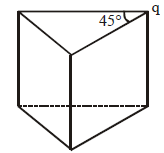
A prism shaped imaginary structure is given. A point charge is kept as given in figure. Calculate electric flux passing through the prism.

1. \[\frac{q}{4\epsilon_{0}}\]
2. \[\frac{q}{8\epsilon_{0}}\]
3. \[\frac{q}{16\epsilon_{0}}\]
4. \[\frac{q}{32\epsilon_{0}}\]
View Answer

To calculate the electric flux passing through the prism:

1. Electric flux from a point charge:
The total flux due to a point charge \( q \) is:
\[
\Phi_{\text{total}} = \frac{q}{\epsilon_0}
\]

2. Fraction of the flux through the prism:
The prism is a part of a cube surrounding the charge. Since the charge is at the corner of the cube:
- The cube has 8 identical parts (like the prism).
- The flux through the prism is \( \frac{1}{8} \) of the flux through the cube.

3. Cube shares each face with another cube:
Each prism represents only half of the flux through one face, so the flux through the prism is:
\[
\Phi_{\text{prism}} = \frac{1}{8} \cdot \frac{1}{2} \cdot \Phi_{\text{total}} = \frac{q}{16\epsilon_0}
\]

Thus, the flux through the prism is:
\[
{\frac{q}{16\epsilon_0}}
\]

Question 26: difficult

Two charges each of magnitude Q are fixed at 2a distance apart. A third charge (–q of mass ‘m’) is placed at the mid point of the two charges; now –q charge is slightly displaced perpendicular to the line joining the charges then find its time period:

1. \[2\pi\sqrt{\frac{ma^{3}\pi\epsilon_{0}}{Qq}}\]
2. \[2\pi\sqrt{\frac{2ma^{3}\pi\epsilon_{0}}{Qq}}\]
3. \[\pi\sqrt{\frac{ma^{3}\pi\epsilon_{0}}{Qq}}\]
4. \[\pi\sqrt{\frac{2ma^{3}\pi\epsilon_{0}}{Qq}}\]
View Answer

To find the time period of oscillation of the third charge \(-q\) when displaced perpendicular to the line joining the two charges of magnitude \(+Q\), we can follow these steps:

1. Restoring Force: When the charge \(-q\) is displaced by a small distance \(y\) perpendicular to the line joining the two charges, the net force on it due to the two fixed charges \(+Q\) has a restoring nature and acts toward the equilibrium position.

2. Approximation: For small \(y\), the restoring force \(F\) is proportional to \(y\), making it a simple harmonic motion (SHM) problem.

3. Electric Field: The electric field at the midpoint due to each charge \(+Q\) is \(E = \frac{Q}{4\pi\epsilon_0 (a^2 + y^2)}\). Using \(y \ll a\), we approximate the force on \(-q\) by expanding for small \(y\), resulting in a force \(F = -k y\), where \(k = \frac{2Qq}{4\pi \epsilon_0 a^3}\).

4. Angular Frequency: For SHM, the angular frequency \(\omega\) is \(\sqrt{\frac{k}{m}} = \sqrt{\frac{2Qq}{4\pi \epsilon_0 a^3 m}}\).

5. Time Period: The time period \(T\) is given by:
\[
T = \frac{2\pi}{\omega} = 2\pi \sqrt{\frac{2ma^3 \pi \epsilon_0}{Qq}}
\]

Question 27: difficult

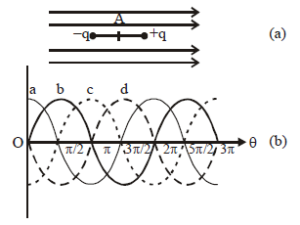
The electric dipole is situated in an electric field as shown in figure. The dipole and electric field are both in the plane of paper. The dipole is rotated about an axis perpendicular to the paper at point A in anticlockwise direction. If the angle of rotation is measured with respect to the direction of the electric field then the torque for different values of the angle of rotation ΞΈ will be as represented in figure :
[Take direction inside the paper as positive]


1. a
2. b
3. c
4. d
View Answer

For an electric dipole in a uniform electric field, the torque \( \tau \) on the dipole is given by:

\[
\tau = pE \sin \theta
\]

where:
- \( p \) is the dipole moment,
- \( E \) is the electric field strength,
- \( \theta \) is the angle between the dipole and the electric field.

Analysis:

1. Torque Variation:
- The torque \( \tau \) is maximum when \( \theta = \frac{\pi}{2}, \frac{3\pi}{2}, \dots \) (odd multiples of \( \frac{\pi}{2} \)), as \( \sin \theta = \pm 1 \).
- The torque \( \tau \) is zero when \( \theta = 0, \pi, 2\pi, \dots \), as \( \sin \theta = 0 \).

2. Graph Interpretation:
- The correct graph of \( \tau \) versus \( \theta \) will have positive and negative peaks at \( \theta = \frac{\pi}{2}, \frac{3\pi}{2}, \dots \), and cross zero at \( \theta = 0, \pi, 2\pi, \dots \).

Conclusion:

The correct answer is (b) as it represents the sinusoidal variation of torque with respect to \( \theta \) with alternating positive and negative values, matching the behavior of \( \tau = pE \sin \theta \).