Electromagnetic Induction - NEET Physics Questions
← All Chapters

Electromagnetic Induction

Question 11: easy

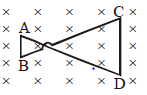
A conducting wire frame is placed in a magnetic field which is directed into the paper. The magnetic field is increasing at a constant rate. The directions of induced current in wires AB and CD are :
1. B to A and D to C
2. A to B and C to D
3. A to B and D to C
4. B to A and C to D
View Answer

in a circuit consisting of two loops connected in series (like a figure-eight), the larger loop effectively dictates the direction of the current for the entire circuit.
Question 12: easy

A coil resistance 20 Ω and inductance 5 H is connected with a 100 V battery. Energy stored in the coil will be :

1. 41.5 J
2. 62.50 J
3. 125 J
4. 250 J
View Answer

$$I = \frac{V}{R} = \frac{100}{20} = 5 \text{ A}$$
$$U = \frac{1}{2} L I^2 = \frac{1}{2} \times 5 \times 5^2 = 62.5 \text{ J}$$

Energy stored = 62.5 J

Question 13: easy

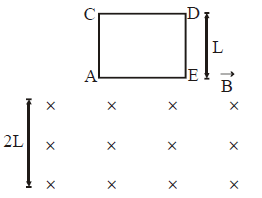
A square coil ACDE with its plane vertical is released from rest in a horizontal uniform
magnetic field B of length 2L. The acceleration of the coil is :

1. less than g for all the time till the loop crosses the magnetic field completely
2. less than g when it enters the field and greater than g when it comes out of the field
3. g all the time
4. less than g when it enters and comes out of the field but equal to g when it is within the field
View Answer

The acceleration is less than 'g' when entering or leaving the field because the changing magnetic flux induces a current that creates an opposing upward force (Lenz's Law).

Once the coil is fully inside the uniform 2L field, the flux is constant, the induced current drops to zero, and the coil falls freely with acceleration equal to g.

Question 14: easy

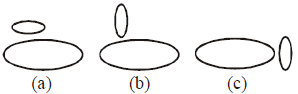
Two circular coils can be arranged in any of the three situations shown in the figure. Their
mutual inductance will be :

1. maximum In situation (a)
2. maximum In situation (b)
3. maximum In situation (c)
4. the same in all situations
View Answer

Based on the visual arrangement of the coils, the mutual inductance is maximum in situation (a).

This is because the coils are placed co-axially (one above the other), allowing the maximum amount of magnetic flux from the primary coil to pass through the secondary coil, resulting in the highest coupling coefficient.

Question 15: easy

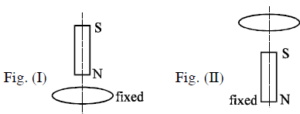
A vertical bar magnet is dropped from position on the axis of a fixed metallic coil as shown in fig – I. In fig. II the magnet is fixed and horizontal coil is dropped. The acceleration of the magnet and coil are a1 and a2 respectively then

1. a1 > g , a2 > g
2. a1 > g , a2 < g
3. a1 < g , a2 < g
4. a1 < g , a2 > g
View Answer

In both cases, relative motion between the magnet and the coil induces a current that creates a magnetic force opposing the motion (Lenz's Law). This upward retarding force reduces the downward acceleration below gravity ($g$), resulting in a_1 < g and a_2 < g.

Question 16: easy

Two identical coaxial circular loops carry a current i each circulating in the same direction. If the loops approach each other

1. the current in each will decrease
2. the current in each will increase
3. the current in each will remain the same
4. the current in one will increase and in other will decrease
View Answer

When two loops with current in the same direction approach each other, the magnetic flux through each loop increases. According to Lenz's Law, an induced current will arise to oppose this change, causing the current in both loops to decrease.

Question 17: easy

Two coils X and Y are placed in a circuit such that a current changes by 2 A in coil X and the magnetic flux change of 0.4 Wb occurs in coil Y. The value of mutual inductance of coils is :

1. 0.2 H
2. 2 H
3. 0.5 H
4. 5 H
View Answer

The mutual inductance ($M$) is calculated by the ratio of flux change in coil Y to the current change in coil X:

$$M = \frac{\Delta \phi_Y}{\Delta I_X} = \frac{0.4 \text{ Wb}}{2 \text{ A}}$$

$M = 0.2 \text{ H}$

Question 18: easy

A small square loop of wire of side l is placed inside a large square loop of wire of side L ( L > l ). The loops are coplanar and their centres coincide. The mutual inductance of the system is proportional to :

1. l / L
2. / L
3. L/l
4. L²/l
View Answer

The mutual inductance M is found by calculating the magnetic flux through the small loop due to the current I in the large loop. Using the formula for the magnetic field at the center of a square loop, B  \frac{I}{L}.

Since the small loop is much smaller than the large one \(L \gg l)\, the field is approximately uniform across its area \A = l^2\. The flux \Phi = B \cdot A$ is therefore proportional to \\frac{I}{L} \cdot l^2\.

Because $M = \frac{\Phi}{I}$, the mutual inductance scales as:

$$M \propto \frac{l^2}{L}$$