Faraday's Law of Electromagnetic Induction - NEET Physics Questions
← Back to Electromagnetic Induction

Faraday's Law of Electromagnetic Induction

Question 1: moderate

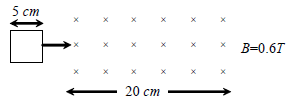
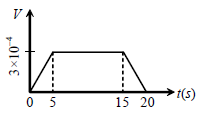
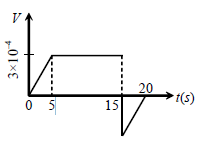
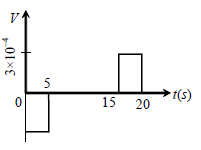
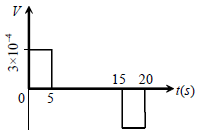
A square loop of side 5 cm enters a magnetic field with 1 cms–1. The front edge enters the
magnetic field at t = 0 then which graph best depicts emf ?
1.
2.
3.
4.
View Answer
Question 2: easy

The magnetic flux linked with a coil, in webers, is given by the equations Φ = 3t² + 4t + 9. Then
the magnitude of induced e.m.f. at t = 2 second will be

1. 2 volt
2. 4 volt
3. 8 volt
4. 16 volt
View Answer
Question 3: difficult

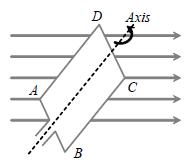
A rectangular coil ABCD is rotated anticlockwise with a uniform angular velocity about the axis
shown in diagram below. The axis of rotation of the coil as well as the magnetic field B are
horizontal. The induced e.m.f. in the coil would be maximum when

1. The plane of the coil is horizontal
2. The plane of the coil makes an angle of 45° with the magnetic field
3. The plane of the coil is at right angles to the magnetic field
4. The plane of the coil makes an angle of 30° with the magnetic field
View Answer
Question 4: easy

The flux linked with a coil at any instant ‘t’ is given by Φ = 10t² – 50t + 250. The induced emf at t = 3 s is :

1. 10 V
2. 190 V
3. -190 V
4. -10 V
View Answer
Question 5: moderate

In an AC generator, a coil with N turns, all of the same area A and total resistance R, rotates with frequency ω in a magnetic field B. The maximum value of emf generated in the coil is :

1. N.A.B.R.
2. N.A.B.ω
3. N.A.B.R.ω
4. N.A.B.
View Answer
Question 6: easy

A coil having 500 square loops each of side 10 cm is placed normal to a magnetic flux which increases at the rate of 1.0 Tesla/second. The induced e.m.f. in volts is :

1. 0.1
2. 0.5
3. 1
4. 5
View Answer
Question 7: moderate

A conducting circular loop is placed in a uniform magnetic field of inducting B tesla with its plane normal to the field. Now, radius of the loop starts shrinking at the rate (dr/dt). Then the induced e.m.f. at the instant when the radius is r is :

1. \[\pi rB\left( \frac{dr}{dt} \right)\]
2. \[2\pi rB\left( \frac{dr}{dt} \right)\]
3. \[\pi r^{2}B\left( \frac{dr}{dt} \right)\]
4. \[\frac{\pi Br^{2}}{2}\left( \frac{dr}{dt} \right)\]
View Answer
Question 8: moderate

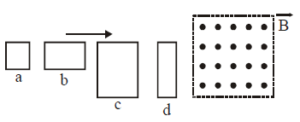
The figure shows four wire loops, with edge lengths of either L or 2L. All four loops will move
through a region of uniform magnetic field \[\overrightarrow{B}\] (directed out of the page) at the same constant velocity. Rank the four loops according to the maximum magnitude of the e.m.f induced as they move through the field, greatest first :-

1. \[\left( e_{c}=e_{d} \right)<\left( e_{a}=e_{b} \right)\]
2. \[\left( e_{c}=e_{d} \right)>\left( e_{a}=e_{b} \right)\]
3. \[e_{c}>e_{d}>e_{b}>e_{a}\]
4. \[e_{c}<e_{d}<e_{b}<e_{a}\]
View Answer
Question 9: moderate

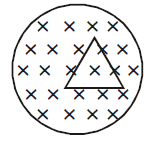
An equilaterial triangular loop having a resistance R and length of each side ‘l’ is placed in a magnetic field which is varying at dB/dt =1 T/s. The induced current in the loop will be :

1. \[\frac{\sqrt{3}}{4}\frac{l^{2}}{R}\]
2. \[\frac{4}{\sqrt{3}}\frac{l^{2}}{R}\]
3. \[\frac{\sqrt{3}}{4}\frac{R}{l^{2}}\]
4. \[\frac{4}{\sqrt{3}}\frac{R}{l^{2}}\]
View Answer