A metallic ring is attached with the wall of a room. When the north pole of a magnet is brought near to it, the induced current in the ring will be
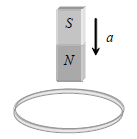
A metallic ring is attached with the wall of a room. When the north pole of a magnet is brought near to it, the induced current in the ring will be
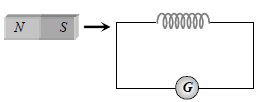
As shown in the figure, a magnet is moved with a fast speed towards a coil at rest. Due to this
induced electromotive force, induced current and induced charge in the coil is E, I and Q
respectively. If the speed of the magnet is doubled, the incorrect statement is

Lenz’s law is a consequence of the law of conservation of:
A wire is bent to form the double loop shown in figure. There is a uniform magnetic field directed into the plane of the loop. If the magnitude of this field is decreasing, current will flow from :-

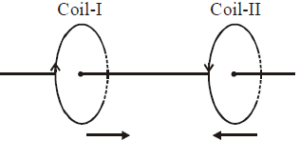
Two coils carrying current in opposite direction placed co-axially as shown in figure. Now that brought closer to each other, than :

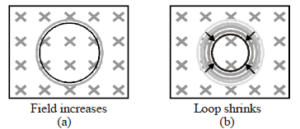
Using Lenz’s Law, determine the direction of current flow in the loop for each of the two
situations shown below.

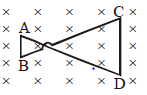
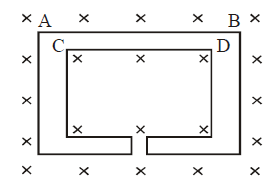
A conducting wire frame is placed in a magnetic field which is directed into the paper. The magnetic field is increasing at a constant rate. The directions of induced current in wires AB and CD are :

in a circuit consisting of two loops connected in series (like a figure-eight), the larger loop effectively dictates the direction of the current for the entire circuit.
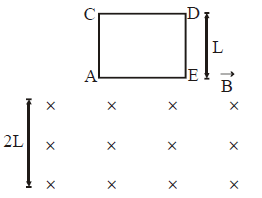
A square coil ACDE with its plane vertical is released from rest in a horizontal uniform
magnetic field B of length 2L. The acceleration of the coil is :

The acceleration is less than 'g'Β when entering or leaving the field because the changing magnetic flux induces a current that creates an opposing upward force (Lenz's Law).
Once the coil is fully inside the uniform 2LΒ field, the flux is constant, the induced current drops to zero, and the coil falls freely with acceleration equal to g.
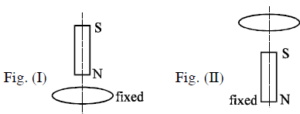
A vertical bar magnet is dropped from position on the axis of a fixed metallic coil as shown in fig – I. In fig. II the magnet is fixed and horizontal coil is dropped. The acceleration of the magnet and coil are a1 and a2 respectively then

In both cases, relative motion between the magnet and the coil induces a current that creates a magnetic force opposing the motion (Lenz's Law). This upward retarding force reduces the downward acceleration below gravity ($g$), resulting in a_1 < g and a_2 < g.
Two identical coaxial circular loops carry a current i each circulating in the same direction. If the loops approach each other
When two loops with current in the same direction approach each other, the magnetic flux through each loop increases. According to Lenz's Law, an induced current will arise to oppose this change, causing the current in both loops to decrease.