An inductor L, a resistance R and two identical bulbs, B1 and B2 are connected to a battery
through a switch S as shown in the figure. Which of the following statements gives the correct
description of the happenings when the switch S is closed ?
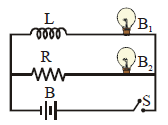
1. The bulb B2 lights up earlier than B1 and finally both the bulbs shine equally bright
2. B1 lights up earlier and finally both the bulbs acquire equal brightness
3. B2 lights up earlier and finally B1 shines brighter than B2
4. B1 and B2 light up together with equal brightness all the time
View Answer
The adjoining figure shows two bulbs B1 and B2 resistor R and an inductor L. When the switch S is turned off :
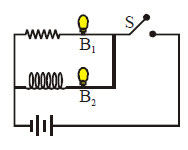
1. Both B1 and B2 die out promptly
2. Both B1 and B2 die out with some delay
3. B1 dies out promptly but B2 with some delay
4. B2 dies out promptly but B1 with some delay
View Answer
Two resistors of 10 W and 20 W and an ideal inductor of 10 H are connected to a 2 V battery
as shown. The key K is inserted at time t = 0. The initial (t = 0) and final (t →∞) currents
through battery are
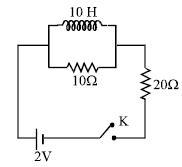
1. \[\frac{1}{15} A,\frac{1}{10} A\]
2. \[\frac{1}{10} A,\frac{1}{15} A\]
3. \[\frac{2}{15} A,\frac{1}{10} A\]
4. \[\frac{1}{15} A,\frac{2}{25} A\]
View Answer
The figure shows three circuits with identical batteries, inductors, and resistors. Rank the circuits according to the current through the battery (i) just after the switch is closed and (ii) a long time later, greatest first :
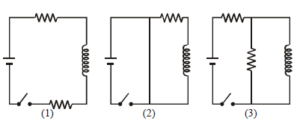
1. (i) i2 > i3 > i1 (i1 = 0) (ii) i2 > i3 > i1
2. (i) i2 < i3 > i1 (i1 ≠ 0) (ii) i2 > i3 > i1
3. (i) i2 = i3 = i1 (i1 = 0) (ii) i2 > i3 > i1
4. (i) i2 = i3 > i1 (i1 ≠ 0) (ii) i2 > i3 > i1
View Answer
(i) Just after the switch is closed (t = 0): An inductor opposes any sudden change in current. Initially, it acts like an infinite resistance (open circuit). No current can flow through any branch containing the inductor at this instant.
(ii) A long time later (t =infinity): Once the current reaches a steady state, the inductor no longer opposes the flow. It acts like an ideal wire (short circuit) with zero resistance. You can then rank the circuits by calculating the total equivalent resistance of the remaining resistors.
The expression for magnetic induction inside a solenoid of length \(L\) carrying a current \(I\) and having \(N\) number of turns is:
1. \(\frac{\mu_0 N}{4\pi L I}\)
2. \(\mu_0 N I\)
3. \(\frac{\mu_0}{4\pi} N L I\)
4. \(\mu_0 \frac{N}{L} I\)
View Answer
Magnetic field inside a long solenoid is given by \(B = \mu_0 n I\), where \(n = \frac{N}{L}\) is the number of turns per unit length. Therefore, \(B = \mu_0 \frac{N}{L} I\).