Question 1:
easy
The self inductance of a toroid is :
The self inductance of a toroid is :
A varying current in a coil changes from 10 amp to zero in 0.5 sec. If average EMF is induced in
the coil is 220 volts, the self inductance of coil is :
How much length of a very thin wire is required to obtain a solenoid of length l0 and inductance L.
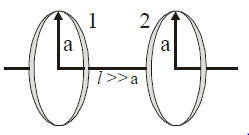
What is the mutual inductance of a two-loop system as shown with centre separation l ?
A coil resistance 20 Ω and inductance 5 H is connected with a 100 V battery. Energy stored in the coil will be :
Energy stored = 62.5 J
A current of \(2\text{ A}\) is increasing at a rate of \(4\text{ A/s}\) through a coil of inductance \(2\text{ H}\). The energy stored in the inductor per unit time in given instant is:
Formula for rate of change of energy in an inductor is \(\frac{dU}{dt} = LI\frac{dI}{dt}\). Given \(L = 2\text{ H}\), \(I = 2\text{ A}\), and \(\frac{dI}{dt} = 4\text{ A/s}\), we get \(\frac{dU}{dt} = 2 \times 2 \times 4 = 16\text{ J/s}\).
A coil of \(\text{Cu}\) wire (radius \(r\), self inductance \(L\)) is bent in two concentric turns each having radius \(\frac{r}{2}\). The self-inductance now is:
Self-inductance of a coil is \(L \propto N^2 r\). When bent into \(2\) turns of radius \(r/2\), new self-inductance is \(L' \propto (2)^2 (r/2) = 2 L\).
Assertion (A): The self inductance of a solenoid can be increased by decreasing length if number of turns are fixed.
Reason (R): Self inductance of a solenoid is directly proportional to current passing through it.
Self inductance of a solenoid is given by \(L = \frac{\mu_0 N^2 A}{l}\). So, Assertion (A) is true as \(L\) is inversely proportional to \(l\). Self inductance \(L\) is a property of the coil's geometry and material, not dependent on current. So, Reason (R) is false. Thus, (A) is true but (R) is false.
Which among the following unit represents henry?
From induced emf \(e = L \frac{di}{dt}\), we have \(L = \frac{e dt}{di}\). Thus, the unit of inductance (henry) is equivalent to \(\frac{\text{Volt-second}}{\text{Ampere}}\).