Thermal Physics - NEET Physics Questions
← All Chapters

Thermal Physics

Question 1: moderate

‘A’ is a closed vessel of volume V and contains O2 at pressure P and temperature T. ‘B’ is another closed vessel of same volume and it contains H2 at same temperature and 2P pressure. Ratio of masses of O2 and H2 in vessel ‘A’ and ‘B’ is :

1. 2 : 1
2. 4 : 1
3. 8 : 1
4. 1 : 8
View Answer

Using the ideal gas law \( PV = nRT \), we find the moles \( n \) in each vessel:

1. For vessel \( A \) with \( O_2 \):
\[
n_{\text{O}_2} = \frac{PV}{RT}
\]

2. For vessel \( B \) with \( H_2 \) at \( 2P \):
\[
n_{\text{H}_2} = \frac{2PV}{RT} = 2 \times \frac{PV}{RT}
\]

Now, the mass \( m = n \times \text{molar mass} \):

- Mass of \( O_2 \) in \( A = n_{\text{O}_2} \times 32 = \frac{PV}{RT} \times 32 \)
- Mass of \( H_2 \) in \( B = n_{\text{H}_2} \times 2 = 2 \times \frac{PV}{RT} \times 2 \)

So, the mass ratio is:
\[
\frac{\text{mass of } O_2}{\text{mass of } H_2} = \frac{\frac{PV}{RT} \times 32}{2 \times \frac{PV}{RT} \times 2} = \frac{32}{4} = 8:1
\]
Question 2: moderate

One mole of an ideal gas undergoes a process \( P=\frac{_{P_{0}}}{1+\left( \frac{V_{0}}{V} \right)^{2}} \) , Here P0 and V0 are constants. Change in temperature of the gas when volume is changed from V = V0 to V = 2V0 is :

1. \[ \frac{-2P_{0}V_{0}}{5R}\]
2. \[ \frac{11P_{0}V_{0}}{10R}\]
3. \[ \frac{-5P_{0}V_{0}}{4R}\]
4. \[ P_{0}V_{0}\]
View Answer

For one mole of an ideal gas, we use the ideal gas law:

\[
PV = RT
\]

Given \( P = \frac{P_0}{1 + \left( \frac{V_0}{V} \right)^2} \), find \( T \) at \( V = V_0 \) and \( V = 2V_0 \).

1. When \( V = V_0 \):
\[
P = \frac{P_0}{1 + \left( \frac{V_0}{V_0} \right)^2} = \frac{P_0}{1 + 1} = \frac{P_0}{2}
\]
\[
T_1 = \frac{PV}{R} = \frac{\frac{P_0}{2} \cdot V_0}{R} = \frac{P_0 V_0}{2R}
\]

2. When \( V = 2V_0 \):
\[
P = \frac{P_0}{1 + \left( \frac{V_0}{2V_0} \right)^2} = \frac{P_0}{1 + \frac{1}{4}} = \frac{P_0}{\frac{5}{4}} = \frac{4P_0}{5}
\]
\[
T_2 = \frac{PV}{R} = \frac{\frac{4P_0}{5} \cdot 2V_0}{R} = \frac{8P_0 V_0}{5R}
\]

3. Change in temperature:
\[
\Delta T = T_2 - T_1 = \frac{8P_0 V_0}{5R} - \frac{P_0 V_0}{2R} = \frac{11P_0 V_0}{10R}
\]

Question 3: moderate

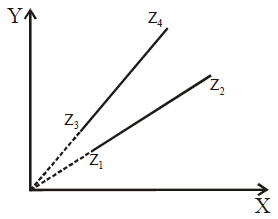
In the diagram as shown, find parameters representing x and y axis and also parameter z, if z1 = z2, z3 = z4 and z2 > z3 :

1. Volume, Pressure and temperature
2. Temperature, volume and pressure
3. Temperature, pressure and volume.
4. Both (2) and (3)
View Answer
Question 4: moderate

An ideal diatomic gas occupies a volume V1 at a pressure P1 undergoes a process in which the pressure is directly proportional to the volume.
At the end of the process the rms speed of gas molecules has doubled from its initial value. Heat supplied to the gas in the given process is :

1. \[ 7P_{1}V_{1}\]
2. \[ 8P_{1}V_{1} \]
3. \[ 9P_{1}V_{1} \]
4. \[ 10P_{1}V_{1}\]
View Answer

Since the pressure \( P \) is directly proportional to the volume \( V \), we have:

\[
P \propto V \Rightarrow P = kV
\]

where \( k \) is a constant. This process describes a line through the origin on a \( P \)-\( V \) graph, where work \( W \) done by the gas is given by the area under the line:

\[
W = \frac{P_{\text{final}} V_{\text{final}} - P_{\text{initial}} V_{\text{initial}}}{2}
\]

Given that the r.m.s. speed doubles, we know the temperature \( T \) has quadrupled (since \( v_{\text{rms}} \propto \sqrt{T} \)). Therefore:

\[
\frac{T_{\text{final}}}{T_{\text{initial}}} = 4
\]

For an ideal gas, \( PV = nRT \), so if \( T \) quadruples, \( PV \) also quadruples, making \( P_{\text{final}} V_{\text{final}} = 4 P_1 V_1 \).

Using the work formula above:

\[
W = \frac{4 P_1 V_1 - P_1 V_1}{2} = \frac{3 P_1 V_1}{2} = 3 P_1 V_1
\]

The change in internal energy \( \Delta U \) for a diatomic gas (\( C_V = \frac{5}{2}R \)) is:

\[
\Delta U = n C_V \Delta T = \frac{5}{2} (P_1 V_1) \cdot 3 = \frac{15}{2} P_1 V_1 = 7.5 P_1 V_1
\]

Using the first law of thermodynamics \( Q = \Delta U + W \):

\[
Q = 7.5 P_1 V_1 + 3 P_1 V_1 = 9 P_1 V_1
\]

Answer: The heat supplied to the gas is \( 9 P_1 V_1 \).

Question 5: moderate

If a thermometer reads freezing point of water as 20ºC and boiling point as 150ºC, how much thermometer read when the actual temperature is 60ºC ?

1. 98ºC
2. 110ºC
3. 40ºC
4. 60ºC
View Answer

To solve this, we can set up a linear relationship between the actual Celsius scale (0ºC to 100ºC) and the thermometer's faulty scale (20ºC to 150ºC).

1. Set up the linear equation:

The faulty thermometer's scale can be represented as:
\[
T_{\text{faulty}} = a \cdot T_{\text{actual}} + b
\]

Using the freezing point:
\[
20 = a \cdot 0 + b \Rightarrow b = 20
\]

Using the boiling point:
\[
150 = a \cdot 100 + 20
\]
\[
130 = 100a \Rightarrow a = 1.3
\]

So, the relation is:
\[
T_{\text{faulty}} = 1.3 \cdot T_{\text{actual}} + 20
\]

2. Find the faulty reading at 60ºC actual temperature:
\[
T_{\text{faulty}} = 1.3 \cdot 60 + 20 = 78 + 20 = 98
\]

Therefore, the thermometer will read 98ºC at an actual temperature of 60ºC.

Question 6: moderate

An ideal gas contained in a cylinder undergoes a thermodynamic process during which pressure relates to volume as \( P=\frac{A}{1+\left( \frac{B}{V} \right)^{2}}\), where A and B are constants. As the volume of the gas is changed from V = B to V = 2B, its change of temperature can be expressed as :

1. 6AB/5R
2. AB/2
3. -3AB/5R
4. 11AB/10R
View Answer

Given:

\[
P = \frac{A}{1 + \left( \frac{B}{V} \right)^2}
\]

Using the ideal gas equation, \( PV = nRT \), for initial and final states, we can express the temperature change.

 Step 1: Initial State (at \( V = B \))
\[
P_1 = \frac{A}{1 + \left( \frac{B}{B} \right)^2} = \frac{A}{2}
\]
\[
T_1 = \frac{P_1 V}{R} = \frac{\left(\frac{A}{2}\right) B}{R} = \frac{AB}{2R}
\]

Step 2: Final State (at \( V = 2B \))
\[
P_2 = \frac{A}{1 + \left( \frac{B}{2B} \right)^2} = \frac{A}{1 + \frac{1}{4}} = \frac{A}{\frac{5}{4}} = \frac{4A}{5}
\]
\[
T_2 = \frac{P_2 V}{R} = \frac{\left(\frac{4A}{5}\right) (2B)}{R} = \frac{8AB}{5R}
\]

 Step 3: Temperature Change
\[
\Delta T = T_2 - T_1 = \frac{8AB}{5R} - \frac{AB}{2R} = \frac{16AB - 5AB}{10R} = \frac{11AB}{10R}
\]

Answer: \(\frac{11AB}{10R}\)

Question 7: moderate

Reading of a temperature may be same on :
(i) Celsius and kelvin scale.
(ii) Fahrenheit and kelvin scale.
(iii) Celsius and Fahrenheit scale.
(iv) All the three scales.

1. (i, ii)
2. (ii, iii)
3. (i, iv)
4. (ii, iv)
View Answer
Question 8: moderate

The freezing point on a new thermometer is marked as 20° and the boiling point as 150°. A temperature of 60°C on this thermometer will be read as :

1. 40°
2. 65°
3. 98°
4. 110°
View Answer
Question 9: moderate

A beaker is completely filled with water at 4°C. It will overflow if :

1. heated above 4°C
2. cooled below 4°C
3. (1) & (2) both
4. none of the above
View Answer

Water has a unique property: it reaches its maximum density at 4°C. This means that as water is heated or cooled from 4°C, it expands. Here’s why:

1. If the water is heated above 4°C: It begins to expand, decreasing in density. Since the beaker is already full, this expansion causes water to overflow.

2. If the water is cooled below 4°C: Water also expands when cooled below 4°C due to the formation of an open, hexagonal structure in its molecules (especially as it approaches freezing). This expansion also leads to overflow.

Therefore, the beaker will overflow if the temperature changes from 4°C in either direction: heating above 4°C or cooling below 4°C.

Question 10: moderate

Coefficient of apparent expansion of mercury in a glass vessel is \( 153 × 10^{–6}/°C \) and in a steel vessel is \(144 × 10^{–6}/°C\) . If α for steel is \(12 × 10^{–6}/°C\) then that of glass is :

1. \[ 36\times 10^{-6}/°C\]
2. \[ 6\times 10^{-6}/°C\]
3. \[ 27\times 10^{-6}/°C\]
4. \[ 9\times 10^{-6}/°C\]
View Answer

The coefficient of apparent expansion of mercury in a vessel is given by:

\[
\gamma_{\text{apparent}} = \gamma_{\text{mercury}} - \alpha_{\text{vessel}}
\]

For the glass vessel:
\[
153 \times 10^{-6} = \gamma_{\text{mercury}} - \alpha_{\text{glass}}
\]

For the steel vessel:
\[
144 \times 10^{-6} = \gamma_{\text{mercury}} - \alpha_{\text{steel}}
\]

Subtracting these two equations, we get:

\[
153 \times 10^{-6} - 144 \times 10^{-6} = \alpha_{\text{steel}} - \alpha_{\text{glass}}
\]

Substitute \(\alpha_{\text{steel}} = 12 \times 10^{-6}/^\circ \text{C}\):

\[
9 \times 10^{-6} = 12 \times 10^{-6} - \alpha_{\text{glass}}
\]

Solving for \(\alpha_{\text{glass}}\):
\[
\alpha_{\text{glass}} = 3 \times 10^{-6}/^\circ \text{C}
\]