Thermal Physics - NEET Physics Questions
← All Chapters

Thermal Physics

Question 11: moderate

A rod of 40 cm has the coefficient of linear expansion α1 = 6 × 10⁻⁶/°C. The other rod has coefficient of linear expansion α2 = 4 × 10⁻⁶/°C. If the difference in their lengths at all temperatures remains the same, the length of the other rod is:

1. 26 cm
2. 32 cm
3. 60 cm
4. 80 cm
View Answer

Let the length of the other rod be \( L \).

Since the difference in their lengths remains the same at all temperatures, the expansion of each rod must be identical.

For the first rod:
\[
\Delta L_1 = 40 \times \alpha_1 \times \Delta T
\]

For the second rod:
\[
\Delta L_2 = L \times \alpha_2 \times \Delta T
\]

Since \(\Delta L_1 = \Delta L_2\):
\[
40 \times \alpha_1 = L \times \alpha_2
\]

Substitute \(\alpha_1 = 6 \times 10^{-6}/^\circ \text{C}\) and \(\alpha_2 = 4 \times 10^{-6}/^\circ \text{C}\):
\[
40 \times 6 \times 10^{-6} = L \times 4 \times 10^{-6}
\]

Dividing both sides by \(4 \times 10^{-6}\):
\[
L = \frac{40 \times 6}{4} = 60 \, \text{cm}
\]

So, the length of the other rod is \( 60 \, \text{cm} \).
Question 12: moderate

A tap supplies water at 10°C and another tap at 100°C. How much hot water must be taken so that we get 20 kg water at 35°C ?

1. 7.2 kg
2. 10 kg
3. 5.6 kg
4. 14.4 kg
View Answer

We can solve this problem using the concept of heat exchange. Let \( m_h \) be the mass of hot water at 100°C, and \( m_c \) be the mass of cold water at 10°C. The total mass of water is given as 20 kg, so:

\[
m_h + m_c = 20 \, \text{kg}
\]

We also know that the final temperature of the mixture is 35°C. The heat gained by cold water must equal the heat lost by hot water:

\[
\text{Heat gained by cold water} = \text{Heat lost by hot water}
\]

Let the specific heat of water be \( c = 4200 \, \text{J/kg}^\circ \text{C} \). Using the formula for heat change:

\[
m_c c (35 - 10) = m_h c (100 - 35)
\]

Since the specific heat \( c \) is the same for both, it cancels out:

\[
m_c (35 - 10) = m_h (100 - 35)
\]
\[
m_c \times 25 = m_h \times 65
\]

We also know \( m_h + m_c = 20 \), so \( m_c = 20 - m_h \). Substituting this into the equation:

\[
(20 - m_h) \times 25 = m_h \times 65
\]
\[
500 - 25 m_h = 65 m_h
\]
\[
500 = 90 m_h
\]
\[
m_h = \frac{500}{90} \approx 5.56 \, \text{kg}
\]

Thus, the mass of hot water needed is approximately 5.56 kg.

Question 13: moderate

Solid ball of 200 gm at 20°C is dropped in an equal amount of water at 80°C. The resulting temperature is 60°C. This means the specific heat of solid is :

1. one fourth of water
2. one half of water
3. twice of water
4. four times of water
View Answer

Given:
- Mass of water \( m_w = 0.2 \, \text{kg} \)
- Initial temperature of water \( T_w = 80^\circ \text{C} \)
- Final temperature \( T_f = 60^\circ \text{C} \)
- Specific heat of water \( c_w = 4200 \, \text{J/kg}^\circ \text{C} \)
- Mass of solid \( m_s = 0.2 \, \text{kg} \)
- Initial temperature of solid \( T_s = 20^\circ \text{C} \)
- Specific heat of solid \( c_s \) (to be found)

Heat lost by water:
\[
Q_{\text{lost (water)}} = m_w c_w (T_w - T_f) = 0.2 \times 4200 \times (80 - 60) = 16800 \, \text{J}
\]

Heat gained by solid:
\[
Q_{\text{gained (solid)}} = m_s c_s (T_f - T_s) = 0.2 \times c_s \times (60 - 20) = 8 c_s
\]

From the heat exchange equation:
\[
16800 = 8 c_s
\]
\[
c_s = \frac{16800}{8} = 2100 \, \text{J/kg}^\circ \text{C}
\]

Since the specific heat of water is \( 4200 \, \text{J/kg}^\circ \text{C} \), we see that the specific heat of the solid is:

\[
c_s = \frac{4200}{2} = 2100 \, \text{J/kg}^\circ \text{C}
\]

Thus, the specific heat of the solid is indeed half of the specific heat of water.

Question 14: moderate

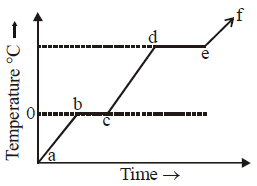
The following figure represents the temperature versus time plot for a given amount of a substance when heat energy is supplied to it at a fixed rate.

Which part of the above plot represent a phase change ?

1. a to b and e to f
2. b to c and c to d
3. d to e and e to f
4. b to c and d to e
View Answer

In Part b to c temperature remains constant even when heat is supplied

Similarly in part d to e temperature remains constant

So state is changing in part b to c and in d to e.

Question 15: moderate

Two spheres A and B have diameters in the ratio 1 : 2, densities in the ratio 2 : 1 and specific heats in the ratio 1 : 3; find the ratio of their thermal capacities :

1. 1 : 6
2. 1 : 12
3. 1 : 3
4. 1 : 4
View Answer

Given:

- Diameter ratio = 1:2
- Density ratio = 2:1
- Specific heat ratio = 1:3

Step 1: Mass ratio
Mass is proportional to \( \text{density} \times \text{volume} \).
Volume is proportional to the cube of the diameter, so the volume ratio is \( (1:2)^3 = 1:8 \).

Thus, mass ratio = \( \text{density} \times \text{volume} = \frac{2 \times 1}{1 \times 8} = 1:4 \).

Step 2: Thermal capacity ratio
Thermal capacity = mass × specific heat.

So, thermal capacity ratio = \( \frac{1 \times 1}{4 \times 3} = 1:12 \).

Final Answer:
The ratio of the thermal capacities is 1:12.

Question 16: moderate

Two liquids A and B are at temperatures of 75°C and 15°C. Their masses are in the ratio of 2 : 3 and their specific heats in the ratio 3 : 4. What is the resulting temperature :

1. 90°C
2. 70°C
3. 35°C
4. 60°C
View Answer

To find the resulting temperature when two liquids A and B are mixed, we can use the principle of conservation of heat energy: the heat lost by the hotter liquid (A) equals the heat gained by the cooler liquid (B).

Given:
- Temperature of liquid A = 75°C
- Temperature of liquid B = 15°C
- Masses of A and B are in the ratio 2:3, so let the masses of A and B be \( 2m \) and \( 3m \), respectively.
- Specific heats of A and B are in the ratio 3:4, so let the specific heats of A and B be \( 3c \) and \( 4c \), respectively.

Let the final temperature of the mixture be \( T \).

Step 1: Heat lost by liquid A (hotter liquid):
\[
Q_A = \text{mass of A} \times \text{specific heat of A} \times (\text{initial temp of A} - T)
\]
\[
Q_A = 2m \times 3c \times (75 - T) = 6mc(75 - T)
\]

Step 2: Heat gained by liquid B (cooler liquid):
\[
Q_B = \text{mass of B} \times \text{specific heat of B} \times (T - \text{initial temp of B})
\]
\[
Q_B = 3m \times 4c \times (T - 15) = 12mc(T - 15)
\]

Step 3: Apply the conservation of heat:
Heat lost by A = Heat gained by B
\[
6mc(75 - T) = 12mc(T - 15)
\]

 Step 4: Simplify and solve for \( T \):
Cancel out \( mc \) from both sides:
\[
6(75 - T) = 12(T - 15)
\]
Expand both sides:
\[
450 - 6T = 12T - 180
\]
Combine like terms:
\[
450 + 180 = 12T + 6T
\]
\[
630 = 18T
\]
Solve for \( T \):
\[
T = \frac{630}{18} = 35 \, ^\circ\text{C}
\]

Final Answer:
The resulting temperature is 35°C.

Question 17: moderate

Steam is passed into 54 gm of water at 30°C till the temperature of mixture becomes 90°C. If the latent heat of steam is 530 cal/gm, the mass of the mixture will be :

1. 80 gm
2. 60 gm
3. 50 gm
4. 24 gm
View Answer

Here’s a short solution:

Given

- Mass of water = 54 gm
- Initial temperature of water = 30°C, Final temperature = 90°C
- Latent heat of steam = 530 cal/gm
- Specific heat of water = 1 cal/gm°C

Step 1: Heat gained by water to reach 90°C:

\[
Q_{\text{gained}} = m_{\text{water}} \times c_{\text{water}} \times \Delta T = 54 \times 1 \times (90 - 30) = 3240 \, \text{cal}
\]

Step 2: Heat lost by steam:

\[
Q_{\text{lost}} = m_s \times (530 + 10) = 540 m_s
\]

Step 3: Equating heat gained and heat lost:

\[
3240 = 540 m_s \quad \Rightarrow \quad m_s = \frac{3240}{540} = 6 \, \text{gm}
\]

Step 4: Total mass of the mixture:

\[
m_{\text{mixture}} = 54 \, \text{gm} + 6 \, \text{gm} = 60 \, \text{gm}
\]

Final Answer:
The mass of the mixture is 60 grams.

Question 18: moderate

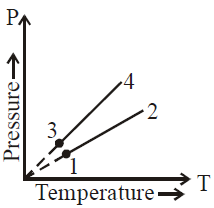
Pressure versus temperature graph of an ideal gas of equal number of moles (μ) of different volumes are plotted as shown in figure. Choose the correct alternative :

1. V1 = V2, V3 = V4 and V2 > V3
2. V1 = V2, V3 = V4 and V2 < V3
3. V1 = V2 = V3 = V4
4. V4 > V3 > V2 > V1
View Answer

For an ideal gas, at constant volume, the pressure \( P \) is directly proportional to the temperature \( T \) (Gay-Lussac's Law):

\[
P \propto T
\]

In the graph, each line represents a pressure-temperature relationship at different volumes. A steeper slope indicates a smaller volume (since \( P = \frac{nRT}{V} \) and a higher \( V \) gives a less steep line).

From the figure:
1. Lines \( 1 \) and \( 2 \) have the same slope, indicating \( V_1 = V_2 \).
2. Lines \( 3 \) and \( 4 \) also have the same slope, indicating \( V_3 = V_4 \).
3. The slope of lines \( 3 \) and \( 4 \) is steeper than that of lines \( 1 \) and \( 2 \), meaning \( V_2 > V_3 \).

Thus, the correct answer is \( V_1 = V_2 \), \( V_3 = V_4 \), and \( V_2 > V_3 \).

Question 19: moderate

A given volume of air at 17°C exerts a pressure of 870 mm of mercury. The temperature at which the pressure becomes 1800 mm of Hg is :

1. 300 K
2. 400 K
3. 500 K
4. 600 K
View Answer

To solve this, we can use Gay-Lussac's Law, which states:

\[
\frac{P_1}{T_1} = \frac{P_2}{T_2}
\]

Given:
- Initial pressure \( P_1 = 870 \, \text{mm Hg} \),
- Final pressure \( P_2 = 1800 \, \text{mm Hg} \),
- Initial temperature \( T_1 = 17^\circ \text{C} = 17 + 273 = 290 \, \text{K} \).

Rearrange to find \( T_2 \):

\[
T_2 = \frac{P_2 \times T_1}{P_1}
\]

Substitute the values:

\[
T_2 = \frac{1800 \times 290}{870}
\]

Calculating this:

\[
T_2 = 600 \, \text{K}
\]

So, the temperature at which the pressure becomes 1800 mm of Hg is  600 K.

Question 20: moderate

Which of the following methods will enable the volume of an ideal gas to be made four times ?
(Consider absolute temperature)

1. Quarter the pressure at constant temperature
2. Quarter the temperature at constant pressure
3. Half the temperature, double the pressure
4. Double the temperature, double the pressure
View Answer

To make the volume of an ideal gas four times its initial volume, we can use Boyle's Law, which states:

\[
P \propto \frac{1}{V} \quad \text{(at constant temperature)}
\]

If the initial pressure is \( P \) and the initial volume is \( V \), we want the final volume \( V_{\text{final}} = 4V \).

According to Boyle's Law:

\[
P_{\text{final}} \times V_{\text{final}} = P \times V
\]

Substituting \( V_{\text{final}} = 4V \):

\[
P_{\text{final}} \times 4V = P \times V
\]

\[
P_{\text{final}} = \frac{P}{4}
\]

So, to make the volume four times, we quarter the pressure at constant temperature.