Ray Optics - NEET Physics Questions
Question 41: moderate

Light rays from a source are incident on a glass prism of index of refraction μ and angle of prism α. At near normal incidence, the angle of deviation of the emerging rays is
1. (μ–2)α
2. (μ–1)α
3. (μ+1)α
4. (μ+2)α
View Answer
Question 42: moderate

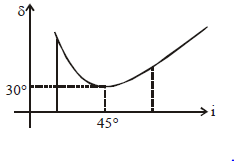
Variation of angle of deviation δ versus angle of incidence for a prism is given the figure. The value of refractive index of prism :

1. √3
2. √2
3. \[\sqrt{\frac{3}{2}}\]
4. 2/√3
View Answer
Question 43: moderate

In the displacement method, a convex lens is placed in between an object and a screen. If magnification in the two positions are \(m_1\) and \(m_2\) (\(m_1 > m_2\)) and the distance between two positions of the lens is x, the focal length of the lens is

1. \(\frac{x}{m_1+m_2}\)
2. \(\frac{x}{m_1-m_2}\)
3. \(\frac{x}{(m_1+m_2)^2}\)
4. \(\frac{x}{(m_1-m_2)^2}\)
View Answer

In displacement method, \(m_1 = \frac{v_1}{u_1}\) and \(m_2 = \frac{v_2}{u_2} = \frac{u_1}{v_1}\). Since the distance between two positions is \(x = v_1 - u_1\), we obtain \(m_1 - m_2 = \frac{x}{f}\), hence \(f = \frac{x}{m_1-m_2}\).

Question 44: moderate

Given below are two statements: one is labelled as Assertion A and the other is labelled as Reason R.


Assertion A: The mass density of an optically denser medium is greater than that of an optically rarer medium.


Reason R: Optical density is found by the ratio of the speed of light in two media while mass density is mass per unit volume.


In the light of the above statements, choose the correct answer from the option given below.

1. Both A and R are true and R is the correct explanation of A
2. Both A and R are true but R is not the correct explanation of A
3. A is true but R is false
4. A is false but R is true
View Answer

Mass density and optical density are not directly related. For example, oil is optically denser than water but has a lower mass density. Thus, Assertion A is false but Reason R is true.

Question 45: moderate

If a container of height \(17.3\text{ cm}\) is filled with a liquid of refractive index \(\mu\). The bottom of container appear to be raised by \(3.46\text{ cm}\) when seen from above. Refractive index of liquid is

1. 1.33
2. 1.25
3. 1.52
4. 1.1
View Answer

The apparent shift is \(s = d\left(1 - \frac{1}{\mu}\right)\). Substituting the values: \(3.46 = 17.3 \left(1 - \frac{1}{\mu}\right) \implies 1 - \frac{1}{\mu} = 0.2 \implies \mu = 1.25\).

Question 46: moderate

The refracting angle and minimum angle of deviation of a prism is same as \(60^\circ\). The refractive index of prism is

1. 1.732
2. 1.414
3. 2
4. 2.82
View Answer

Using the prism formula: \(\mu = \frac{\sin\left(\frac{A + D_m}{2}\right)}{\sin(A/2)}\). Since \(A = D_m = 60^\circ\), \(\mu = \frac{\sin(60^\circ)}{\sin(30^\circ)} = \sqrt{3} \approx 1.732\).

Question 47: moderate

Match the elements of List-I with List-II:

$$\begin{array}{ll} \textbf{List-I} & \textbf{List-II} \\ \hline \text{(A) Simple microscope} & \text{(H) Image virtual, erect and enlarged} \\ \text{(B) Compound microscope} & \text{(E) Image magnified, inverted and virtual} \\ \text{(C) Astronomical telescope} & \text{(G) Virtual, inverted and high resolution} \\ \text{(D) Terrestrial telescope} & \text{(F) Image virtual, erect and high resolution} \\ \end{array}$$
1. A-H, B-F, C-E, D-G
2. A-H, B-E, C-G, D-F
3. A-H, B-E, C-F, D-G
4. A-F, B-G, C-E, D-G
View Answer

A simple microscope forms an erect, virtual, and enlarged image (A-H). A compound microscope forms a magnified, inverted, and virtual final image (B-E). An astronomical telescope has a virtual, inverted, high resolution final image (C-G). A terrestrial telescope has a virtual, erect, high resolution final image (D-F).