Question 31:
moderate
Two thin prisms of flint glass, with refracting angles of 6° and 8° respectively, possess dispersive powers in the ratio :
Two thin prisms of flint glass, with refracting angles of 6° and 8° respectively, possess dispersive powers in the ratio :
A thin Prism P1 with angle 4° and made from glass of refractive index 1.54 is combined with another thin Prism P2 made from glass of refractive index 1.72 to produce dispersion without deviation. The angle of Prism P2 is
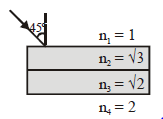
In the figure shown the angle made by the light ray with the normal in the medium of refractive index √2 is :
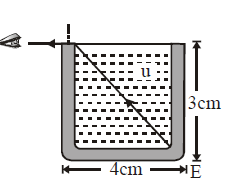
When the rectangular metal tank is filled to the top with an unknown liquid, as observer with eyes level with the top of the tank can just see the corner E; a ray that refracts towards the observer at the top surface of the liquid is shown. The refractive index of the liquid will be nearly :
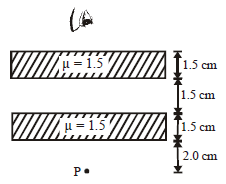
The image of point P when viewed from top of the slabs will be :
If in a plano-convex lens, the radius of curvature of the convex surface is 10 cm and the focal length of the lens is 30 cm, then the refractive index of the material of lens will be
A convex lens of focal length 50 cm forms a real image of size three times of size of object then position of object will be :
A beam of light propagating in medium A with index of refraction n (A) passes across an interface into medium B with index of refraction n(B). The angle of incidence is greater than the angle of refraction ; v(A) and v(B) denote the speed of light in A and B. Then which of the following is true :
The refractive index of a prism for a monochromatic wave is √2 and its refracting angle is 60°. For minimum deviation, the angle of incidence will be :
For two positions of a lens, the images are obtained on a fixed screen. If the size of object is 2 cm and the size of diminished image is 0.5cm, the size of the other image will be :