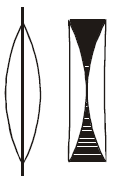
A convex lens is made up of three different materials as shown in the figure. For a point object placed on its axis, the number of images formed are :
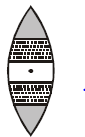
A convex lens is made up of three different materials as shown in the figure. For a point object placed on its axis, the number of images formed are :
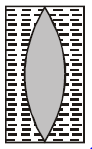
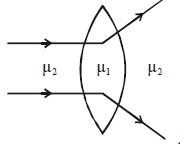
A convex lens made up of a material of refractive index ΞΌ1 is immersed in a medium of refractive index ΞΌ2 as shown in the figure. The relation between ΞΌ1 and ΞΌ2 is :

As shown in figure, a convergent lens is placed inside a cell filled with liquid. The lens has focal length +20 cm when in air, and its material has refractive index 1.50. If the liguid has refractive index 1.60, the focal length of the system is :

Two convex lens each of focal length 20 cm are separated by 125 cm. An object of height 0.5 cm placed at distance 25 cm left side from the first lens then, find height of the final image.
If in a plano-convex lens, the radius of curvature of the convex surface is 10 cm and the focal length of the lens is 30 cm, then the refractive index of the material of lens will be
Two convex lens of focal length 20 cm and 25 cm are placed in contact with each other, then power of this combination isΒ
A convex lens of focal length 50 cm forms a real image of size three times of size of object then position of object will be :
A beam of light propagating in medium A with index of refraction n (A) passes across an interface into medium B with index of refraction n(B). The angle of incidence is greater than the angle of refraction ; v(A) and v(B) denote the speed of light in A and B. Then which of the following is true :
A thin equiconvex glass lens of focal length 10 cm is cut and separated and a material of refractive index 3 is filled between them. What is the focal length of the combination ?
\[\left( \mu_{glass}=1.5\right)\]

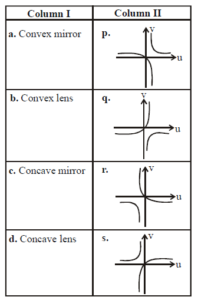
Match the correct u-v graph with optical system using Cartesian sign conventions :