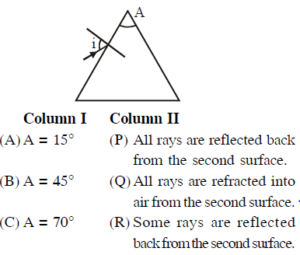
The angle of a prism is ‘A’. One of its refracting surfaces is silvered. Light rays falling at an angle of incidence 2A on the first surface returns back through the same path after suffering reflection at the silvered surface. The refractive index μ, of the prism is :
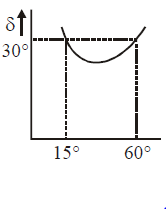
Figure shows graph of deviation d versus angle of incidence for a light ray striking a prism. Angle of prism is :

For a prism of refracting angle A and refractive index 2. Assume rays are incident at all angles of incidence 0° ≤ i ≤ 90°. Ignore partial reflection.

Two thin prisms of flint glass, with refracting angles of 6° and 8° respectively, possess dispersive powers in the ratio :
A thin Prism P1 with angle 4° and made from glass of refractive index 1.54 is combined with another thin Prism P2 made from glass of refractive index 1.72 to produce dispersion without deviation. The angle of Prism P2 is
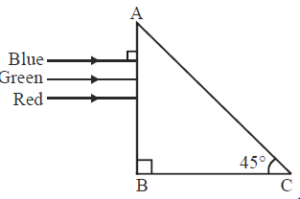
A beam of light consisting of red, green and blue colours incident on a right angled prism. The refractive index of the material of the prism for the above red, green and blue wavelengths are 1.39, 1.44 and 1.47, respectively.

The prism will :-
The refractive index of a prism for a monochromatic wave is √2 and its refracting angle is 60°. For minimum deviation, the angle of incidence will be :
A prism (μ = 1.5) has refracting angle of 30°. The deviation of a monochromatic ray incident normally on its one surface will be : –
(sin 48° 36′ = 0.75)
For two positions of a lens, the images are obtained on a fixed screen. If the size of object is 2 cm and the size of diminished image is 0.5cm, the size of the other image will be :
Light rays from a source are incident on a glass prism of index of refraction μ and angle of prism α. At near normal incidence, the angle of deviation of the emerging rays is