A plane mirror is placed along the x-axis facing negative y-axis. The mirror is fixed. A point
object is moving with \[3\hat{i}+4\hat{j}\] in front of the plane mirror. The relative velocity of image with respect to its object is :
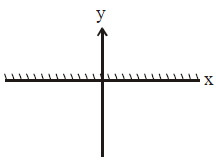
A plane mirror is placed along the x-axis facing negative y-axis. The mirror is fixed. A point
object is moving with \[3\hat{i}+4\hat{j}\] in front of the plane mirror. The relative velocity of image with respect to its object is :
A boy is 1.8 m tall and can see his image in a plane mirror fixed on a wall. His eyes are 1.6 m from the floor level. The minimum length of the mirror required to view his complete image is :
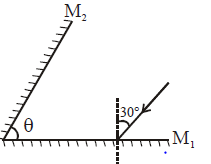
The reflecting surfaces of two mirrors M1 and M2 are at an angle θ as shown in the figure. A ray of light is incident on M1. The emerging ray intersects , the incident ray at an angle Φ. Then,
A ray of light strikes a silvered surface inclined to another one at an angle of 90° then the reflected ray will turn through :

Two plane mirrors are inclined at an angle of 75° to each other. Find the total number of images formed when an object is placed as shown in figure.

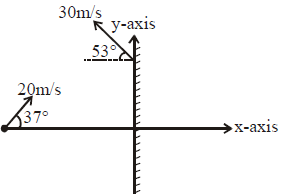
Find the velocity of the image with respect to ground of a moving object in situation as shown in figure :

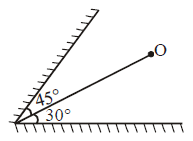
Two plane mirrors inclined to each other as shown. A ray after the three successive reflections falls on the mirror (M1) and finally retraces its path. Calculate the angle between the two plane mirror :

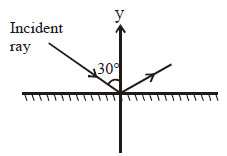
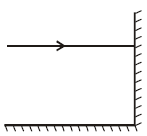
By what angle mirror should be rotated to obtain reflected ray on +y-axis :

A clock hung on a wall has marks instead of numerals on its dial. On the adjoining wall, there is a plane mirror and the image of the clock in the mirror indicates the time 7 : 10. Then the time on the clock is :
Two plane mirrors are parallel to each other and spaced 20 cm apart. An object is kept between them at 15 cm from A. Out of the following at which point, an image is not formed in mirror A: (distance measured from mirror A)