A plane mirror is placed along the x-axis facing negative y-axis. The mirror is fixed. A point
object is moving with \[3\hat{i}+4\hat{j}\] in front of the plane mirror. The relative velocity of image with respect to its object is :
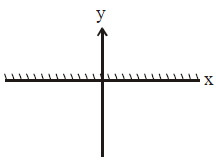
A plane mirror is placed along the x-axis facing negative y-axis. The mirror is fixed. A point
object is moving with \[3\hat{i}+4\hat{j}\] in front of the plane mirror. The relative velocity of image with respect to its object is :
A boy is 1.8 m tall and can see his image in a plane mirror fixed on a wall. His eyes are 1.6 m from the floor level. The minimum length of the mirror required to view his complete image is :
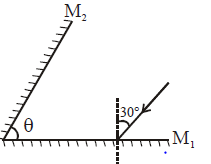
The reflecting surfaces of two mirrors M1 and M2 are at an angle θ as shown in the figure. A ray of light is incident on M1. The emerging ray intersects , the incident ray at an angle Φ. Then,
A ray of light strikes a silvered surface inclined to another one at an angle of 90° then the reflected ray will turn through :

Two plane mirrors are inclined at an angle of 75° to each other. Find the total number of images formed when an object is placed as shown in figure.

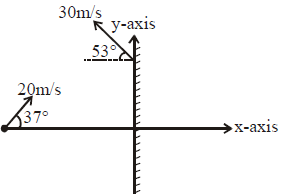
Find the velocity of the image with respect to ground of a moving object in situation as shown in figure :

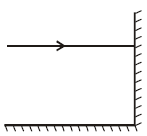
Two plane mirrors inclined to each other as shown. A ray after the three successive reflections falls on the mirror (M1) and finally retraces its path. Calculate the angle between the two plane mirror :

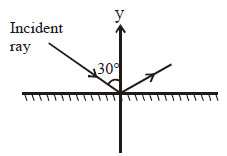
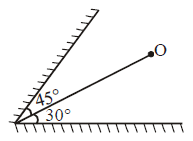
By what angle mirror should be rotated to obtain reflected ray on +y-axis :

An object is placed in front of a convex mirror of radius of curvature 20 cm. Its image is formed 8 cm behind the mirror. The object distance is :
When an object is kept at a distance of 30 cm from a concave mirror, the real image is formed at a distance of 10 cm. If the object is moved with a speed of 9 m/s along principal axis, the speed with which image moves is :